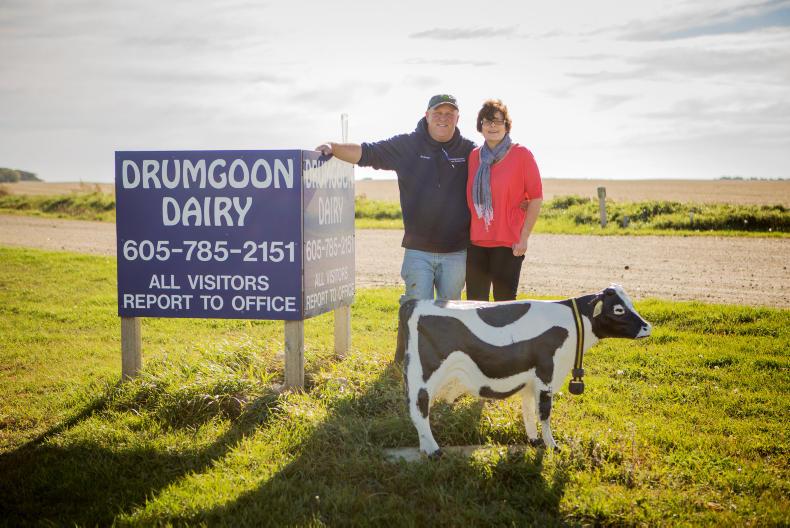
In 2006, the eyes of the farming community in Britain and Ireland were glued to Rodney and Dorothy Elliott. The pair featured on the BBC television programme Wanted: Farmers, which profiled the Elliotts’ transition from dairy farming in Co Fermanagh to buying a farm and establishing a super dairy in South Dakota in the US. At the time, I asked myself, why? Why would you sell your ancestral home, leaving behind family and friends and move a young family across the world to rural America? I was still asking myself why last September as I made the journey along Interstate 29 towards Drumgoon Dairies, not far from Watertown in South Dakota.
Drumgoon is the townland in Co Fermanagh that was home to the Elliotts. Rodney was milking 140 cows on a 180ac farm there. Like most farms in the area, farming was a challenge as heavy soils, combined with high rainfall, made field work and grazing difficult.
The farm was a traditional Northern Irish dairy farm – cows started calving in the autumn and finished in late spring. The herd of pedigree Holstein Friesian cows were high-yielding, well-managed and fed on a good TMR diet. But the Elliotts wanted more.
After selling Drumgoon, Rodney purchased 160 acres of bare corn ground in South Dakota. A farm of this size is known as a quarter in the US as the land is divided up into square mile grids. Each square mile is 640 acres so – a quarter of a square mile is 160 acres.
This part of South Dakota is traditional corn ground. When I visited in September the corn harvest was about to start. Traditionally, corn in the area was harvested with combines with the cobs sent away for food processing and the stalk and leaves chopped and ploughed back into the ground. If potatoes are synonymous with Ireland, then corn is synonymous with the midwest of the US – the whole region is like one massive corn field.
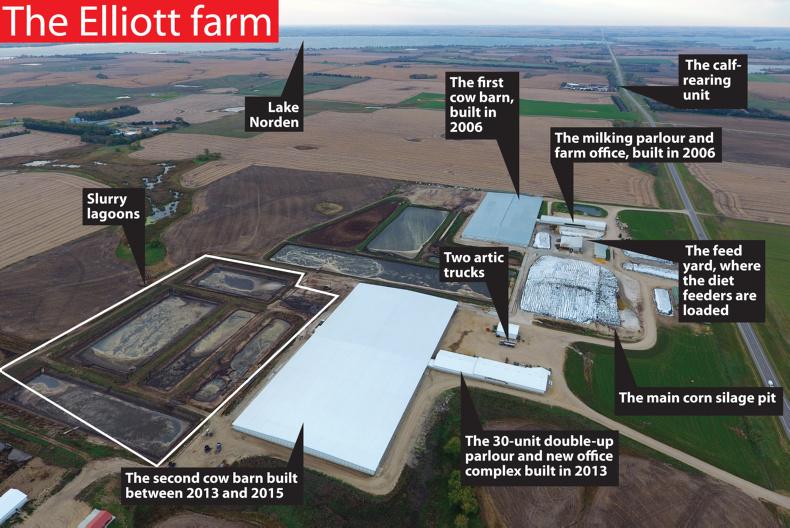
The Elliotts have gone from milking 140 cows on a 180-acre farm to a herd of 4,500 cows producing just shy of one million litres of milk per week.The Elliotts have gone from milking 140 cows on a 180-acre farm to a herd of 4,500 cows producing just shy of one million litres of milk per week.
But within the last decade, more and more of the corn grown in this part of South Dakota is going for silage. There are 20 newly built large dairies along Interstate 29 in South Dakota ranging in size from 1,500 to 5,000 cows. One of these farms is the business Dorothy and Rodney established when they bought that ‘‘quarter’’ in 2006.
Today, Drumgoon is a big business, employing 48 people, milking 4,500 cows and producing just shy of 1m litres of milk per week. It’s a far cry from the 140 cows in Co Fermanagh.
“When we came out first the intention was to establish an 850-cow dairy farm and buy in all the feed. We needed to borrow about $1m to build the yard and buy the cows and we were in negotiations with a couple of different banks. The banks were humming and hawing then one banker came back with a straight no – he said he wouldn’t give us $1m but he would give us $3m.”
The banker’s rationale was that you needed sufficient scale for a large dairy to work. Rodney took the banker’s advice on board, borrowed the money from him and built the facilities for 1,400 cows in the first year in 2006.
Since then, the herd has more than tripled in size. Rodney says he got lucky – milk prices were high in 2007 and 2008, which made life easier for the first two years. But luck only goes so far. Milk price took a nosedive in 2009, yet the Elliotts came out the other side and expanded further.
In 2013, the sod was turned on a new dairy right next to the existing dairy. This facility can house 2,600 cows and has a 30-unit double-up milking parlour. The original dairy can house 1,900 cows and has a 24-unit double-up parlour.
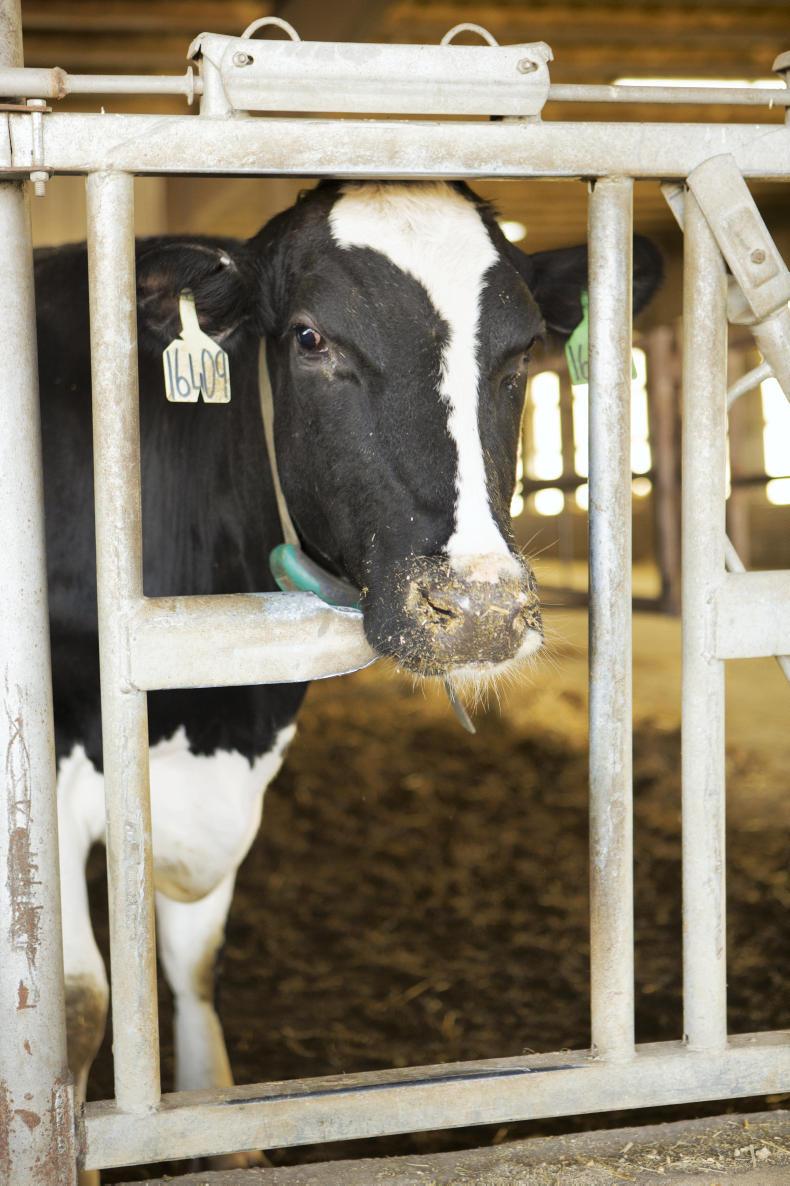
The original dairy can house 1,900 cows and has a 24-unit double-up parlour.The system
When you are on the farm, it is easy to get overwhelmed by the scale of the operation. The farmyard is massive and now covers most of the original 160 acres that were purchased in 2006, between sheds, feed bunkers, and slurry lagoons.
But when we break it down it’s still a farm. Cows are fed and cows are milked – just like in any other farm. The big difference here is the scale.
Cows are housed on sand-bedded cubicles with 270 cows per pen. The two dairies are of similar design – three rows of cubicles to every one row of feed space. The cubicles are covered by a low-pitch steel roof with no ventilation in the roof.
Ventilation is provided by fans located on the eastern side of the shed and this provides air flow through the shed and out the other side. Rodney was able to tell me that the internal wind speed is 6mph. Everything here is measured.
While there are 4,500 cows on the farm, about 600 of these are dry at any one time. There is no seasonality in supply as the milk processors want a steady volume each day. For Rodney, this means he supplies five to six truckloads of milk per day.
Cows are milked three times daily, which is 12,000 milkings per day. Both parlours are going 24 hours a day, with milk going through for 22.5 hours. When milk isn’t flowing, the machines are washing.
Labour
There are 16 people involved in milking. They operate in two 12-hour shifts and get a 60-minute break for lunch while the machines are washing in the middle of their shifts. The milking teams consists of three milkers and one person pushing up cows from the cubicles to the parlour. Output through each parlour is about 300 cows per hour.
Cathy Verhoel is the parlour manager – she is responsible for all quality control and record keeping and liaises with the milk processor. Cathy is a local woman who used to have a small family dairy herself. The SCC is currently 140,000, so she is doing a good job.
Most of the staff working on the farm are Hispanic. Rodney says most new employees start off in the milking parlour and progress from there. Milking cows for 12 hours on the trot is tough going, but they work for three days and then get one day off.
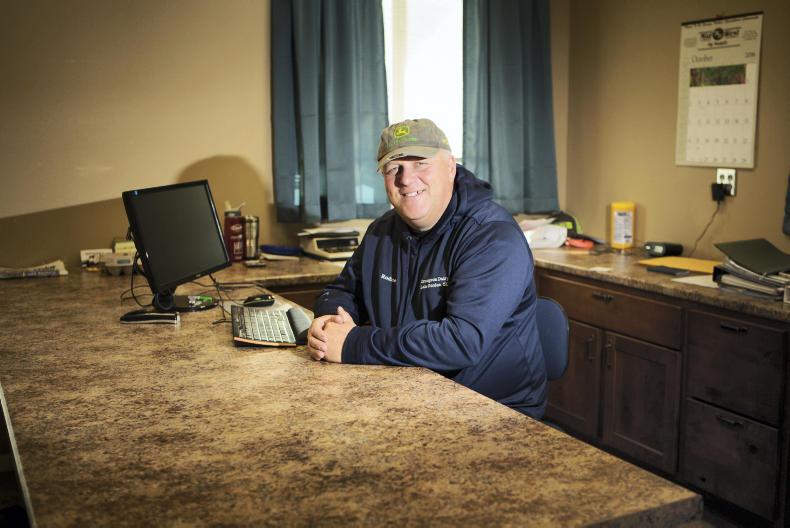
Like in any farm, it’s the people that are the key to success. Despite owning 4,500 cows, Rodney does very little manual work. His role is to oversee the whole operation. When he was in Fermanagh he was managing cows. Now he is managing people. How does this work with a largely Hispanic workforce?
“I meet key personnel such as our heads of department every day. They know their job and their team’s responsibilities and I trust them to make sure that the job is done. Our herd manager is Nicaraguan and he manages a team of 12 who manage the maternity and sick pens, as well as all the milking herd and dry or cows. Our parlour manager and her assistant deal with the milkers on a one-to-one basis. The milkers and the guys scraping the sheds are also accountable to the herd team so we need to have good people in these roles,” Rodney says.
Driving around the farm with Rodney, it is clear that he is a people person. Despite having only very basic Spanish, he knew everyone by name and had a few friendly words with all of the employees. It was clear there was mutual respect between boss and worker.
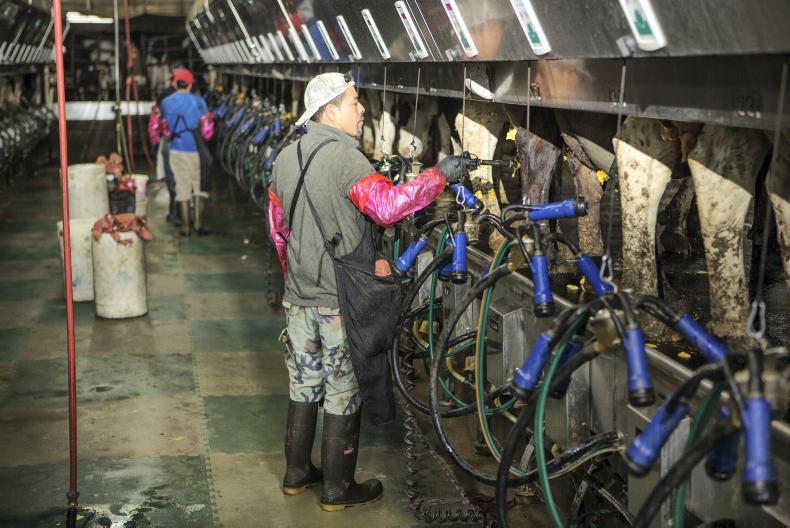
There are 16 people involved in milking. They operate in two 12-hour shifts.There are 16 people involved in milking. They operate in two 12-hour shifts.
Doughnut day
Saturday is doughnut day, when Rodney picks up some doughnuts for everyone on the farm and distributes them around. When he’s not around, he makes sure someone else buys the doughnuts. On our tour around the farm we visited one of the heifer rearing farms where a team of seven or eight people was after covering a silage pit and they were all sitting down eating ice cream, which Rodney’s son David had just purchased for them. These are the small touches of kindness which Rodney maintains is essential for keeping the workforce happy.
But he is also a business man. Rodney tells the story about struggling to get milkers three years ago. The farm staff shortage was a problem across the state but the lack of staff was really beginning to affect Drumgoon.
“In response, we decided to pay the milkers $1 extra per hour. In terms of increasing overall costs, it was going to have a relatively small effect. After giving the pay rise, the problem seemed to rectify itself overnight but then we had other employees looking for a pay rise also. But we sat them down and we said the pay rise was for milkers, if they wanted to milk then, they could get a $1 more per hour too.”
The Elliotts’ eldest son, David, completed a degree in philosophy but decided to return to the farm and is now the feed supervisor. Despite being only 12 when he moved to North Dakota, he still has the Northern Ireland accent.
Like milking, feeding is a big logistical effort, with four people working in the feed yard. Two diet feeders are going all day every day. The herd is fed twice daily – they get 70% of their daily feed allocation before 8.30am in the morning with the second feed in the afternoon. Rodney says that feeding twice a day increases dry matter intake and splitting the feeding means more cows can be fed fresh feed early in the morning.
One thing that Rodney looks at closely is the pregnancy rate. This is the number of cows pregnant after 21 days of breeding. The industry target is to get more than 21% of eligible cows pregnant. Rodney’s rolling average is 24%.
“Things are automated as much as possible. The parlour is linked to the feed software, so it knows how many cows are in each pen and how much feed to put out but it still needs people to run it. I always say you can divide feeding into three sections – what you are supposed to be feeding, what the man on the feeder thinks he is feeding and what is actually being fed. Most of the time there is a difference between all three,” Rodney says.
David explains that 50% of the cow’s diet is forage, with the rest made up of concentrate feeds. There are four types of forage on the farm – corn silage, alfalfa haylage, prairie hay and straw. The concentrates are ground corn, soya bean meal, soya hulls, distillers grains, liquid molasses and a mineral pack. All of these ingredients are available locally. The total intake is 25kg dry matter per cow. The TMR is 50% dry matter.
So where does all of this feed come from? Since buying the original 160 acres in 2006, Rodney and Dorothy have bought over 1,200 more acres around their base at Norden. As Rodney says, buying land is a business decision. If he thinks he is getting value he will buy land.
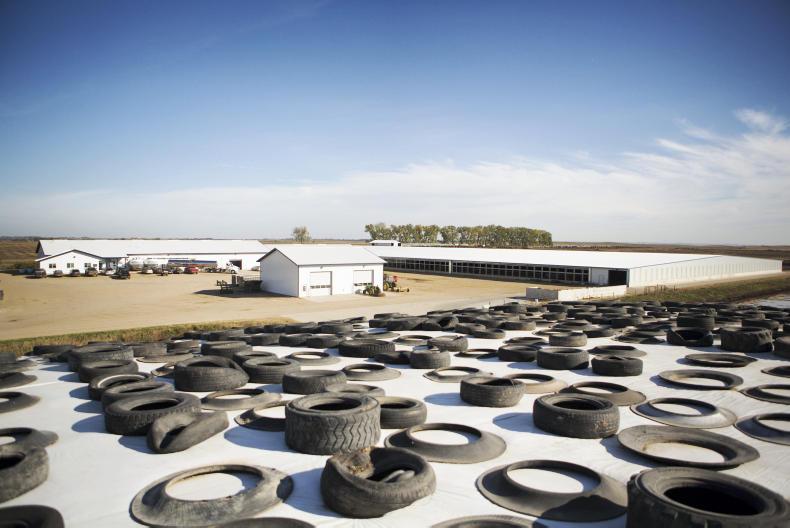
Average production per cow is 12,000 litres at 3.85% fat and 3.25% protein. The milk is sold to Valley Queen Cheese, which manufactures cheese for Kraft Foods. Average production per cow is 12,000 litres at 3.85% fat and 3.25% protein. The milk is sold to Valley Queen Cheese, which manufactures cheese for Kraft Foods.
Despite owning almost 1,400 acres, it represents only a small fraction of the land he needs. In total, Rodney needs about 3,000 acres of corn silage and about 2,000 acres of alfalfa. He sources most of this from local contract-growers, driving around every spring doing deals with local tillage farmers to secure their crops. He also has some rented land of his own, but all other feeds are bought in. Feed is by far the biggest cost on the farm, accounting for over half of the total costs at $7/cwt (14.31c/l). In contrast, labour accounts for only $2/cwt (4.05c/l).
While the feed comes in, slurry must go out. The slurry from the cubicle sheds is scraped by dedicated scraper tractor drivers into a number of massive lagoons.
Rodney has manure easement rights on 7,000 acres of land. This is an agreement by the landowners that Rodney can spread his slurry on their land. Easements are required by the South Dakota Department of Environment and Natural Resources, which is the body responsible for all environmental regulations in the state. Rodney has to submit annual soil samples from these fields, detailing nitrate and phosphorus levels at 24in and 48in depths.
On the day I visited, the slurry contractors were busy pumping slurry out of one of the big lagoons on to some of the fields that were harvested for corn silage. Distance is no obstacle to these people. They can literally travel miles with the 10in pipes, putting in extra pumps at various intervals. However, the further you travel, the more it costs. When grain prices were good, the crop farmers paid for the slurry to be spread. Now, the costs are shared equally between Rodney and the crop farmers.
Contractors do all the sowing, harvesting and slurry spreading. But Rodney still has a fleet of tractors of his own that would put most contractors in Ireland to shame. Most of the tractors including the loading shovels are supplied by the local John Deere machinery dealer.
One thing that Rodney looks at closely is the pregnancy rate. This is the number of cows pregnant after 21 days of breeding. The industry target is to get more than 21% of eligible cows pregnant. Rodney’s rolling average is 24%. Business end
So what about the business end of the operations? At this stage, about 65% of the herd is crossbred – a far cry from the pedigree Holstein Friesian cows Elliott had in the original Drumgoon dairy in Fermanagh. The ideal cow for Rodney is a three-way cross of a Holstein Friesian crossed with a Jersey and that first cross cow bulled with a Swedish Red. This three-way cross animal will then be bulled with a Friesian and the cycle begins again.
Rodney is unequivocal about the use of crossbreds: “I can’t wait until they’re all crossbred. I couldn’t care less what a cow looked like anymore, the bottom line is that crossbred cows are more profitable than any other breed so I want them and I can’t get enough of them.”
Since he started crossbreeding, health, fertility and milk solids have improved. Rodney sells his milk to a cheese company, so the more solids he produces the more money he gets for his milk – just like in Ireland.
The average age of the herd is two lactations. He doesn’t breed any cow the past fifth lactation and replacement rate is 30%. The calving interval is 390 days. I put it to Rodney that there is room for improvement within these figures but he disagrees: “The way I see it, every cubicle is a hotel room and every cow is a paying guest. If she’s not performing well, we need to get rid of her. We can’t afford any passengers. Calving interval is a trade-off between giving up milk when dry and having too many cows in late lactation, so calving every 13 months is optimum out here. We must remember that a lot of the culling is done voluntarily.”
One thing that Rodney looks at closely is the pregnancy rate. This is the number of cows pregnant after 21 days of breeding. The industry target is to get more than 21% of eligible cows pregnant. Rodney’s rolling average is 24%. Conception rate is averaging at 40 to 45%.
One thing that affects fertility big time is heat stress. Temperatures can get as high as 36 °C during the summer and this can rise in the space of a few hours. The immediate result is a 4% to 5% reduction in feed intake and increased embryo mortality. The fans in the shed are linked to the local met station so they operate automatically, which helps to keep the sheds cool.
Heifers are reared on farm and they calve at 22 months of age. Average production per cow is 12,000 litres at 3.85% fat and 3.25% protein. The milk is sold to Valley Queen Cheese, which manufactures cheese for Kraft Foods.
Financials
Because of the higher milk solids, Rodney gets a 5% milk price top-up. He also gets a 5% top-up based on having an approved quality control programme and meeting the quality bonus in terms of TBC and SCC. So, while the base price is currently $16.50/cwt (33.75c/l), Rodney is receiving $18.85/cwt (38.56c/l).
It has been a difficult year for milk price across the world and South Dakota is no different. When all cash costs are included, including Rodney and Dorothy’s salary and debt repayments, the cash costs come to $17.70/cwt (36.20c/l). At current milk prices, the farm is making a cash surplus of $1.15/cwt (2.35c/l), but Rodney expects that over the whole of 2016 the farm will probably just break even, as milk prices were lower earlier in the year.
Rodney is a big fan of benchmarking. His consultants and accountants are based in Iowa and benchmark Drumgoon Dairies against other large dairies across the midwest. Rodney says he has regularly topped the list in terms of profitability.
This article first appeared in the Irish Dairy Farmer magazine.
In 2006, the eyes of the farming community in Britain and Ireland were glued to Rodney and Dorothy Elliott. The pair featured on the BBC television programme Wanted: Farmers, which profiled the Elliotts’ transition from dairy farming in Co Fermanagh to buying a farm and establishing a super dairy in South Dakota in the US. At the time, I asked myself, why? Why would you sell your ancestral home, leaving behind family and friends and move a young family across the world to rural America? I was still asking myself why last September as I made the journey along Interstate 29 towards Drumgoon Dairies, not far from Watertown in South Dakota.
Drumgoon is the townland in Co Fermanagh that was home to the Elliotts. Rodney was milking 140 cows on a 180ac farm there. Like most farms in the area, farming was a challenge as heavy soils, combined with high rainfall, made field work and grazing difficult.
The farm was a traditional Northern Irish dairy farm – cows started calving in the autumn and finished in late spring. The herd of pedigree Holstein Friesian cows were high-yielding, well-managed and fed on a good TMR diet. But the Elliotts wanted more.
After selling Drumgoon, Rodney purchased 160 acres of bare corn ground in South Dakota. A farm of this size is known as a quarter in the US as the land is divided up into square mile grids. Each square mile is 640 acres so – a quarter of a square mile is 160 acres.
This part of South Dakota is traditional corn ground. When I visited in September the corn harvest was about to start. Traditionally, corn in the area was harvested with combines with the cobs sent away for food processing and the stalk and leaves chopped and ploughed back into the ground. If potatoes are synonymous with Ireland, then corn is synonymous with the midwest of the US – the whole region is like one massive corn field.
The Elliotts have gone from milking 140 cows on a 180-acre farm to a herd of 4,500 cows producing just shy of one million litres of milk per week.The Elliotts have gone from milking 140 cows on a 180-acre farm to a herd of 4,500 cows producing just shy of one million litres of milk per week.
But within the last decade, more and more of the corn grown in this part of South Dakota is going for silage. There are 20 newly built large dairies along Interstate 29 in South Dakota ranging in size from 1,500 to 5,000 cows. One of these farms is the business Dorothy and Rodney established when they bought that ‘‘quarter’’ in 2006.
Today, Drumgoon is a big business, employing 48 people, milking 4,500 cows and producing just shy of 1m litres of milk per week. It’s a far cry from the 140 cows in Co Fermanagh.
“When we came out first the intention was to establish an 850-cow dairy farm and buy in all the feed. We needed to borrow about $1m to build the yard and buy the cows and we were in negotiations with a couple of different banks. The banks were humming and hawing then one banker came back with a straight no – he said he wouldn’t give us $1m but he would give us $3m.”
The banker’s rationale was that you needed sufficient scale for a large dairy to work. Rodney took the banker’s advice on board, borrowed the money from him and built the facilities for 1,400 cows in the first year in 2006.
Since then, the herd has more than tripled in size. Rodney says he got lucky – milk prices were high in 2007 and 2008, which made life easier for the first two years. But luck only goes so far. Milk price took a nosedive in 2009, yet the Elliotts came out the other side and expanded further.
In 2013, the sod was turned on a new dairy right next to the existing dairy. This facility can house 2,600 cows and has a 30-unit double-up milking parlour. The original dairy can house 1,900 cows and has a 24-unit double-up parlour.
The original dairy can house 1,900 cows and has a 24-unit double-up parlour.The system
When you are on the farm, it is easy to get overwhelmed by the scale of the operation. The farmyard is massive and now covers most of the original 160 acres that were purchased in 2006, between sheds, feed bunkers, and slurry lagoons.
But when we break it down it’s still a farm. Cows are fed and cows are milked – just like in any other farm. The big difference here is the scale.
Cows are housed on sand-bedded cubicles with 270 cows per pen. The two dairies are of similar design – three rows of cubicles to every one row of feed space. The cubicles are covered by a low-pitch steel roof with no ventilation in the roof.
Ventilation is provided by fans located on the eastern side of the shed and this provides air flow through the shed and out the other side. Rodney was able to tell me that the internal wind speed is 6mph. Everything here is measured.
While there are 4,500 cows on the farm, about 600 of these are dry at any one time. There is no seasonality in supply as the milk processors want a steady volume each day. For Rodney, this means he supplies five to six truckloads of milk per day.
Cows are milked three times daily, which is 12,000 milkings per day. Both parlours are going 24 hours a day, with milk going through for 22.5 hours. When milk isn’t flowing, the machines are washing.
Labour
There are 16 people involved in milking. They operate in two 12-hour shifts and get a 60-minute break for lunch while the machines are washing in the middle of their shifts. The milking teams consists of three milkers and one person pushing up cows from the cubicles to the parlour. Output through each parlour is about 300 cows per hour.
Cathy Verhoel is the parlour manager – she is responsible for all quality control and record keeping and liaises with the milk processor. Cathy is a local woman who used to have a small family dairy herself. The SCC is currently 140,000, so she is doing a good job.
Most of the staff working on the farm are Hispanic. Rodney says most new employees start off in the milking parlour and progress from there. Milking cows for 12 hours on the trot is tough going, but they work for three days and then get one day off.
Like in any farm, it’s the people that are the key to success. Despite owning 4,500 cows, Rodney does very little manual work. His role is to oversee the whole operation. When he was in Fermanagh he was managing cows. Now he is managing people. How does this work with a largely Hispanic workforce?
“I meet key personnel such as our heads of department every day. They know their job and their team’s responsibilities and I trust them to make sure that the job is done. Our herd manager is Nicaraguan and he manages a team of 12 who manage the maternity and sick pens, as well as all the milking herd and dry or cows. Our parlour manager and her assistant deal with the milkers on a one-to-one basis. The milkers and the guys scraping the sheds are also accountable to the herd team so we need to have good people in these roles,” Rodney says.
Driving around the farm with Rodney, it is clear that he is a people person. Despite having only very basic Spanish, he knew everyone by name and had a few friendly words with all of the employees. It was clear there was mutual respect between boss and worker.
There are 16 people involved in milking. They operate in two 12-hour shifts.There are 16 people involved in milking. They operate in two 12-hour shifts.
Doughnut day
Saturday is doughnut day, when Rodney picks up some doughnuts for everyone on the farm and distributes them around. When he’s not around, he makes sure someone else buys the doughnuts. On our tour around the farm we visited one of the heifer rearing farms where a team of seven or eight people was after covering a silage pit and they were all sitting down eating ice cream, which Rodney’s son David had just purchased for them. These are the small touches of kindness which Rodney maintains is essential for keeping the workforce happy.
But he is also a business man. Rodney tells the story about struggling to get milkers three years ago. The farm staff shortage was a problem across the state but the lack of staff was really beginning to affect Drumgoon.
“In response, we decided to pay the milkers $1 extra per hour. In terms of increasing overall costs, it was going to have a relatively small effect. After giving the pay rise, the problem seemed to rectify itself overnight but then we had other employees looking for a pay rise also. But we sat them down and we said the pay rise was for milkers, if they wanted to milk then, they could get a $1 more per hour too.”
The Elliotts’ eldest son, David, completed a degree in philosophy but decided to return to the farm and is now the feed supervisor. Despite being only 12 when he moved to North Dakota, he still has the Northern Ireland accent.
Like milking, feeding is a big logistical effort, with four people working in the feed yard. Two diet feeders are going all day every day. The herd is fed twice daily – they get 70% of their daily feed allocation before 8.30am in the morning with the second feed in the afternoon. Rodney says that feeding twice a day increases dry matter intake and splitting the feeding means more cows can be fed fresh feed early in the morning.
One thing that Rodney looks at closely is the pregnancy rate. This is the number of cows pregnant after 21 days of breeding. The industry target is to get more than 21% of eligible cows pregnant. Rodney’s rolling average is 24%.
“Things are automated as much as possible. The parlour is linked to the feed software, so it knows how many cows are in each pen and how much feed to put out but it still needs people to run it. I always say you can divide feeding into three sections – what you are supposed to be feeding, what the man on the feeder thinks he is feeding and what is actually being fed. Most of the time there is a difference between all three,” Rodney says.
David explains that 50% of the cow’s diet is forage, with the rest made up of concentrate feeds. There are four types of forage on the farm – corn silage, alfalfa haylage, prairie hay and straw. The concentrates are ground corn, soya bean meal, soya hulls, distillers grains, liquid molasses and a mineral pack. All of these ingredients are available locally. The total intake is 25kg dry matter per cow. The TMR is 50% dry matter.
So where does all of this feed come from? Since buying the original 160 acres in 2006, Rodney and Dorothy have bought over 1,200 more acres around their base at Norden. As Rodney says, buying land is a business decision. If he thinks he is getting value he will buy land.
Average production per cow is 12,000 litres at 3.85% fat and 3.25% protein. The milk is sold to Valley Queen Cheese, which manufactures cheese for Kraft Foods. Average production per cow is 12,000 litres at 3.85% fat and 3.25% protein. The milk is sold to Valley Queen Cheese, which manufactures cheese for Kraft Foods.
Despite owning almost 1,400 acres, it represents only a small fraction of the land he needs. In total, Rodney needs about 3,000 acres of corn silage and about 2,000 acres of alfalfa. He sources most of this from local contract-growers, driving around every spring doing deals with local tillage farmers to secure their crops. He also has some rented land of his own, but all other feeds are bought in. Feed is by far the biggest cost on the farm, accounting for over half of the total costs at $7/cwt (14.31c/l). In contrast, labour accounts for only $2/cwt (4.05c/l).
While the feed comes in, slurry must go out. The slurry from the cubicle sheds is scraped by dedicated scraper tractor drivers into a number of massive lagoons.
Rodney has manure easement rights on 7,000 acres of land. This is an agreement by the landowners that Rodney can spread his slurry on their land. Easements are required by the South Dakota Department of Environment and Natural Resources, which is the body responsible for all environmental regulations in the state. Rodney has to submit annual soil samples from these fields, detailing nitrate and phosphorus levels at 24in and 48in depths.
On the day I visited, the slurry contractors were busy pumping slurry out of one of the big lagoons on to some of the fields that were harvested for corn silage. Distance is no obstacle to these people. They can literally travel miles with the 10in pipes, putting in extra pumps at various intervals. However, the further you travel, the more it costs. When grain prices were good, the crop farmers paid for the slurry to be spread. Now, the costs are shared equally between Rodney and the crop farmers.
Contractors do all the sowing, harvesting and slurry spreading. But Rodney still has a fleet of tractors of his own that would put most contractors in Ireland to shame. Most of the tractors including the loading shovels are supplied by the local John Deere machinery dealer.
One thing that Rodney looks at closely is the pregnancy rate. This is the number of cows pregnant after 21 days of breeding. The industry target is to get more than 21% of eligible cows pregnant. Rodney’s rolling average is 24%. Business end
So what about the business end of the operations? At this stage, about 65% of the herd is crossbred – a far cry from the pedigree Holstein Friesian cows Elliott had in the original Drumgoon dairy in Fermanagh. The ideal cow for Rodney is a three-way cross of a Holstein Friesian crossed with a Jersey and that first cross cow bulled with a Swedish Red. This three-way cross animal will then be bulled with a Friesian and the cycle begins again.
Rodney is unequivocal about the use of crossbreds: “I can’t wait until they’re all crossbred. I couldn’t care less what a cow looked like anymore, the bottom line is that crossbred cows are more profitable than any other breed so I want them and I can’t get enough of them.”
Since he started crossbreeding, health, fertility and milk solids have improved. Rodney sells his milk to a cheese company, so the more solids he produces the more money he gets for his milk – just like in Ireland.
The average age of the herd is two lactations. He doesn’t breed any cow the past fifth lactation and replacement rate is 30%. The calving interval is 390 days. I put it to Rodney that there is room for improvement within these figures but he disagrees: “The way I see it, every cubicle is a hotel room and every cow is a paying guest. If she’s not performing well, we need to get rid of her. We can’t afford any passengers. Calving interval is a trade-off between giving up milk when dry and having too many cows in late lactation, so calving every 13 months is optimum out here. We must remember that a lot of the culling is done voluntarily.”
One thing that Rodney looks at closely is the pregnancy rate. This is the number of cows pregnant after 21 days of breeding. The industry target is to get more than 21% of eligible cows pregnant. Rodney’s rolling average is 24%. Conception rate is averaging at 40 to 45%.
One thing that affects fertility big time is heat stress. Temperatures can get as high as 36 °C during the summer and this can rise in the space of a few hours. The immediate result is a 4% to 5% reduction in feed intake and increased embryo mortality. The fans in the shed are linked to the local met station so they operate automatically, which helps to keep the sheds cool.
Heifers are reared on farm and they calve at 22 months of age. Average production per cow is 12,000 litres at 3.85% fat and 3.25% protein. The milk is sold to Valley Queen Cheese, which manufactures cheese for Kraft Foods.
Financials
Because of the higher milk solids, Rodney gets a 5% milk price top-up. He also gets a 5% top-up based on having an approved quality control programme and meeting the quality bonus in terms of TBC and SCC. So, while the base price is currently $16.50/cwt (33.75c/l), Rodney is receiving $18.85/cwt (38.56c/l).
It has been a difficult year for milk price across the world and South Dakota is no different. When all cash costs are included, including Rodney and Dorothy’s salary and debt repayments, the cash costs come to $17.70/cwt (36.20c/l). At current milk prices, the farm is making a cash surplus of $1.15/cwt (2.35c/l), but Rodney expects that over the whole of 2016 the farm will probably just break even, as milk prices were lower earlier in the year.
Rodney is a big fan of benchmarking. His consultants and accountants are based in Iowa and benchmark Drumgoon Dairies against other large dairies across the midwest. Rodney says he has regularly topped the list in terms of profitability.
This article first appeared in the Irish Dairy Farmer magazine. 





SHARING OPTIONS