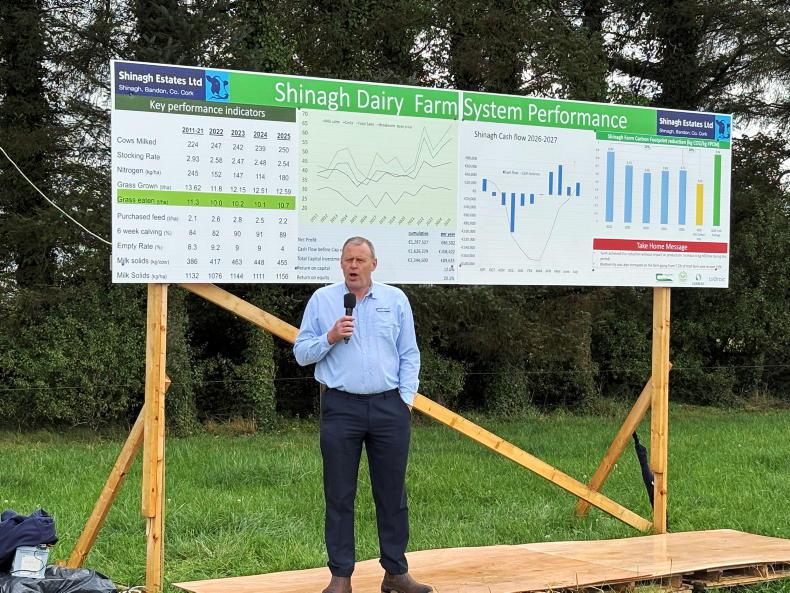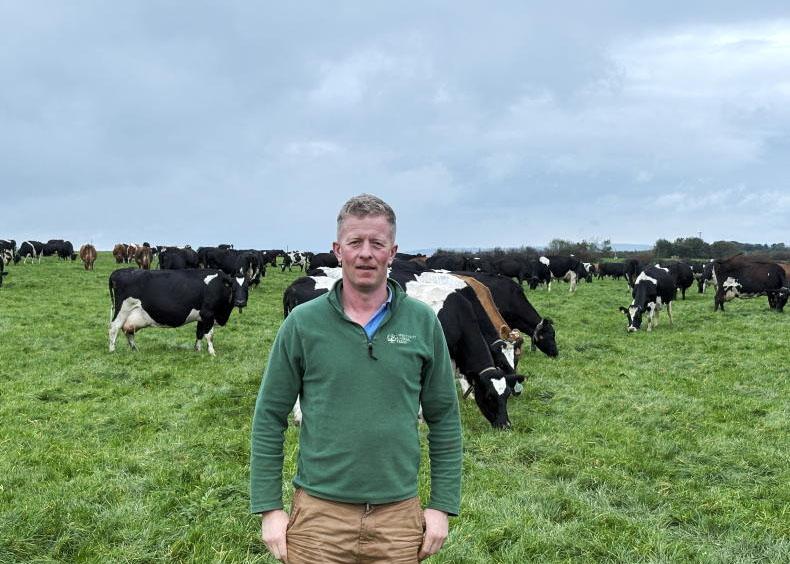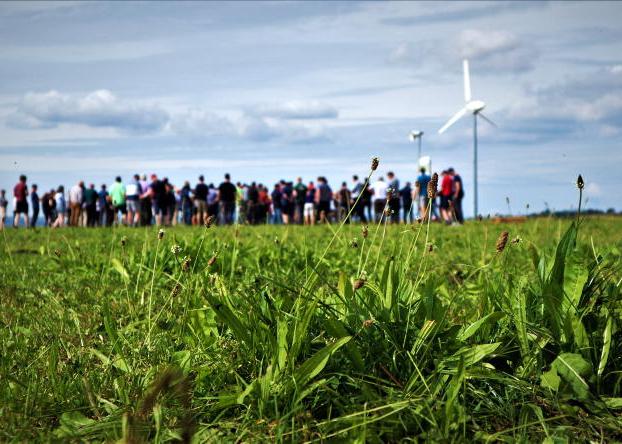
The open day at Shinagh Farm focused on the physical and financial performance of the farm over the last 15 years.
Bringing the financials up to date for 2025, Dr Padraig French from Teagasc showed that the milk price received in 2025 was 62c/l, with total receipts reaching 70c/l. At the same time, total costs including full labour and land rental increased to 49c/l in 2025, resulting in a net profit of 20c/l, or approximately €1,100/cow.
Looking ahead to 2026 however, Padraig cautioned that the farm now faces a major cashflow challenge for the rest of this year and into 2027.
Milk price has fallen by approximately 12c/l so far this year, while the summer drought has left the farm short 400kg of winter feed per cow, which will increase feed costs by 3c/l as additional silage will have to be purchased.
Higher livestock sales during the first half of 2026 will help to buffer the reduced milk price. The farm is part of the Tipperary Dairy-calf to Beef Project with all surplus calves brought to finish in Fethard, Co Tipperary.
The average calf sold from the farm this year was 57kg leaving the farm at 28 days and was worth €422.
Surplus cow sales were also good and empty cows have already been sold.
Despite the improvement in livestock sales, the net profit margin on the farm will reduce to 4-6c/l in 2026.
As there is no single farm payment on the farm, cash flow will be extremely tight between now and May 2027.
Even with the increase in livestock revenues, higher costs mean that the breakeven base milk price required in 2026 is likely to be 36c/l, compared to 27c/l during the initial 11 years of the project (2011-2021).
Padraig said “similar to many other farms, Shinagh faces a cashflow crisis rather than a feed crisis, and this is likely to result in a current account overdraft of €160,000 for the farm by March 2027”.
The farm is owned by the four west cork co-ops and was converted from a beef farm in 2010. The farm is a practical showcase for profitable, simple, environmentally sustainable dairy farming systems in the region in partnership with Teagasc, University College Dublin and Carbery Co-op.
The 2011 to 2021 period was entirely focused on delivering good financial returns.
The farm grew 13.5t DM/ha during that period, had 250 cows stocked at 2.9 cows per hectare, maximised its fertiliser N allowance and fed about 700kg of supplement per cow.
Initially, 200 crossbred in-calf heifers were purchased to maximise fertility and production efficiency resulting in compact calving and low empty rates.
Based on a young herd during the initial years, a medium level of production per cow was sold (386kg MS) and this has increased to 455kg in recent years.
Based on matching SR to grass growth, 1,100-1,200kg MS/ha have been sold from the farm each year.
On average, the farm has delivered a net profit of €86,000 per year over the 15 years after full rent (€300/ac) and labour costs are included.
During the initial years, total costs of production were 33c/l, and, based on an average milk price of 37c/l plus 4c/l from livestock sales, a net profit of 7c/l or €350/cow was achieved.
A total capital investment of €1.3m was required to convert the farm and buy stock, leaving a 12% return on capital invested.
The farm has been a focal point for the Farm Zero C project which is a collaboration between UCD, Teagasc and Carbery Co-op to reduce the carbon footprint of milk production. Padraig Walsh from Carbery explained that the carbon footprint of the farm has reduced by 20% (from 0.89kg to 0.71kg CO2/kg milk) between 2018 and 2025.
Padraig explained that the reduction was achieved by breeding a high EBI herd (now in the top 5% nationally; €181), getting white and red clover established in swards to reduce chemical fertiliser use from 250 to 150kg/ha, using slurry additives during winter and using low crude protein feeds.
The farm has also increased the level of biodiversity from 7.5 to 11% by planting extra trees and hedgerows on the farm.
The farm is located in a free-draining nitrate sensitive catchment and, as part of the Farming for Water EIP, has adopted several practices to reduce the risk of nitrate loss. While including clovers in the sward has allowed chemical N fertiliser to be reduced, the N provided by clover has largely replaced the reduction in chemical N applied.
Dr William Burchill from UCC explained that the farm has taken a number of additional actions to reduce nutrient losses including:
The third objective of the project is to make the farm a more attractive workplace.
This stems from a recent Carbery survey of suppliers which showed that almost 50% of suppliers were at or approaching retirement age and had no identified successor for their holdings.
The goal of the project is to simplify and reduce workload to demonstrate how attractive dairy farming careers can be for the next generation. In addition to Kevin Ahern who is farm manager, Chloe McCarthy is also employed as an apprentice on the farm.
Chloe is not from a farming background but loves the lifestyle working on the farm. Chloe has also trained five of her friends to become relief milkers both at Shinagh and elsewhere around the locality. The steps taken to reduce the workload on the farm include having a defined working day from 6am in the morning to 5pm in the evening.
Kevin also uses contractors for machinery work including winter feeding and employs relief milkers for weekends and busy periods.
By investing in smart technologies such as cow collars in addition to improved farm infrastructure such as better calf housing, the project aims to reduce working hours while maintaining high levels of performance.
This was a great event and was well attended by local farmers. The project has been brave and ambitious in adopting mitigations and highlighting the challenges of maintaining farm profitability while reducing GHG emissions and improving water quality. It was brilliant to see the full financial picture presented.
The reduction in profits for 2026, and likely cashflow pressures this autumn, were a timely warning of a difficult few months ahead for the dairy sector. More co-ops should develop local demo programmes like this one to point the way for future systems in their regions.