



The change in weather conditions is something that was brought up on our Tech Talk podcast this week, with the team discussing if more extreme weather conditions will affect the way that we farm.
Aidan and myself discussed how it affects dairy cows and what are the best ways of combatting it.
Two key things that we mentioned and that probably need to be addressed on farms are water supply and shelter.
Too often, water troughs might be updated, but how often do we look at the pipe or pump directing water to these troughs and look to update them?
Half-inch of ¾-inch pipes are only suitable for beef and sheep farms in reality, with all dairy herds looking at a minimum of one-inch pipes or greater.
Shelter belts
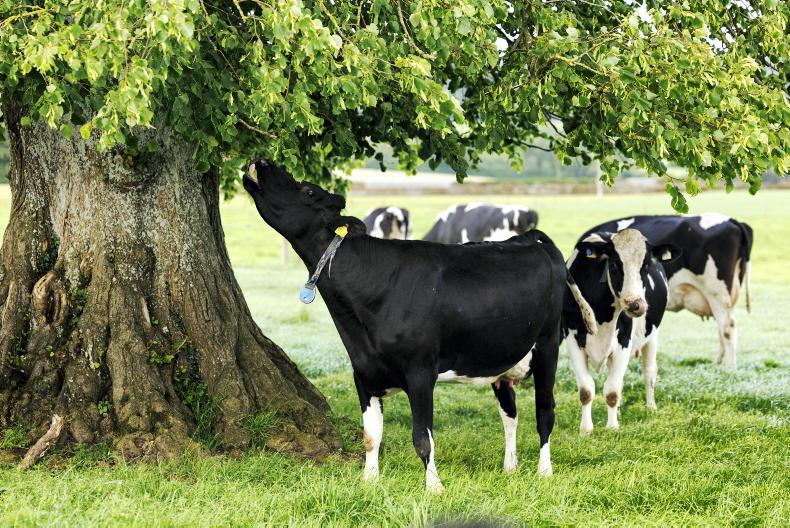
Shelter and shade also came up for discussion. Farmers this week may have seen their rotation thrown out of kilter in their efforts to try to keep stock as cool as possible by offering them paddocks with more shade, provided by trees and hedges.
It was agreed by the team that it’s something that we as farmers will need to do more of in the line of planting of trees and hedgerows.
It’s a win-win where they offer shelter in the shoulders of the year and shade in the hot summer months, while also being a positive for biodiversity on farm.
I think farmers should do similar to a reseeding plan, whereby the paddocks with the worst shelter (as opposed to worst grass growth) are targeted for planting of trees and hedges next spring.
Grass growth
Grass growth has been excellent for the most part, though some farmers have struggled up until the last week or so, with those cooler temperatures and rain not suiting all farms.
I have heard from a lot of farmers that grass is stressing a lot this year as well. Farmers who had topped or pre-mown in the last round arrived back to paddocks only to find stem in them yet again.
Some of this may be a result of skipping a round of nitrogen in the last rotation owing to good growth, though the changing conditions could also be a factor. Is it time that we started looking to varieties of grasses more capable of putting up with our changeable conditions? Answers on a postcard.




SHARING OPTIONS