



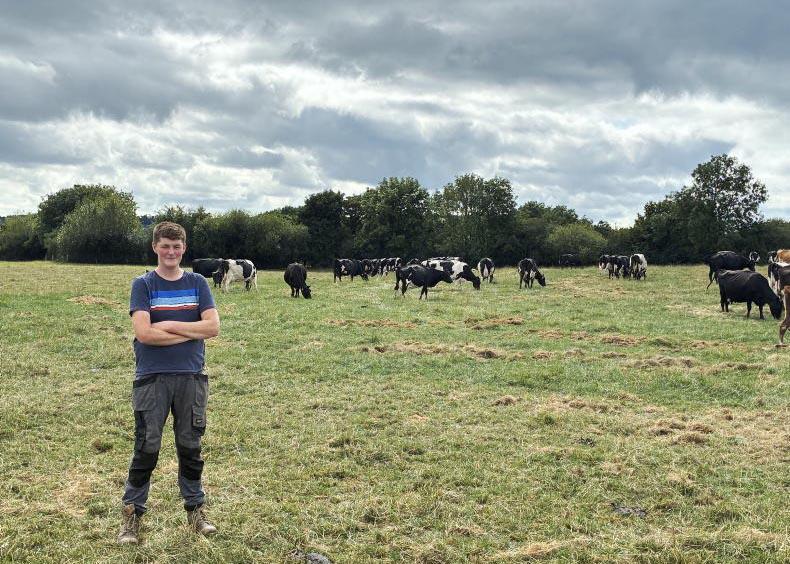
The long-term success of any sector depends on a healthy pipeline of talented, highly motivated young people who want to become the next generation of leaders. While some people bemoan the lack of successors who want to take up the mantle and become the next generation of dairy farmers, this is at odds with my personal experience.
Attending dairy events, I see so many young people showing up with parents, who are putting their hands up to be dairy farmers.
There are also many examples of people who are not from dairy farms who are becoming successful dairy farmers in their own right.
Last week I visited one such example in Liscarroll, Co Cork.
Working outdoors
Darragh Scully is not from a farming background, growing up in Kilavullen, Co Cork. He is 29 years old, and over the last seven years, has been in partnership with Shane and Sinead Horgan from Carrignavar, Co Cork on a 240-cow dairy farm, supplying Kinisla Co-op.
I began by asking Darragh why he wanted to be a dairy farmer.
“I have worked on neighbouring dairy farms at weekends and during holidays since I was in secondary school.
“My uncle is a dairy farmer in Co Clare, so I have always loved being around animals and working outdoors.
“I love calving season, nature and the structure of the year. I do all the calving and calves myself,” he said.
After finishing secondary school, Darragh attended the Bachelor of Agricultural Science course at Munster Technology University (MTU) in Cork. As part of that course, he did on-farm work experience with Shane and Sinead Horgan in Carrignavar.
While he enjoyed the initial two years of the course, spending a lot of time at Teagasc Clonakilty Agricultural College, year three of the course became more academic and science-based which he didn’t enjoy.
Speaking to some of the farmers he had worked with, he decided to join the Professional Diploma in Dairy Herd Management course which was a two-year farm placement-based course with approximately 30 days of course work between Kildalton Agricultural College, Co Kilkenny and Teagasc Moorepark, Co Cork.
He commenced the course in 2016 and over the following 2 years, undertook three eight-month on-farm placements on two different types of profitable grass-based dairy farms in Ireland, as well as on an award-winning dairy farm on the North Island of New Zealand.
He found the mix of farms really useful to understand different types of farm systems from mixed enterprise to highly specialised dairy farms.
This experience left a lasting impression, clarifying the kind of dairy farm system he would prefer to operate.
After finishing the course in 2018, he travelled to Australia for four months to experience the harvest, before returning home in February, 2019. He kept in contact with the Horgans, who he continued to work with when available.
Shane, Sinead and Darragh then decided they would look for a suitable farm to go into partnership on, looking at a number of farms across north Cork and Limerick during spring 2019.
During the summer of 2019, they walked a 93ha farm in Liscarroll (77-hectare milking platform with a support block two miles away).
The farm had a mixed land type and good facilities including a 20-unit milking parlour, 200 cubicles, adequate slurry storage and a well laid-out paddock network.
There was no big capital investment required to begin milking.
They originally set up as an 80:20 partnership based on the capital they each brought into the business.
Shane and Sinead also guaranteed a loan to provide working capital to allow the partnership to buy cows.
In September 2019, 80 autumn calving cows were purchased and they began supplying milk from the farm.
By spring 2020, further in-calf heifers were purchased and 220 cows were milked on the farm during 2020. Today there are 240 cows being milked on the farm. Darragh was paid a farm manager wage working in the business.
“The farming system is a grass-based system with a small, efficient crossbred cow.
“I like a system which has some variability so I love spending time working with the youngstock on the out-farm and we do some of the slurry and fertiliser and most of the winter feeding ourselves.”
Over time, he has been able to build up his share of the stock, machinery, and infrastructure, so the partnership is now an even 50-50 split of profits generated after all costs and loans have been repaid.
Darragh really likes the partnership model because, working with Shane and Sinead, he has great autonomy to farm the way he wants.
At the same time, the Horgans have been a great support providing a second opinion when needed.
Darragh has also learned a huge amount about financial management over the initial seven years of the partnership from the Horgans and he finds their support invaluable.
“In the middle of March, when you’re under pressure, you can pick up the phone and have a chat with Shane or Sinead, and sometimes somebody outside having a look can see things you can’t see.”
Both the Horgans and Darragh also have very similar views about the importance of time away from the farm. Working in this partnership, you don’t feel guilty for being away from the farm which is very important.
“Taking time off it a good sign that things are going well.
“In fact, the biggest issue at the moment is that my partner is an accountant, and she finds it hard to get the time off for us to travel more.”
Darragh is also a member of two discussion groups, who have been really helpful in terms of developing his ideas about farming and setting goals for the future. He has always been good at writing down his personal and business goals.
He wants to combine a simple profitable dairy farming system that provides adequate rewards with the lifestyle and personal goals, he and his partner Claire want for the future.
“We are currently looking to buy a home somewhere in the countryside in the next year to two. I’m probably also going to have to get married in the next few years, [tongue firmly in cheek].”
Darragh loves the lifestyle, working with cows and youngstock and the day to day of being a farmer. The flexibility within the partnership is a huge attraction.
He knows he is very busy in spring from the beginning of calving in February until the end of the first round of breeding in early June.
He also has a really busy period in November when grazing is difficult and before the cows are dried off.
He makes the system as simple as possible for the six weeks around Christmas and from June onwards so he gets lots of time away from the farm.
From June onwards, Darragh does three morning milkings each week and occasional evening milkings.
“There are two of us full-time on the farm so we share out the ten week day milkings between us and we’re both off at weekends.
“My younger sister, Roisin, does a lot of the relief milkings. If we’re under pressure with other jobs, sometimes relief milkers will also be used during the week as well.”
In terms of work days, Darragh is up at 6am, if milking, or 7.30am if not, and works until 5pm most days.
He loves to get away at weekends, visiting friends.
“I have a couple of horses, and I like going to events. We keep the horses on the farm.
“That’s a real attraction too to have my hobby in the yard where I work.”
He also really likes the feel of community around farming.
There’s a loop walk nearby where he takes the horses in the evening, and he always meets somebody along the way for a chat.
In the partnership, there is a great support network. Between his partner Claire, his family, Shane and Sinead and people who have worked with him on the farm, Darragh feels very lucky to have great people around him.
He also speaks very highly of his contractors and his AI man has become one of his closest friends.
“I wasn’t here two weeks when I got a text from the local AI man saying if I needed anything, to let him know.
“He is one of my best friends now. There’s a brilliant community around farming.”
Dealing with setbacks
There have been setbacks along the way too and it hasn’t always been easy. Mixing groups of animals at the start, issues like lameness, black spot, learning to organise work well in advance, having contractors booked, and so on.
Darragh says that those setbacks have been a positive in terms of learning to solve problems, to fix lameness cases etc.
In terms of organising work, every day between 10.30am and mid-day, that’s when all the calls that need to be made are make.
“I write down a list of jobs to be done, and tick them off as we get through them.”
In terms of advice to perspective young farmers who want a career in dairying, Darragh is very clear on his learnings. Work with good people and learn good systems from the best farmers. Save as much as you can to maximise equity. A trusted partnership is a huge help, based on shared goals and a similar outlook on systems and farming.
Darragh is a fantastic example of a young dairy farmer learning the skills, working in partnership.
The partnership model between the Horgans and Darragh is very impressive, both in terms of the autonomy and support that it provides and great credit is due to both parties.
There’s a huge thirst out there among young people to become young dairy farmers, and with talented people like Darragh looking at those opportunities, the future of the sector is in safe hands.
Darragh is a great example of the graduates of the Professional Diploma in Dairy Farm Management which has now been updated to an Earn While You Learn apprenticeship.
The objective of the programme is to equip early career farmers with vital knowledge, skills and experience to secure successful careers in farming. Following completion of the apprenticeship, graduates take on roles in farm management, return to their own family farms or enter collaborative farming opportunities.
The main component of the apprenticeship is practical experience on a commercial farm across a two-year period coupled with three-five day blocks of lectures, discussion groups, farm visits and practical skills training at Teagasc Kildalton College and Moorepark.
The next intake for the Farm Manager Apprenticeship starts in mid-September 2026. For more information, contact emmalouise.coffey@teagasc.ie or apprenticeships@teagasc.ie



SHARING OPTIONS