



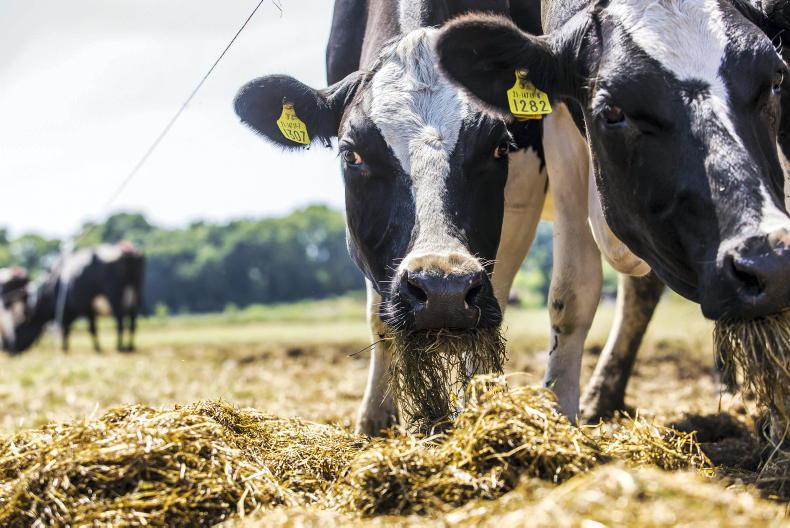
Soil moisture: Different parts of the country have different challenges when it comes to grass. Soils are still saturated in the northwest while grass quality is the main challenge in the southwest.
Meanwhile the south, east and midlands look to be heading into a soil moisture deficit (SMD) impacting grass growth rates. With high temperatures and no rain forecast for at least the next 10 days, it seems inevitable that grass growth rates are going to suffer.
Its already impacting many farms in the south east, with the affected area spreading daily. When SMD goes above 40mm it begins to impact grass growth. It is now over 40mm in most of the south east and over 60mm in parts and will increase by over 10mm per week in this weather. This means that by this day next week most of the eastern half of Ireland will be over 50mm.
Supplement: Speaking on the Inside Dairy podcast this week, Teagasc’s John Maher advised farmers to stick to a 25-day rotation length and only put in feed if the pre-grazing yield doesn’t support a 25-day round. He cautioned farmers against putting in too much feed while there is still a lot of grass on farms as this leads to wasting grass.
It doesn’t make sense to put in a lot of feed now to try and hold on to grass when if things get very dry that grass will only whither away anyway. Let’s say there are 30ha (74ac) in the milking platform. A 25-day round means there is 1.2ha (three acres) available for grazing per day (30ha divided by 25 days). If the platform is stocked at three cows/ha, then there will be 90 cows to feed per day.
If the pre-grazing yield is 1,500kg then there is potentially 20kg of grass available per cow (1,500kg multiplied by 1.2ha divided by 90 cows). If the pre-grazing yield is 1,000kg then that drops to just over 13kg of grass per cow per day. In that case, around 5kg of supplement per cow will be needed to maintain the round length at 25 days. What is really important when in a grass deficit is to ensure that good clean outs are maintained. Cows will be incredibly content to graze out paddocks very tight.
Animal health: I was speaking to a farmer earlier in the week who had two dry cull cows with summer mastitis present themselves that morning. They were destined for the factory so he wasn’t too worried about losing the quarters but the cows were so sick with it that he risked losing the cows themselves. This warm weather is a real problem for flies and the most at risk cows are autumn calvers that are dried off and also in-calf heifers. If this warm weather continues its likely that fly populations will explode, with knock-on consequences for mastitis and other diseases. The other thing to always be mindful of during the hot weather is water supply.
Dairy cows can drink up to 100l per day during the hot days and any disturbance to water supply will cause serious distress.
Algae will also thrive in this weather so it’s a good idea to clean out water troughs as dirty troughs have been found to limit cow water intake.




SHARING OPTIONS