




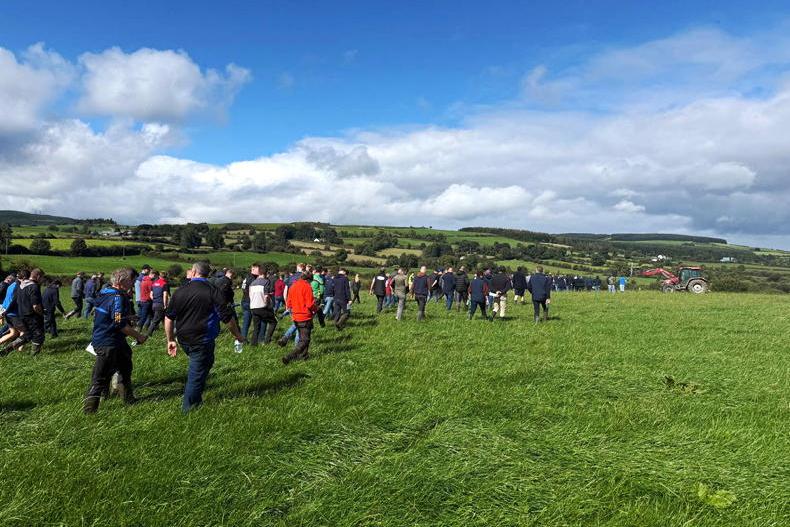
A strong crowd, both young and old turned out to the Darcy’s farm in Ardcroney, Co Tipperary recently, to hear how the family went about involving the next generation in the farm business.
The event was organised by Arrabawn-Tipperary in co-ordination with local Teagasc adviser John Conroy and the Nenagh ifac office to highlight to the co-op members the options available when it comes to structuring collaborative arrangements on farms.
Ger and Noelle Darcy are farming with their son Alan, in a limited company on the outskirts of Nenagh town. Alan is the fifth generation on the farm in Ardcroney and the second generation of dairy farmer.
The family are currently milking 150 cows across 100ha comprising 48ha milking platform with a further 52ha in outblocks.
In 1982, Ger and Noelle began milking with just eight cows. A visit at that time from the well-known local consultant Matt Ryan, opened Ger’s eyes to the potential the farm had to make a strong living for the family.
He was inspired and determined to grow the business after the conversation. It wasn’t long after this meeting however, that milk quota entered the fray. From 1984 to 2015 the farm was constrained by quotas. The Darcys had a 20ha platform but were unable to maximise it in the way they wanted to.
Ger bought up whatever quota he could get his hands on over the years and grew the cow numbers gradually. By 2012, the farm was milking 70 cows, when an adjoining 28ha farm came up for long-term lease. The new block meant the Darcy’s now had a 48ha milking platform with several outblocks.
That same year, Alan went off to Waterford Institute of Technology to study agricultural science with the view of returning home to farm in the future. This gave the family confidence to keep driving on and investing in the business.
With the increased land area on the milking platform and the abolition of quotas in 2015, the herd size jumped from 70 cows up to 150 cows. Alan was coming to the end of his degree at that stage and discussions had started around the opportunity to form a partnership on the farm.
Alan described the early discussions as informal and casual.
There was no pressure from his parents and they were willing to explore the different options out there when it was clear he was keen.
“There was no big formal sit-down meeting in the early stages, to be honest. The conversation would start around the breakfast table and we would just trash out different ideas. I think this was important as there was less pressure and expectation.

“It was only then when I had committed to it and we needed solid advice from a financial and tax point of view that we went to ifac and Teagasc,” Alan said.
The basis of the partnership started from solid communication, according to both Ger and Alan. The family were open with each other from the beginning and that continues to be the case now when it comes to everyday tasks or bigger business decisions.
From day one, Ger was willing to let Alan make decisions, try things and inevitably make some mistakes.
Without doing this he felt Alan wouldn’t be able to learn or feel like he had some autonomy in the arrangement.
With the assistance of the local ifac office in Nenagh, the Darcys entered a registered farm partnership in 2017.
The registered farm partnership (RFP) was the best option at the time as it allowed the business to make full use of the scheme incentives under the common agricultural policy (CAP) and to enable a gradual integration of Alan into the business.
In an RFP, everything goes through a single bank account. The profit is then split according to the percentage ownership share in the partnership.
According to Ruth Fennell, Teagasc’s collaborative farming specialist, the RFP is typically the best option when there is a young person coming into the business, particularly within a family arrangement.
An RFP requires no land transfer and can allow the older generation to remain involved in the day-to-day running of the business.
The young farmer can qualify for several scheme benefits under CAP. In this scenario, the big addition for the Darcys was the TAMS grants.
As a young trained farmer, Alan qualified for the higher grant rate of 60%. As the farm was in partnership, the TAMS ceiling increased from €90,000 up to €160,000. They could now claim 60% grants up to €90,000 and 40% on the remaining €70,000.
In the period from 2017, the family have made the most of these grants as seen in Table 2.
The partnership also allowed Alan to access young farmer Complementary Income Support (CIS-YF). This is a top-up payment which is currently valued at €152/ha up to a maximum of 50 hectares.
The top-up can be claimed once the young farmer is added to the herd number and he/she must be named on the partnership bank account.

Another big benefit of the RFP model was the tax incentives. Depending on the profit share model, each partner can avail of the lower tax band rate at the current limit of €42,000.
In the Darcy’s case there are three partners, Ger, Noelle and Alan. Therefore, they could earn up to €126,000 combined at low-rate income tax.
In 2024, the decision was then made by the Darcys to move from the farm partnership structure to a limited company, which they named Clashateeaun Farm Ltd.
This decision was based on the facts that the increased ceiling for TAMS aid had been maximised, the farm was making more profit and they wanted to be tax efficient while also availing of greater capital allowances.
Tax savings are usually the biggest drivers for companies. A company is required to pay just 12.5% tax on profit before the capital repayments are deducted, according to Tim Ryan of ifac who spoke on the day.
This can mean significant savings over time in a profitable enterprise. Any wages that are taken out however, will be taxed at normal rates. Any further drawings taken will also be tax deductible, even after 12.5% is paid. In the company structure each partner is known as a director. In the Darcy’s case, Ger, Noelle and Alan are the directors.
The farm assets, for example, machinery and stock, are then loaned into the company by the directors. The land can be either leased or sold into the company but one must be wary that there are capital gains tax on land sold into a company.
These assets are referred to as a director’s loan, if they are not purchased by the company. The value of these assets can then be drawn out of the company as tax free income.
There is more paperwork involved in the company structure with annual accounts and tax returns required. There were other considerations for the Darcys but the structure made the most sense at that time.
They are delighted with how things are working out with the company structure so far, particularly on the back of a good year in terms of profitability in 2025.
With a big interest on the day from both young and old, it’s clear there is an appetite out there for farms to involve the next generation in the family farm.
A notable point from the discussion was Alan’s decision to return home almost immediately after college.
He did take the opportunity to travel to the States for a number of months, but he was sure returning home to farm was something he wanted to do.
This won’t suit in every succession or collaborative arrangement. Giving the young person the opportunity to work off-farm for a number of years or the opportunity to travel before settling at home is important.
That way there’s not the same risk for resentment or anger from the younger person towards the older generation. For more information on collaborative arrangement or company structures, details can be found on both the ifac and Teagasc websites under the title, Collaborative Farming Arrangements.



SHARING OPTIONS