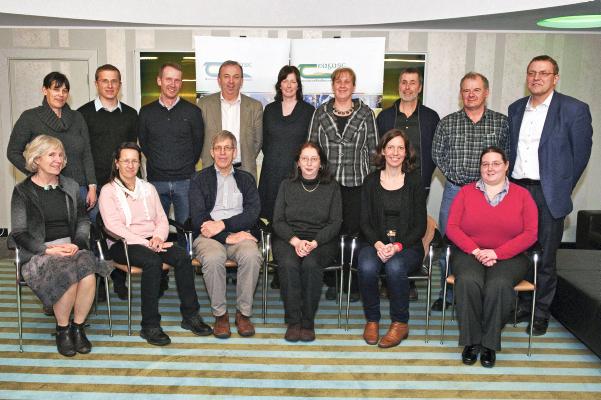
These are just some of the questions scientists from around Europe are trying to answer. A new European project called ‘Autograssmilk’ has just started and I met the group of leading scientists when they gathered in Cork.
The overall aim of the project is to optimise or marry grass based dairy farming with robotic milking. Across Europe, farmers are investing heavily in robotic milking, but mostly in production systems where the cows are indoors all year round and cows don’t leave the shed where the robot is working. Meal is offered in the robots to entice cows into the robot. Cows are milked about three times a day in these systems. The principles of grass based systems are different as they focus on maximising grazed grass, feeding meal when necessary and milking twice a day.
Dairy farming in Europe has adopted robotic milking at an accelerating rate for reasons such as improvement in lifestyle, less physical work, problems attracting skilled labour and increased profitability based on higher milk production and lower labour costs. The defining feature of robots is that the cows come voluntary to the milking unit and milking is evenly distributed over a 24 hour period.
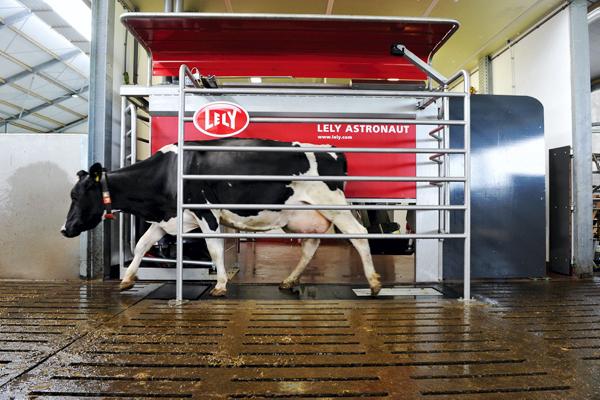
The majority of robots on dairy farms are fixed single box machines, developed to milk herds of 50 to 80 cows. However, new robotic technologies like Rotary robots and mobile robots are beginning to be used and some of the researchers I met are working with these machines.
Traditional grazing research does not provide the answers when robotic milking is combined with grazing. Feed is the main motivator for cows to move voluntarily into the robot. This means the researchers have to look at other ways of using grass to entice cows into the robots.
Who is involved in the project?
There are 15 different partners in six countries – Ireland, France, Belgium, the Netherlands, Sweden and Denmark. There are six research organisations and then two farms, one each in Ireland and Denmark.
The Irish farm involved in this project is the Tipperary farm of Aidan and Anne Power, Templederry, Nenagh, Co Tipperary.
The Powers are milking a herd of Holstein Friesian cows and have one robot installed and are installing a second robot at the moment. The Danish farm belongs to Thure Worm, an organic Danish dairy farm. Thure has three robots and is milking 210 cows farming over 450 hectares in total. The project co-ordinator is Dr. Bernadette O’Brien, Teagasc Moorepark.
IN BRIEF
There has been a big swing towards robotic milking across Europe, where cows are housed all year round on high input and output production systems.
A new European project has just started where European research organisations have been allocated funding to research how to marry grass based milk production systems with robotic milking.
Six research organisations are involved in this three-year research programme to develop and adopt new robotic technologies such as robotic milking on rotary and mobile parlours and ways to make robotic milking suit grazing systems.
These are just some of the questions scientists from around Europe are trying to answer. A new European project called ‘Autograssmilk’ has just started and I met the group of leading scientists when they gathered in Cork.
The overall aim of the project is to optimise or marry grass based dairy farming with robotic milking. Across Europe, farmers are investing heavily in robotic milking, but mostly in production systems where the cows are indoors all year round and cows don’t leave the shed where the robot is working. Meal is offered in the robots to entice cows into the robot. Cows are milked about three times a day in these systems. The principles of grass based systems are different as they focus on maximising grazed grass, feeding meal when necessary and milking twice a day.
Dairy farming in Europe has adopted robotic milking at an accelerating rate for reasons such as improvement in lifestyle, less physical work, problems attracting skilled labour and increased profitability based on higher milk production and lower labour costs. The defining feature of robots is that the cows come voluntary to the milking unit and milking is evenly distributed over a 24 hour period.
The majority of robots on dairy farms are fixed single box machines, developed to milk herds of 50 to 80 cows. However, new robotic technologies like Rotary robots and mobile robots are beginning to be used and some of the researchers I met are working with these machines.
Traditional grazing research does not provide the answers when robotic milking is combined with grazing. Feed is the main motivator for cows to move voluntarily into the robot. This means the researchers have to look at other ways of using grass to entice cows into the robots.
Who is involved in the project?
There are 15 different partners in six countries – Ireland, France, Belgium, the Netherlands, Sweden and Denmark. There are six research organisations and then two farms, one each in Ireland and Denmark.
The Irish farm involved in this project is the Tipperary farm of Aidan and Anne Power, Templederry, Nenagh, Co Tipperary.
The Powers are milking a herd of Holstein Friesian cows and have one robot installed and are installing a second robot at the moment. The Danish farm belongs to Thure Worm, an organic Danish dairy farm. Thure has three robots and is milking 210 cows farming over 450 hectares in total. The project co-ordinator is Dr. Bernadette O’Brien, Teagasc Moorepark.
IN BRIEF
There has been a big swing towards robotic milking across Europe, where cows are housed all year round on high input and output production systems.
A new European project has just started where European research organisations have been allocated funding to research how to marry grass based milk production systems with robotic milking.
Six research organisations are involved in this three-year research programme to develop and adopt new robotic technologies such as robotic milking on rotary and mobile parlours and ways to make robotic milking suit grazing systems.





SHARING OPTIONS