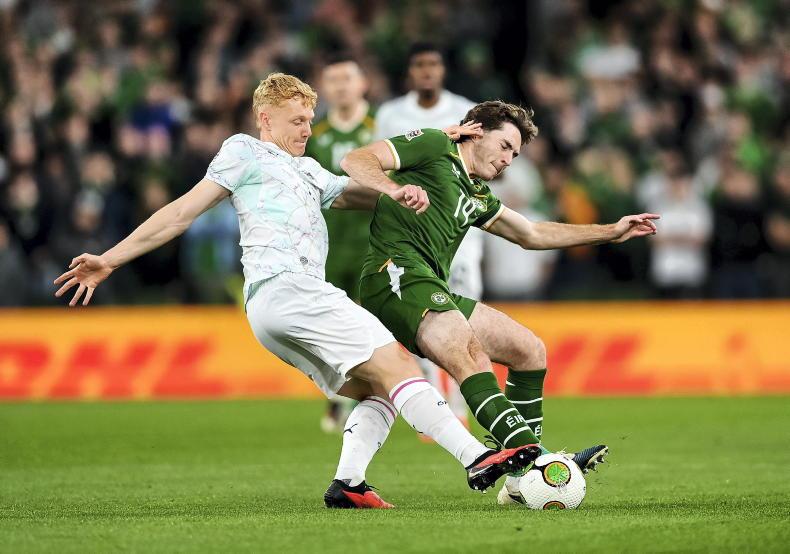
In 1993, Opel achieved its highest share of new cars sold in Ireland.
At the time, the German brand accounted for 13.9% of sales, behind Ford (14.1%) and Toyota (15.1%), and the Astra was the country’s best-selling model. In recent years, the make has dropped below 2% of what is a market twice as large as it was three decades ago.
How much of Opel’s prior success in Ireland was tied up in the fact that it was the first shirt sponsor of the Republic of Ireland football team is impossible to fully gauge, but it could be argued that the period around 1992-93 was when Jack Charlton’s side were at their peak.
The team had narrowly missed out on qualifying for Euro ‘92 and were on the way to reaching a second straight World Cup – in the time since, Ireland have reached just one more, even allowing for two increases in the number of teams making the finals.
Eircom and then Three Mobile followed Opel – though, in the case of the latter, their stylised ‘3’ logo meant that everybody looked as though they were playing left-back – but, following the departure of the telecommunications giant in 2019, there was a five-year gap until the arrival of Sky.
Performances on the field – and in the FAI boardroom – meant that the national team was not attractive enough an advertising proposition. Or, rather, the men’s national team was not: Sky’s partnership was actually an extension of the deal to sponsor the women’s side, which had begun in 2022.
They were on the way to qualifying for the World Cup for the first time and a year ago, an unforgettable week provided us with a glimpse of what it might be like were the men’s team to progress again.
Ireland campaign
It’s easy to forget now that, when Ireland started their campaign in September of 2025 with a 2-2 draw at home to 10-man Hungary and then lost in Armenia, morale was low and manager Heimir Hallgrímsson’s dental qualifications were being used against him by sections of the media who felt he wasn’t up to the job of turning Ireland around.
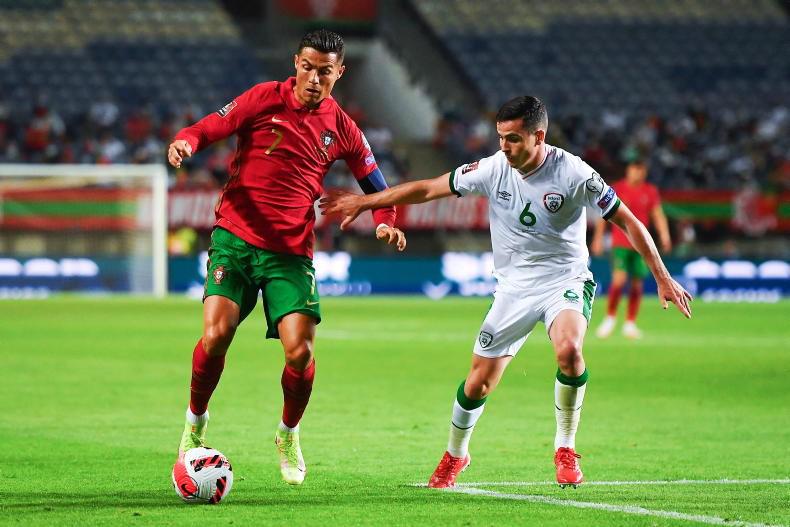
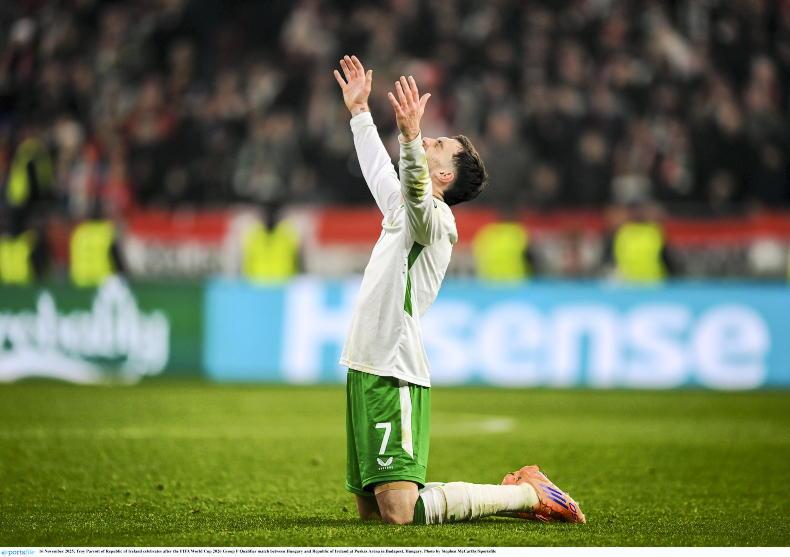
And yet we went from that to the most unlikely of November fairytales, five Troy Parrott goals firing Ireland past Portugal at Aviva Stadium before the incredible scenes in Budapest as his hat-trick earned the team a 3-2 win against Hungary, to give Ireland a place in the play-offs.
The fact that the next game, against Czechia in Prague, was four months away allowed a fervour to build up, though of course even if Ireland had held on for the win, or triumphed in the penalty shootout, there was another game to be negotiated, against Denmark.
The current Nations League B campaign was about trying to build on what had been an encouraging showing – and whatever about the external noise around the two games against Israel, the defeat to Kosovo demonstrated that Ireland are still an inconsistent team.
The cruel joke following the 1-0 loss in Pristina was that they had started their boycott a game early.
Five points from the other three games mean that the team go into the last two fixtures with a chance of achieving promotion. Getting up to League A would provide a better quality of opposition the next time around and aid the seeding position for the Euro 2028 qualifiers. Given that Ireland are co-hosting that tournament, it would be a shame not to be participating – as we saw back in March, the hint of being involved in such a jamboree lifts the national mood.
Incidentally, a recent radio ad informed me that Opel are now a partner of the Irish rugby team; presumably, they felt it was a safer bet in terms of sporting success.
Back in August 2019 we devoted part of our sports coverage to an interview given by Ciara Mageean to RTÉ following her tenth-placed finish in the women’s 1500m at the World Championships in Doha.
So prevalent is the ‘first is first, second is nowhere’ mantra in the modern world, you might expect such a finish to provoke a self-pitying tirade against oneself, but Ciara was able to take pride in what she described as her best championships yet – “For a wee girl from Portaferry, that’s not too bad at all!” – while knowing that there was more in her.
That was proven with her subsequent European Championship medals and a slew of personal bests across different distances, belying the notion that the late 20s and early 30s are a period of decline for a top athlete.
Beyond the on-track activity though, that interview gave an insight into the breadth of her world view.
At the time, there was speculation that some medallists’ performances were chemically enhanced but Sebastian Coe, who was then and is now the president of the IAAF, had dismissed such concerns.
“Athletes talking about externalities are probably not the ones who are going to be walking home with medals,” he had said and it was something Ciara felt had to be countered.
“Not all of us are going to medal,” she said, “It doesn’t mean we’re not as important as the ones standing on the podium.
“Every one of us is an important voice. I didn’t think that comment was too fair.”
Equally, the setting of those championships was something that could be turned to a positive.
“I’m not complaining about competing here,” she said, “hopefully this raises a little bit of support for female sport in Qatar.
“I’d love to see this have an impact and hopefully seeing me race on the world stage has had an impact on kids at home as well.”
Such an attitude of providing encouragement and inspiration was clear right to the premature end, as shown when Rhasidat Adeleke shared the signed dedication from her copy of My Greatest Race, written by Ciara with Cliona Foley.
“To Rhasidat, always remember the joy of pushing yourself hard and reaching to be the best you can be.
“We run in circles and bring people so much joy from that simple act. Always remember it is that simple, and the joy it brings YOU.
“You’re a phenomenal athlete, but most importantly an amazing person!”
Such words could be applied to Ciara herself.
My Greatest Race by Ciara Mageean is €21.99 and available nationwide.