



In the brief window after his football career ended and before he became a crisp salesman and television presenter, Gary Lineker wrote a book.
Well, how much he actually ‘wrote’ can probably be debated – All in The Game has his byline with Stan Hey, the latter being a professional writer.
The plot centres around a young English striker who secures a move to Barcelona, so we divine that Lineker provided much of the background on which to base the story.
When a mini-series based on the book was shown on ITV in 1993, Lineker had a cameo as himself, meeting the protagonist, Darren Matthews, for lunch to advise him on life in Catalunya. He concluded his rather wooden appearance by reminding him of the golden rule – “Score some goals, ya dope!”
If we can bring that recommendation forward three decades and transpose to a different code of football, Ireland remembered the most important maxim when they went to Twickenham three weeks ago.
It’s not just the tally they posted – though of course the 42 points scored tied the second-highest England had ever allowed at home – but it was the return on what are termed visits to the opposition 22.
With thanks to rugby statistician Russ Petty: in their opening two games, Ireland managed 1.7 points per visit away to France and then 2.2 at home to Italy. Combine those and you get 3.9 – and yet the return against England was 4.3 points per visit, not far off a try each time.
Triple Crown
It was a remarkable transformation, but it’s worth noting that the attacking improvement was build upon the foundations of good defence: against France, Ireland conceded 22 turnovers – the second-highest of any game since 2022 – and while the figure against Italy was better, there were still 18. In London, that statistic was down to just 12.
Hard work and application are not difficult things to achieve – under Joe Schmidt, Ireland’s path to the top of the world rankings was built on the old Paul O’Connell motto of being the best at the things that require no skill – but confidence levels can influence their effectiveness.
Early in the second half against Italy, the pessimistic among us were fearing that last Friday’s game against Wales would be a wooden-spoon play-off; thankfully, Ireland found a way to win – against a team that had beaten Scotland, to give Italy their dues – and then were able to mentally reset to such a degree that they could bring
England’s nine-game unbeaten home record to its knees.
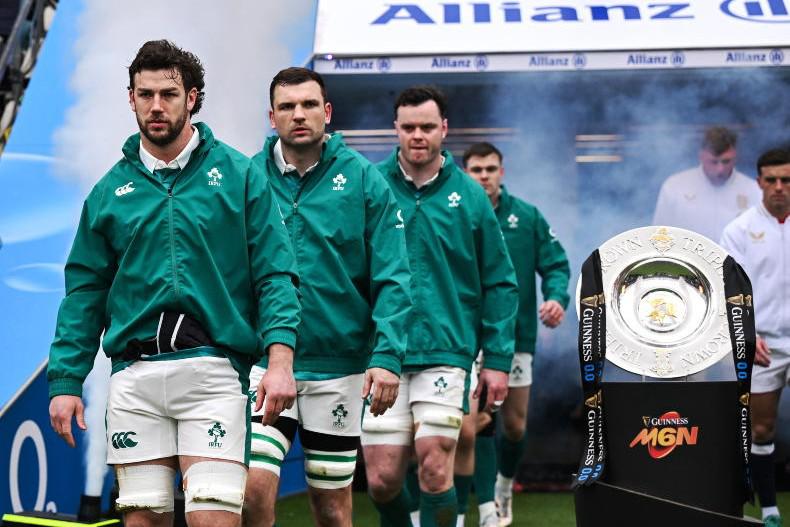
Now, with a low-ebb Wales having been seen off, there is a Triple Crown within reach against Scotland this weekend and even the possibility of winning the championship.

It shows how quickly things can change in the micro, while the plight of last week’s opponents displays how the macro picture can be altered in a relatively short space of time.
Wales won the last pre-Covid-19 Six Nations Championship, achieving the Grand Slam under Warren Gatland, and came out on top in 2021, too. However, they will go in to Saturday’s clash with Italy aiming to avoid what would be a third straight 0-0-5 season, with two wins in their last 24 matches in the competition.
It calls to mind Ireland’s travails of the 1990s – when, ironically, Wales were the only team they seemed able to beat.
While Touching Distance, rugby journalist Brendan Fanning’s marvellous book released last autumn, shows that things are not perfect by any means, the overall landscape has been changed in a positive fashion since the advent of professionalism.
The fact that Ireland’s provinces served as ready-made vehicles for four regional pro teams was a stroke of fortune that should not be overlooked; at the same time, they were stepping stones but progress from that start could not be taken for granted.
Bravehearts
Scotland have managed, with varying degrees of success, with sides based in Edinburgh and Glasgow since the advent of what was originally known as the Celtic League; by contrast, Wales had nine clubs among the 15 sides in that inaugural 2001-2002 season.
While there was a ‘rationalisation’ to five regions two years later, that number was reduced to four and, had the Welsh Rugby Union had their way last year, it would have been halved to two.
Three teams by 2028 was the compromise reached. A less-is-more outcome may result, but it’s no guarantee – with fewer avenues to the top, grassroots participation could suffer.
While Ireland may have a bad result or two – or even a run of defeats that brings calls of a crisis – the under-pinning structures are not in grave danger, as they are with our Celtic cousins.
Should Scotland be beaten at on Saturday, the graph will be clearly pointing upward again. Coming the season after a Lions tour, where the head coach was absent, that is not something to be taken for granted.


SHARING OPTIONS