



As much of the south, east and midlands of Ireland are experiencing an increasingly long period of dry weather, terms such as heatwave, hot days and drought, among others, are repeatedly being used – but what exactly do they mean?
In the northern hemisphere, meteorological summer accounts for the months of June, July and August; beginning 1 June and ending 31 August each year, according to Met Éireann.
Summer is Ireland’s warmest season, with a mean air temperature of 14.6°C, maximum average temperatures of 18.6°C and minimum average temperatures of 10.7°C.
Temperatures are set to rise again this week across the country as Met Éireann has issued a status yellow high-temperature warning for 13 counties.
Heatwave
There is no single global definition of a heatwave, but it is generally understood to be a period of unusually high temperatures, for that climate, that last a few days.
Internationally, a summer day can be defined as a day when the maximum air temperature, in the shade, exceeds 25°C.
In Ireland, a heatwave occurs when there have been five or more consecutive summer days (daily maximum air temperature in the shade > 25°C) at a Met Éireann station.
The hottest summer on record was summer 2025
On average, heatwaves last for about six days in Ireland, and it is rare for a heatwave to be longer than nine days in duration.
However, heatwaves longer than this do occur in Ireland, as seen in Table 1. In July this year, a heatwave of 13 days was recorded at Met Éireann’s weather station in Moorepark, Co Cork.
Seven other stations also observed heatwaves in July 2026, ranging from 5 to 13 consecutive summer days.
Hot days
A hot day occurs when the maximum air temperature, in the shade, remains above 30°C.
Hot days do not occur every year in Ireland. Prior to May 2026, hot days occurred only in June, July and August.
However, on the 26 and 27 May 2026, two consecutive hot days were observed at Shannon Airport, Co Clare, where temperatures rose as high as 30.6°C.
The last hot day in Ireland occurred on 25 June 2026 at 11 primary stations, with temperatures reaching 32.2°C at Athenry, Co Galway.
Tropical nights
In Ireland, a tropical night is defined as when the daily minimum temperature is greater than 20°C.
Tropical nights are a rare occurrence in Ireland. The longest number of consecutive days with tropical nights was two days at Valentia Observatory, ending on Friday 23 July 2021.
Drought
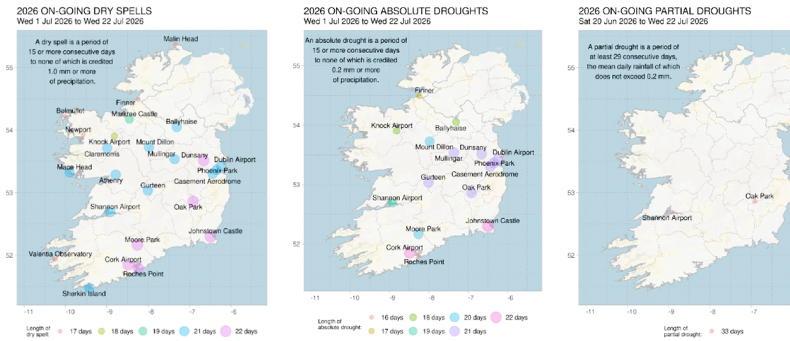
The following drought classifications have been used in Ireland since the late 1880s. They describe rainfall conditions only and do not necessarily imply impacts on water supplies, agriculture or ecosystems:
Climate change
Heatwaves have become more frequent and more intense globally since the 1950s, Met Éireann has said.
Summers that were once unusual are more common now, and cooler summers are becoming increasingly rare.
The hottest summer on record, in 125 years, was summer 2025 (16.19°C), while six of the 10 top hottest summers have occurred within the last 20 years, according to the national forecaster.
Human-caused climate change is the main driver of this increase in extreme heat.
Some recent global heatwaves would have been virtually impossible to occur without human influence on the climate system, according to World Weather Attribution.
Climate projections for Ireland indicate that there will be increases in summer days, warm nights and heatwaves over the coming years.




SHARING OPTIONS