



To visit Eamon and Geraldine McDonagh’s smallholding in south Mayo is to journey back to a time when farming life entailed a more intimate connection with the land and livestock, a time when nothing was wasted, and when self-sufficiency was a fact of life rather than an aspiration.
The farm is wonderfully diverse, considering its size – a 30 acre, two-fields-wide strip of free-draining limestone land. Its diversity is a testament to the hard work and ingenuity of the owners who took it over 15 years ago – the third generation to do so.
Stone wall ‘mereings’ (as farm boundaries are called here) enclose the rolling pastures and tilled fields, with crops rotated on a four-year cycle.
Trees feature prominently: a 10-acre wettish plot at the back of the farm was planted seven years ago, while pockets of mixed woodland are scattered across the farm, as are the lines of broadleaved trees, planted by Geraldine’s parents, Michael and Kathleen Prendergast, who farmed here previously.
Cattle, sheep, horses, pigs and poultry are kept. While low in numbers, they fulfil an impressively wide variety of functions. They provide food for this hardworking family of four (including sons Mikey and Séimí) – with beef, lamb and bacon all on the menu, complemented by a range of homegrown vegetables.
The manure from the cattle and horses is a precious resource on this organic farm, with the pigs enthusiastically churning up and aerating the straw-dung mixture.
Understandably, Eamon isn’t too keen on the current simplistic debate around reducing stock numbers, as for him the stock are central to the functioning of this farm’s ‘circular economy’ (where materials never become waste and nature is regenerated) – without them, he would have to resort to expensive external inputs.
Harnessing animal power
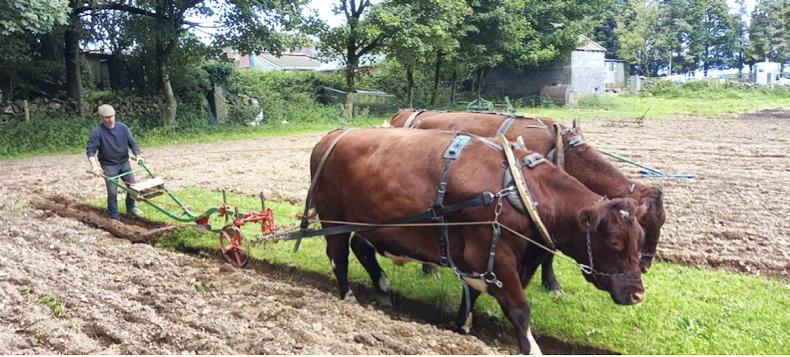
A more unusual function is carried out by the real stars of the show on this farm: the horses – a Percheron and an Ardennais – and the Shorthorn oxen (a term used to describe bovines trained and used as draft animals).

These magnificent beasts are painstakingly trained from birth to work the land while harnessed to a dizzying variety of traditional farm machinery – ploughs, harrows, crumblers, muckspreaders, scufflers, spinners and more.
Many of these implements are patriotically painted in the red and green of Mayo, but they are not just for show: they are routinely used to prepare the ground for the farm’s main cash crop, a range of root vegetables, as well as for planting, weeding, harvesting and transporting the produce.
Eamon is an award-winning ploughman, capable of mustering the oxen to open a remarkably straight furrow, revealing, as he does so, a plethora of earthworms in the shallow sod. These testify to the health of the non-compacted, well-manured soil, to which the horses and oxen add the occasional fresh dollop while ploughing.
This type of work isn’t easy, particularly in a townland named Ballinacarrag – the “town of the rocks” – so great care is needed to navigate the terrain; skilled work, which is both a joy and wonder to behold.
Self-sufficiency
The farm produce – an acre or two of potatoes, carrots and parsnips – is sold to three main buyers, with some beet also grown.
Previously, Eamon sold up to 20 types of veg directly to a range of local restaurants, shops and customers, but finds the current simplified system – where he only plants what he knows he can sell to reliable buyers – to be far better. This year, he is also planting a field of rye for thatch – a bit of a gamble, but he anticipates a good demand for it.
Nothing is wasted. Any excess or damaged potatoes are cooked for the pigs, using a clever homemade, timber-burning outdoor boiler, while Eamon collects his own seed from the crops, and has built a root cellar to store the harvested vegetables, helping to extend their lifespan.
The farmyard and adjacent garden bustle with activity.

Though very modest, Eamon is clearly gifted with his hands and can apparently turn his hand to anything. He has his own mini-sawmill for processing the timber thinned from the forests, extracted using the horses and used for building on the farm.
He is also a skilled blacksmith, his mini farmyard foundry producing everything from ornate railings to farm gates. These skills also prove invaluable for restoring and repairing the wide range of farm machinery he has sourced from near and far.
The farm produce – an acre or two of potatoes, carrots and parsnips – is sold to three main buyers, with some beet also grown
Eamon is a trained carpenter too – a useful source of off-farm income these days when demand for such trades is high.
Geraldine’s domain is the garden and orchard, but she also finds time to work part-time in the local post office at Ballinrobe. Heritage trees from Irish Seed Savers in Co Clare produce a rich harvest of apples and pears, while her no-dig beds are full of a range of salads, fruits and vegetables.
Wood shavings from the sawmill often line the garden pathways, while manure from the horses is carefully preserved to fertilise the beds, which are cleverly made from recycled concrete slats.
Beehives sit in the corner of the orchard, playing their part in ensuring a good harvest by pollinating the fruit trees, while also supplying the house with tasty honey.
Preserving our cultural heritage
What’s most striking about the McDonagh’s farm is the extraordinary range of activities taking place on such a compact area – so many of them familiar to those of us who grew up on Irish farms.
Visiting the farm is a jolting reminder of the extraordinary, unprecedented revolution which has taken place in Irish farming, effectively over a single generation, bringing with it both great opportunities and great challenges.
The McDonaghs clearly do what they do because they love it, relishing the independence and self-sufficiency that it brings, but their hard work and passion is a gift to all of us who hold fond memories of farm life and who cherish our unique rural cultural heritage.
Cultural heritage is widely recognised as a key driver of sustainable development and the McDonaghs preserve it in the best way possible: by living it.
Their farming journey delves into the past, keeping alive the accumulated knowledge and skills of previous generations, offering this ‘living legacy’ to future generations to learn from – hopefully providing valuable clues to inform a more resilient and sustainable future for us all on the land.

As winter approaches, it’s natural for many of us to move from consuming fresh seasonal produce to figuring out how to store homegrown crops for the months ahead.
With many root crops, leaving them in the ground is an effective option, though hungry wildlife and pests – from slugs to carrot fly – may pose a threat.
Mild weather may also encourage plants to bolt, but removing all above-ground foliage by November helps prevent this.
Harvesting any crops is best done in dry weather, if possible. Potatoes, when harvested, are easy to store – in a breathable container or sack, placed in a cool, dry, dark, vermin- and frost-free location. A root cellar such as Eamon’s is ideal.
Other root veg – carrots, beetroot and turnips for example – have a tendency to dry out, so should be stored in containers between layers of sand, compost or sieved soil to keep them moist.
Try to keep the root crops from touching and keep the containers in a cool, dry, frost-free location.
If you have parsnips, these are best left in the ground. They hold well and seem to accumulate flavour over time. Onions and garlic don’t hold well in the ground and should be harvested, dried and hung in a cool dry place with good circulation.
With apples, wrap unblemished apples in paper and store in single layers in containers.
Be sure to check all stored crops regularly and remove any decaying ones to prevent rot from spreading. Happy eating!
For a wonderfully educational and entertaining day out, it’s hard to beat the museum of country life in Mayo.
Free to enter, it contains a collection of hand tools representative of farming on small subsistence farms, horse-drawn agricultural machinery, machines for threshing and pulping, as well as objects connected to animal husbandry and veterinary instruments.
For more on this fascinating trip down memory lane, visit the Country Life website.


SHARING OPTIONS