



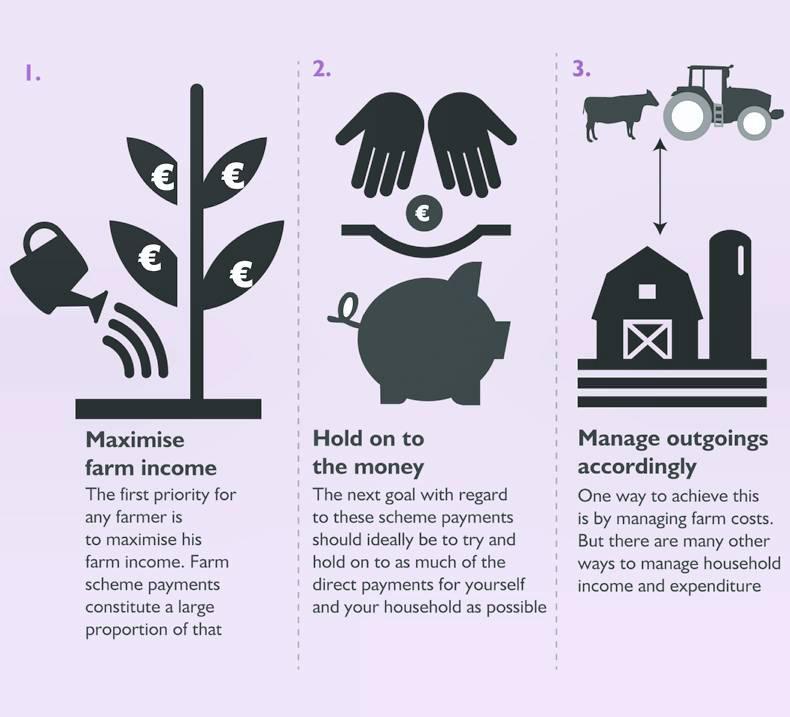
One of the first steps to getting farm financially fit should be to see how much money you need to live off. Surely it should start on the farm, you might ask? Well, no – simply because the reason we farm should be to feed and clothe ourselves. Do you know how much it costs you to live? Many people don’t. The aim is to make a profit that can be brought back into the household, if required.
Many people are surprised when they work it out. Setting up a household budget simply sets out what comes in and what this is spent on. It can be done weekly, fortnightly or monthly – whatever you prefer. People always ask for the target or average figures that they should be spending, but this is something that each family has to do for themselves.
I have seen budgets from €20,000 to €70,000 depending on the number of children, the mortgage, and the number of holidays people feel they need. Family budgeting is a very personal thing and no two situations are the same.
Simple steps for a household budget
1. Know why you are doing it? The main reason is to allow you to be more in control of your finances. It allows you to manage the bills and feel that you are not going from one bill to the next. It also allows you to plan better and make more from the money you have coming in.
2. Set it up. You can do it on a copy book simply by putting the months along the top and using a different line for each heading down the side. If you can use a computer, do the cashflow in the form of an Excel sheet. It is very simple and it does all the additions and subtractions for you. You can also change it to suit your needs. Of course, there are plenty of more advanced options available if you want to get into more detail. However, sometimes simplicity is the key to getting it done.
3. Start with the income. Look at all the money that comes into the house. As well as the farm income, list income from off-farm employment as well. Don’t forget to include any income from savings and social welfare payments such as child benefit. This can be broken down into monthly income or, if you feel the need, to it can be done on a weekly basis.
4. Break down the spending. I prefer to have two main headings in a household budget – essential and non-essential costs. Essential are the one that we can’t get out of. It doesn’t mean we can’t reduce them, but they will still be there in some shape or form. Non-essential are ones where we have more choice if we want to spend money on them or not. This differs between people.
5. Make up your own list under essential costs. I have listed many on the template above. For most families, it would include mortgage, ESB and gas, health insurance and food. Tax and PRSI contribution would come in as well. Then there are telephone bills and the TV licence. Some people break down food between essential and non-essential as they find it easier to reduce the bill that way. Again, find a system that works for you.
6. Be honest about the non-essential costs. Under this heading are items such as holidays, hobbies, savings plans, if you have any in place, credit card balances, entertainment and miscellaneous for the bits and pieces. It is in this area that many find a black hole for money and where financial discipline is needed.
7. Write it down. Writing down what you spend for a week or two is often a good way to identify where the money goes. Have a small notebook and record what is spent and what heading it would go under.
8. Don’t do it alone. Get your husband/partner involved and encourage your children to record their spending. It might not prove popular, but it will be important if you want them to change their habits and give them a responsible attitude towards savings.
9. Look to trim. Once you know what you are spending, you can start to look to where costs can be trimmed or cut out. Look carefully at each of your essential and non-essential costs. Set yourself a challenge on how to reduce a number of costs. In recent years, many people signed up for costs without much thought. Can you find costs that can be cut altogether in the non-essential column?
10. Manage your budget. Knowing what you are spending puts you more in control. You will be able to see when essential bills are due and start to ensure you have money to meet them. Of course, certain times of the year, like when children go back to school or Christmas, are more expensive, but if you plan then it can make it manageable.
11. Start squirrelling. One reason people get stressed about money is that there is no emergency fund. One goal should be to set aside even a few euro each month to build up a fund that can be called on for the unexpected cost. Depending on your situation, you could have definite goals to save for a holiday or children’s education.
12. Get into the habit. Getting into the habit of budgeting will mean that looking to cut costs starts to come naturally. You are always conscious of costs and if done right it means that you shouldn’t feel guilty if you do buy what you want. If you budget, there is much less chance that you will impulse buy.
Hint
A good way of starting the habit is to carry a notebook around and write down what you spend. Some people keep it in the car and write it down as they go. The rest of the bills will come to you in the post or email.





SHARING OPTIONS