
The Irish Farmers Journal Cost Watch interest rate survey published in January 2016 highlighted an average range of 8% between the lowest and highest overdraft rates being charged by banks to farmers and a 4% range for term loans. These differentials highlight that significant savings can be achieved by negotiating a better deal with your bank.
From our experience in IFAC Accountants, mismanagement of bank accounts by the borrower rather than financial problems is the most common contributor to higher interest rate charges. Practices engaged in by those farmers who secure better-than-average interest rates form the bedrock of the following ten tips.
1. Manage your bank accounts in a businesslike manner
Your current account is the bank’s window on your business, so show the bank you are in control of your business and ensure the current account is in credit at least 30 days during the year, not necessarily 30 consecutive days.
2. Maintain continuous contact with your bank relationship
manager
Keep the bank informed about the performance of your business, most especially if you envisage cashflow problems. If the problems envisaged relate to low product prices, remember most other farmers will have the same problem. Communicating unfavourable or anticipated unfavourable news or trends reflects positively on your ability to manage. Avoid nasty surprises and be proactive in managing the bank’s expectations.
3. Don’t use merchant credit to support negative cashflow
Don’t mask cashflow problems with overuse of expensive merchant credit. You should top up by using “credit line” bank financing which can be secured at 4.5% to 6% whereas merchant credit could, while negotiable, cost from zero to 14% together with the higher built in margin of up to 15% that merchants add to the price of goods sold on credit. In addition, in the current climate, banks don’t look very favourably on restructuring merchant credit.
4. Match your bank funding to
your needs
Some farmers are unrealistic regarding paying down borrowings too quickly. This risks the possibility of a default with the resultant loss of creditability with the banks, leading to a less favourable credit rating.
Secure a longer repayment term, giving the option to repay the loans earlier. Avoid funding machinery purchases and capital expenditure from the current account.Cost your farm development capital projections accurately and thoroughly, eg buildings, land reclamation, etc.5. Be realistic in providing for
living expenses
A very contentious area in many financial projections and cashflows is the amount to be provided for living expenses. Be realistic. Get your accountant to analyse your living expenses for the previous year and prepare a household budget for the coming year. If living expenses have been underestimated in bank projections due to ignoring foreseeable expense, eg weddings, third level education, etc. it does not inspire confidence in your ability to manage and plan and the reliability of the other figures.
6. Know your repayment capacity
How can you retain creditability and negotiate successfully with a bank if you cannot answer the following fundamental questions?
How much have you borrowed?How much cash will you require this year to repay borrowings?Will your profit be sufficient to repay loans and provide for living expenses?Not having this information to hand runs the risk of running your bank relationship into a financial iceberg.
7. Extract maximum management information from your annual
accounts
Don’t make serious financial decisions without having sufficient information to diagnose the current financial state of the health or your farming business. The value of your yearly accounts are enhanced if you can benchmark your figures, ie you compare your results against those farmers with a similar enterprise mix. The IFAC Accountants database compares a farmer’s own figures on output, individual costs and profit with the national average and the top 10% with similar enterprise mix. The preparation of a Teagasc eProfit monitor will also enhance your knowledge of your own business and how your farm is performing relative to similar-sized enterprises. This exercise will heighten your awareness of best value in the market on inputs and services relative to what you are paying.
8. Inspire confidence at your bank review meeting
Don’t be relying on your accountant or adviser to do all the talking if they are with you at the bank meeting. It is essential you demonstrate a knowledge of your own accounts with an awareness of what’s happening in the outside world, ie your projections are based on reality.
You earned €70,000 profit last year and you project a profit of €120,000 this year. Is this realistic? If your projected average cost of production is less than the national average, how will you reduce costs? Above-average tillage yields – be able to show how you were above average in the past. If it is a beef enterprise, know your margin.
Have an eProfit monitor. If the profit on the accounts you are submitting is significantly higher or lower than the previous year, know the reasons. If your living expenses have significantly increased or decreased, know the reason. Know your production costs and whether they are above average or below average and the reasons.
9. Be aware of market
interest rates
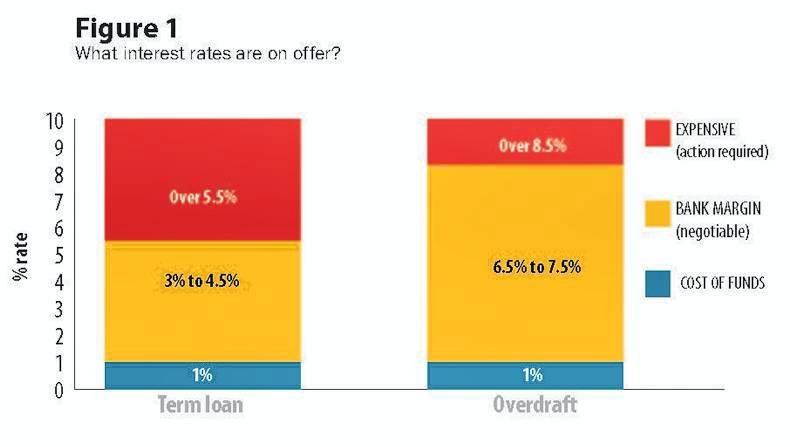
Know the target interest rate you wish to achieve on term loan, overdraft and credit line borrowings. How can you negotiate constructively and effectively if you are not familiar with how interest rates are set or the best interest rates in the market. Bank margins are negotiable and Figure 1 highlights how these are structured based on banks cost of funds and margins which are negotiable.
10. Join an above-average
discussion group
As in sport, competing with above average performers will lift your performance. The same is true of discussion groups. An active participant in an above average discussion group will be acutely aware of their own farm production costs, output and with the management and financial performance of the top 10% of farmers engaged in similar enterprises.
In general, such participants display an in-depth knowledge of their farm performance, average costs of production, average output, reasons for fluctuations and variations, industry projections and inspire confidence in their bank dealings and secure adequate finances at the keenest rates.
To read the full Agri Finance Focus Supplement click here.

The Irish Farmers Journal Cost Watch interest rate survey published in January 2016 highlighted an average range of 8% between the lowest and highest overdraft rates being charged by banks to farmers and a 4% range for term loans. These differentials highlight that significant savings can be achieved by negotiating a better deal with your bank.
From our experience in IFAC Accountants, mismanagement of bank accounts by the borrower rather than financial problems is the most common contributor to higher interest rate charges. Practices engaged in by those farmers who secure better-than-average interest rates form the bedrock of the following ten tips.
1. Manage your bank accounts in a businesslike manner
Your current account is the bank’s window on your business, so show the bank you are in control of your business and ensure the current account is in credit at least 30 days during the year, not necessarily 30 consecutive days.
2. Maintain continuous contact with your bank relationship
manager
Keep the bank informed about the performance of your business, most especially if you envisage cashflow problems. If the problems envisaged relate to low product prices, remember most other farmers will have the same problem. Communicating unfavourable or anticipated unfavourable news or trends reflects positively on your ability to manage. Avoid nasty surprises and be proactive in managing the bank’s expectations.
3. Don’t use merchant credit to support negative cashflow
Don’t mask cashflow problems with overuse of expensive merchant credit. You should top up by using “credit line” bank financing which can be secured at 4.5% to 6% whereas merchant credit could, while negotiable, cost from zero to 14% together with the higher built in margin of up to 15% that merchants add to the price of goods sold on credit. In addition, in the current climate, banks don’t look very favourably on restructuring merchant credit.
4. Match your bank funding to
your needs
Some farmers are unrealistic regarding paying down borrowings too quickly. This risks the possibility of a default with the resultant loss of creditability with the banks, leading to a less favourable credit rating.
Secure a longer repayment term, giving the option to repay the loans earlier. Avoid funding machinery purchases and capital expenditure from the current account.Cost your farm development capital projections accurately and thoroughly, eg buildings, land reclamation, etc.5. Be realistic in providing for
living expenses
A very contentious area in many financial projections and cashflows is the amount to be provided for living expenses. Be realistic. Get your accountant to analyse your living expenses for the previous year and prepare a household budget for the coming year. If living expenses have been underestimated in bank projections due to ignoring foreseeable expense, eg weddings, third level education, etc. it does not inspire confidence in your ability to manage and plan and the reliability of the other figures.
6. Know your repayment capacity
How can you retain creditability and negotiate successfully with a bank if you cannot answer the following fundamental questions?
How much have you borrowed?How much cash will you require this year to repay borrowings?Will your profit be sufficient to repay loans and provide for living expenses?Not having this information to hand runs the risk of running your bank relationship into a financial iceberg.
7. Extract maximum management information from your annual
accounts
Don’t make serious financial decisions without having sufficient information to diagnose the current financial state of the health or your farming business. The value of your yearly accounts are enhanced if you can benchmark your figures, ie you compare your results against those farmers with a similar enterprise mix. The IFAC Accountants database compares a farmer’s own figures on output, individual costs and profit with the national average and the top 10% with similar enterprise mix. The preparation of a Teagasc eProfit monitor will also enhance your knowledge of your own business and how your farm is performing relative to similar-sized enterprises. This exercise will heighten your awareness of best value in the market on inputs and services relative to what you are paying.
8. Inspire confidence at your bank review meeting
Don’t be relying on your accountant or adviser to do all the talking if they are with you at the bank meeting. It is essential you demonstrate a knowledge of your own accounts with an awareness of what’s happening in the outside world, ie your projections are based on reality.
You earned €70,000 profit last year and you project a profit of €120,000 this year. Is this realistic? If your projected average cost of production is less than the national average, how will you reduce costs? Above-average tillage yields – be able to show how you were above average in the past. If it is a beef enterprise, know your margin.
Have an eProfit monitor. If the profit on the accounts you are submitting is significantly higher or lower than the previous year, know the reasons. If your living expenses have significantly increased or decreased, know the reason. Know your production costs and whether they are above average or below average and the reasons.

9. Be aware of market
interest rates
Know the target interest rate you wish to achieve on term loan, overdraft and credit line borrowings. How can you negotiate constructively and effectively if you are not familiar with how interest rates are set or the best interest rates in the market. Bank margins are negotiable and Figure 1 highlights how these are structured based on banks cost of funds and margins which are negotiable.
10. Join an above-average
discussion group
As in sport, competing with above average performers will lift your performance. The same is true of discussion groups. An active participant in an above average discussion group will be acutely aware of their own farm production costs, output and with the management and financial performance of the top 10% of farmers engaged in similar enterprises.
In general, such participants display an in-depth knowledge of their farm performance, average costs of production, average output, reasons for fluctuations and variations, industry projections and inspire confidence in their bank dealings and secure adequate finances at the keenest rates.
To read the full Agri Finance Focus Supplement click here.
SHARING OPTIONS