Cause
Orf scabs contain millions of virus particles which, when they dry up and drop off can contaminate the environment. Scabs can remain infective for a very long time in a dried form (up to 12 years) though the virus will usually not survive adverse climate conditions such as bright sunlight or winter conditions etc. It can, however, over-winter in buildings, in soil or on carrier animals (infected animals that do not show overt clinical signs).
Young lambs born in an infected area have a specific tendency to develop severe lesions inside the mouth involving the gums, palate and tongue and, in severe cases, tracing into the back of the mouth resulting in difficulty swallowing. Due to the localised nature of infection, sheep can only develop a limited immune response. Hence, sheep that were immune (due to disease exposure or vaccination), can become reinfected and subsequently develop clinical signs once immunity wanes – usually more than a year later.
The virus can only cause clinical signs where the skin is damaged – rough grazing or sharp edges on food/water troughs can predispose to infection. Infection pressure can also build up in infected buildings in larger flocks. A flock can become infected through contaminated bedding, feed or trucks, or by direct contact with infected animals (eg replacements brought on to the farm or contact at marts/shows).
Symptoms
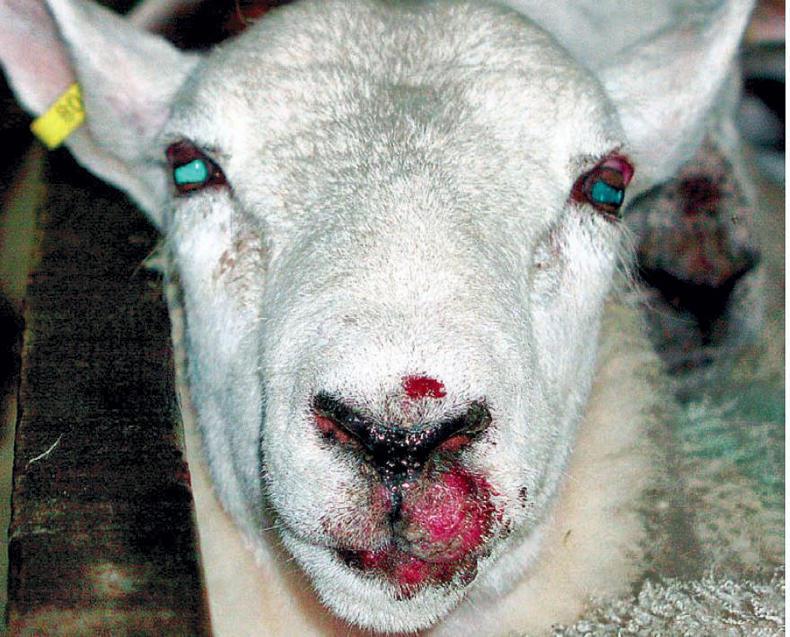
Although the disease can strike at any time of the year, infections are most commonly seen in young lambs and their ewes in springtime and in older lambs in the late summer. Typically, disease is characterised by the development of painful scabby lesions around the mouth, lips and nostrils of lambs. The infection may also affect other parts, particularly the teats of ewes and lower legs of lambs. Ewes often develop infection on the udder from infected lambs suckling.
Nursing ewes may abandon their lambs, leading to lamb starvation and secondary mastitis. Additionally, the virus may spread to other ewes as hungry infected lambs try to feed from unaffected dams. Shared facilities such as drinking troughs, mineral licks and feeders can facilitate spread. The disease normally can last for four to six weeks, though scabs can become extensive or secondarily infected with bacteria and result in serious disease and occasionally death.
Treatment
As orf is a viral disease, there is no reliable treatment. Antiviral drugs have been used in humans successfully to treat infection, though poor results were obtained in sheep using similar products.
Most sheep recover on their own within a few weeks but you can help to prevent the establishment of secondary bacterial infections with the use of topical or, if necessary, injectable antibiotics. Lambs with severe lesions may have problems feeding and should be fed artificially and treated with injectable antibiotics. Ewes, which are affected on the teats or udder, should receive special attention to ensure they do not develop mastitis.
Prevention and control
There are several protective measures that may help reduce the risk of infection in a flock.
Reducing the risk of skin abrasion can greatly help reduce the incidences of orf. This can be done by improving pasture quality by removing thistles, for example. Also, removing sharp objects which could cause potential abrasions is recommended. It is recommended that all newly purchased animals are placed in quarantine until orf is ruled out, then they can be introduced to the rest of the flock. Avoid bringing animals with orf to public events such as marts or shows. Since orf may be transmitted through saliva, some owners assist the judges at shows by opening their own animal’s mouth. A high level of hygiene is vital when it comes to all farm buildings and regular cleaning and disinfecting of farm buildings and their sources of infection such as troughs etc is important in the control of orf. The virus is susceptible to most disinfectants.Vaccinating your flock against orf will help protect your flock and reduce clinical signs and/or lesions of the disease. The number of vaccines available is limited and your vet should be consulted when deciding to vaccinate. Immunity develops two weeks after vaccination and is protective for up to six months. If vaccinating pregnant ewes, do so no less than eight weeks before lambing and keep them away from the lambing area while the scabs are being shed. It is important to know that the immunity in the ewe is not passed to the lamb, as colostrum is not protective. It is advisable to vaccinate lambs as soon as they are dry if exposure is likely. Sheep should be checked approximately one week after vaccination to ensure the vaccine has taken. If no reaction is found at the site of vaccination, the product may need to be administered again. Sheep should not be vaccinated in wet weather and treated animals should not be mixed with unvaccinated animals for eight weeks. The vaccine should be stored in a fridge and out of reach of children. Issues which predispose to immunosuppression can facilitate orf infection. Therefore, where there is an outbreak, it would be prudent to check the mineral status of sheep in the flock, particularly selenium, cobalt and iodine. It would also be useful to investigate if border disease is present and active in the flock, as this too may have an immunosuppressive effect. Humans can also become infected with the orf virus through broken skin resulting in localised swollen, red areas which can be extremely painful. Those working with sheep can protect themselves by following good hygienic practices and by wearing protective gloves when handling infected animals.
Cause
Orf scabs contain millions of virus particles which, when they dry up and drop off can contaminate the environment. Scabs can remain infective for a very long time in a dried form (up to 12 years) though the virus will usually not survive adverse climate conditions such as bright sunlight or winter conditions etc. It can, however, over-winter in buildings, in soil or on carrier animals (infected animals that do not show overt clinical signs).
Young lambs born in an infected area have a specific tendency to develop severe lesions inside the mouth involving the gums, palate and tongue and, in severe cases, tracing into the back of the mouth resulting in difficulty swallowing. Due to the localised nature of infection, sheep can only develop a limited immune response. Hence, sheep that were immune (due to disease exposure or vaccination), can become reinfected and subsequently develop clinical signs once immunity wanes – usually more than a year later.
The virus can only cause clinical signs where the skin is damaged – rough grazing or sharp edges on food/water troughs can predispose to infection. Infection pressure can also build up in infected buildings in larger flocks. A flock can become infected through contaminated bedding, feed or trucks, or by direct contact with infected animals (eg replacements brought on to the farm or contact at marts/shows).
Symptoms
Although the disease can strike at any time of the year, infections are most commonly seen in young lambs and their ewes in springtime and in older lambs in the late summer. Typically, disease is characterised by the development of painful scabby lesions around the mouth, lips and nostrils of lambs. The infection may also affect other parts, particularly the teats of ewes and lower legs of lambs. Ewes often develop infection on the udder from infected lambs suckling.
Nursing ewes may abandon their lambs, leading to lamb starvation and secondary mastitis. Additionally, the virus may spread to other ewes as hungry infected lambs try to feed from unaffected dams. Shared facilities such as drinking troughs, mineral licks and feeders can facilitate spread. The disease normally can last for four to six weeks, though scabs can become extensive or secondarily infected with bacteria and result in serious disease and occasionally death.
Treatment
As orf is a viral disease, there is no reliable treatment. Antiviral drugs have been used in humans successfully to treat infection, though poor results were obtained in sheep using similar products.
Most sheep recover on their own within a few weeks but you can help to prevent the establishment of secondary bacterial infections with the use of topical or, if necessary, injectable antibiotics. Lambs with severe lesions may have problems feeding and should be fed artificially and treated with injectable antibiotics. Ewes, which are affected on the teats or udder, should receive special attention to ensure they do not develop mastitis.
Prevention and control
There are several protective measures that may help reduce the risk of infection in a flock.
Reducing the risk of skin abrasion can greatly help reduce the incidences of orf. This can be done by improving pasture quality by removing thistles, for example. Also, removing sharp objects which could cause potential abrasions is recommended. It is recommended that all newly purchased animals are placed in quarantine until orf is ruled out, then they can be introduced to the rest of the flock. Avoid bringing animals with orf to public events such as marts or shows. Since orf may be transmitted through saliva, some owners assist the judges at shows by opening their own animal’s mouth. A high level of hygiene is vital when it comes to all farm buildings and regular cleaning and disinfecting of farm buildings and their sources of infection such as troughs etc is important in the control of orf. The virus is susceptible to most disinfectants.Vaccinating your flock against orf will help protect your flock and reduce clinical signs and/or lesions of the disease. The number of vaccines available is limited and your vet should be consulted when deciding to vaccinate. Immunity develops two weeks after vaccination and is protective for up to six months. If vaccinating pregnant ewes, do so no less than eight weeks before lambing and keep them away from the lambing area while the scabs are being shed. It is important to know that the immunity in the ewe is not passed to the lamb, as colostrum is not protective. It is advisable to vaccinate lambs as soon as they are dry if exposure is likely. Sheep should be checked approximately one week after vaccination to ensure the vaccine has taken. If no reaction is found at the site of vaccination, the product may need to be administered again. Sheep should not be vaccinated in wet weather and treated animals should not be mixed with unvaccinated animals for eight weeks. The vaccine should be stored in a fridge and out of reach of children. Issues which predispose to immunosuppression can facilitate orf infection. Therefore, where there is an outbreak, it would be prudent to check the mineral status of sheep in the flock, particularly selenium, cobalt and iodine. It would also be useful to investigate if border disease is present and active in the flock, as this too may have an immunosuppressive effect. Humans can also become infected with the orf virus through broken skin resulting in localised swollen, red areas which can be extremely painful. Those working with sheep can protect themselves by following good hygienic practices and by wearing protective gloves when handling infected animals.
SHARING OPTIONS