



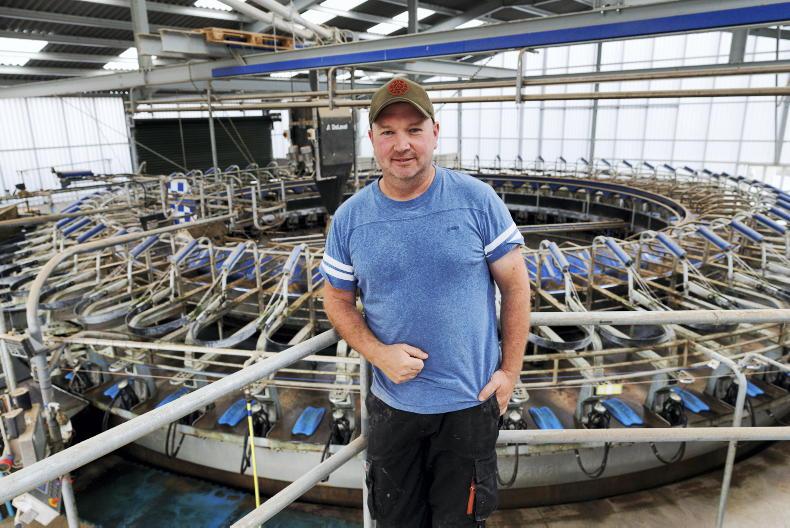
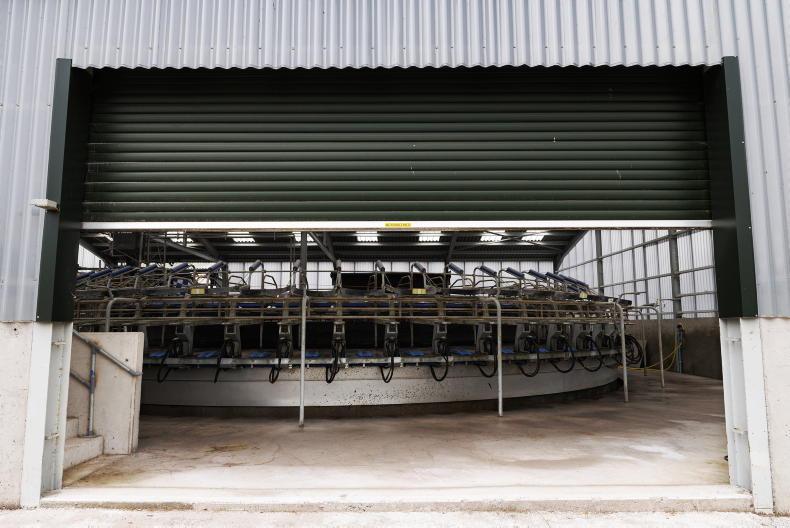
The number of new rotary milking parlours being built in Ireland over the last few years has increased substantially, to reduce milking times and simplify work on larger farms.
While rotary parlours are a more efficient way to milk cows, they are also more expensive to build, so there is a critical herd size of 350 to 400 cows needed to justify the extra expenditure.
Niall and Michelle O’Callaghan are dairy farming on two 500-cow dairy units in Feenagh, Co Limerick. They farm in share and contract-farming partnerships with Richard Roche and Christy Conlan.
In the last three years they have built two new rotary parlours on their farms to future-proof their collaborative business.
The build
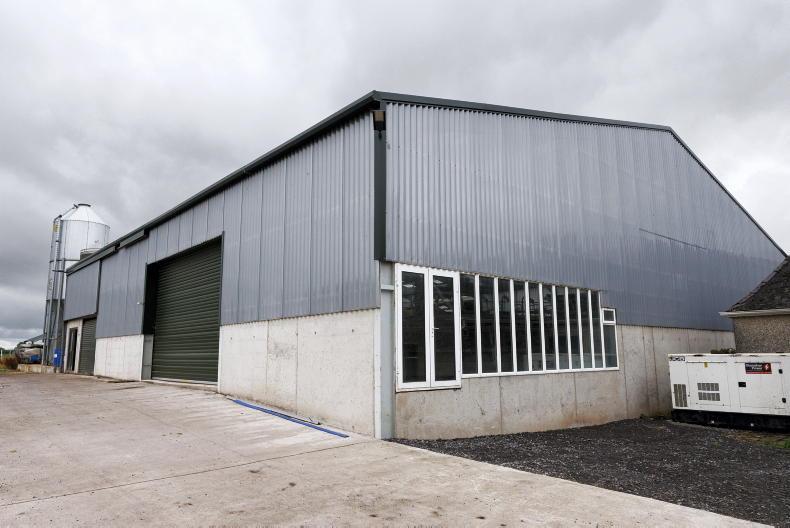
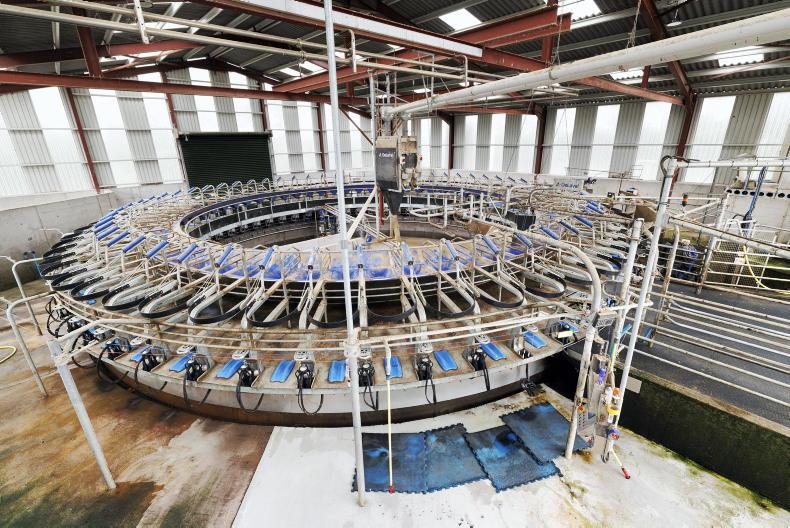
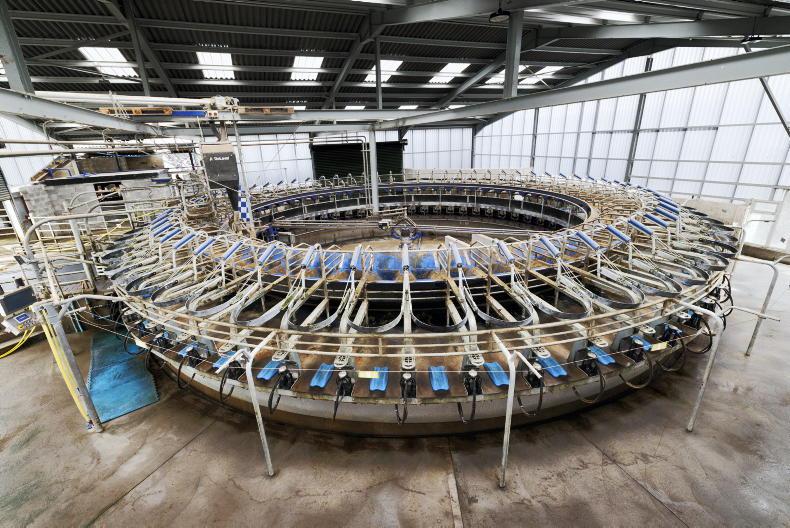
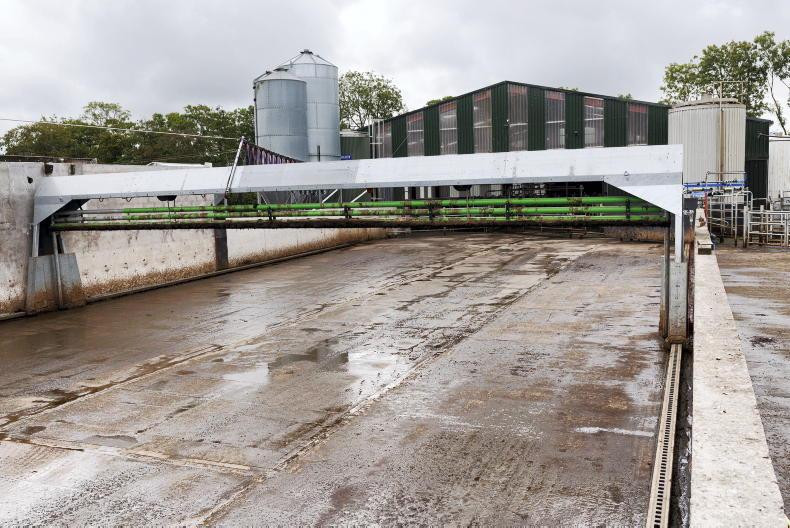
The project involved the construction of two 60-bale rotary parlours to replace two existing 26-bale herringbone parlours. In both cases, the project involved using the existing collection yard as an exit yard and establishing a new collection yard for entry of cows to the new parlours.
Niall believes that they saved €20,000-€30,000 by integrating the new unit into the existing site.
In hindsight, a greenfield option would have been much more efficient and caused a lot less headaches.
There was a 12-month planning lead-in time, where professional planners were used to lay out the new units; and they used the DeLaval blueprint drawings for the design of the new parlours.
Work on the first rotary began in early August 2023 and the project was completed over 12 months. The first job was to level the site and find the centre of the rotary. It is from this point that every other measurement was taken, including the positioning of the round mass concrete wall on which the platform rotates.
The building process involved, first of all, putting in the underpasses for both parlours, followed by drainage and ducting, building the ring wall and the portal sheds and walls, putting in the platforms, followed by the flooring, electrical, water ducting and external floors, before finally fitting the machine and completing the electrical work.
The construction work was done by T. and D. O’Keeffe Builders from Banteer, Co Cork, who had previously built a rotary and knew the process. The electrical and plumbing work was done by Pat and Padraig O’Kelly. Niall and the farm team also provided some of the labour.
In terms of unique features, Niall wanted the dairy and bulk tank for each parlour to be at the cups-on side, so it was visible and easily accessible to anyone milking the cows.
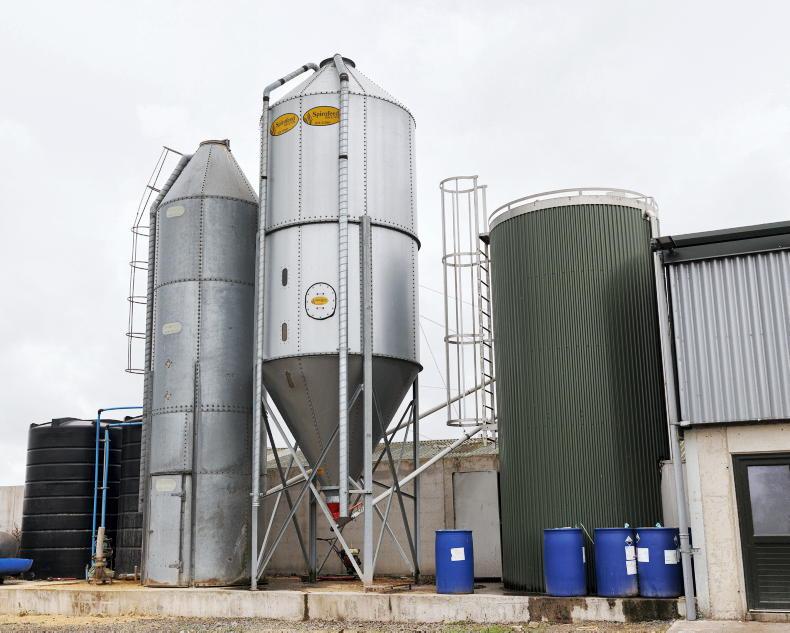
The sheds were side-sheeted with Heatguard roof cladding, to allow natural daylight into the parlours while reducing heat transfer. On both units, feed bins and milk tanks were placed on a plinth outside the parlour, with a large turning area for milk and feed trucks.
Niall looked at six to seven parlours in Ireland and Wales during an 18-month lead-in time, when researching what he wanted.
One area where Niall did a lot of extra work was to reduce water usage requirements, which are often very high with rotary parlours.
The system Niall has designed effectively uses every litre of water three times, reducing total requirements considerably. The water used in the platecooler is collected and stored to wash down the yard and supply water to drinking troughs in the paddocks. Any grey water from washing the parlour is then collected a second time and pumped into a tank that is used to flood wash the collecting yard.
Technology
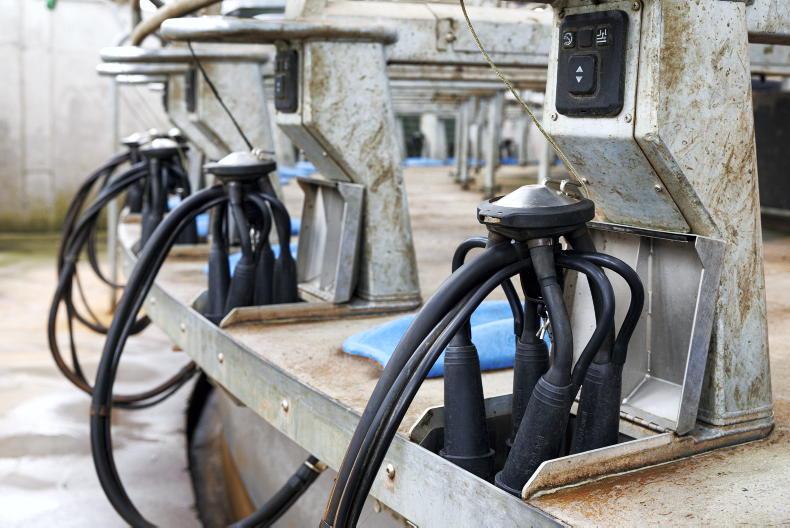
The level of milking efficiency achieved depends on cow flow and automation. For a one-person rotary parlour, automatic cluster removers (ACRs) are a necessity. The parlours Niall chose have a high specification level, with dump-lines, retention bars, robotic teat-spraying and milk meters.
Both parlours were purchased from Alan Sexton Ltd Delaval in Milford, Co Cork, and included auto ID, Alfco backing gates and drafting, and Inspect 4 fixed hoof trimming crates. Solar PV systems were also installed to reduce energy requirements, with 112 panels and 40 kVA batteries.
Project costs
In terms of everything required in the yard, excluding the existing milk tank, power supply which was already nearby, and the solar systems, the total cost per rotary was €950,000. The cost doesn’t include Niall’s own time spent managing the construction of the rotaries full-time over two years leading up to and during the project.
There was also a lot of work done by Niall and the farm team to get the project over the line in the 12-month period. Stephen O’Sullivan looks after all the maintenance and machinery work on the farm, and he took on a lot of extra fabrication and digger work as well, which is not in the build costs.
Transition
“In terms of the transition from herringbone to rotary parlours, the first milkings were very difficult and you need lots of help around the yard to funnel cows in at the beginning. After a week of training, the animals adapted quickly and flowed in thereafter. The backing gate was essential during the transition,” Niall said.
In terms of preparing for a job like this, Niall advises that planning is crucial so look at lots of examples. Niall believes that, given the number of rotary parlours being constructed in Ireland, there is a role for someone to project-manage the construction of rotary parlours, working with owners and contractors to get the project delivered on time and on budget.
Outcome
Niall is very happy with the outcome of the project. “The technology has worked well and the new parlours have significantly reduced milking time, improved cow flow and created more time during the day to get other jobs done on the farms” he said. Milk quality in terms of TBC, SCC and Thermoduric bacteria levels are very good and have all improved since putting in the new parlours.
“The rotary has made milking routines much more uniform, allowing for a stress-free milking experience, and for the farm team to focus on the essential procedures in a safe environment, and without having to waste time walking from cow to cow.”
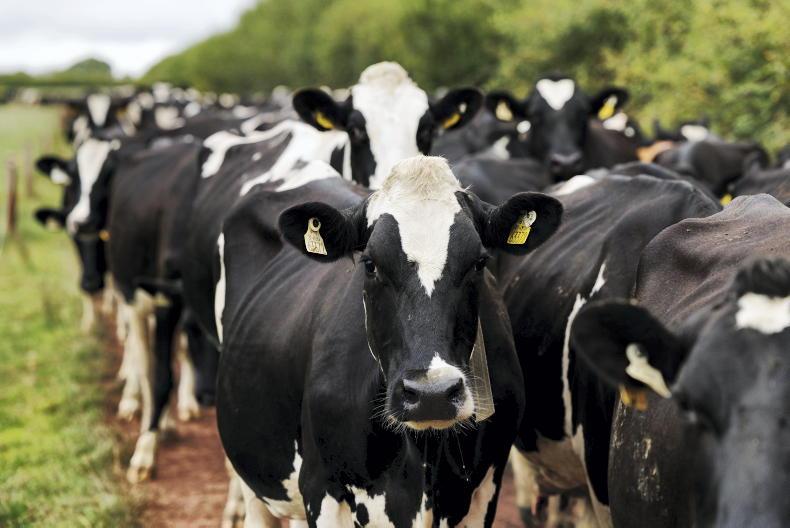
While Niall and the team have not seen an improvement in animal performance (which was already at 500kg milk solids per cow), the length of time cows spend standing in the collecting yards has reduced from six hours to three hours per day.
Milking the 500 cows takes two hours in the morning and one and a half hours in the afternoon, instead of six hours per day beforehand.
Niall also believes that the herds are more content and cow flow into and out of the yards is also very good.
“Ultimately, this project was about future-proofing dairying on the farms, making it more streamlined and labour-efficient, and creating very attractive places for sharemilkers to come and work with us into the future.”
Rotary parlours - what does the research show?
A recent Irish study completed by Ryan Prendergast at Teagasc has confirmed the benefit of rotary milking parlours for milking efficiency.
Ryan compared 20-unit herringbone and 50-bail rotary farms with 180 and 425 cows, respectively.
The average milking efficiency was 94 cows per hour and 73 cows per hour, per operator for herringbone farms, compared to 170 cows per hour and 132 cows per hour, per operator for rotary farms.
A more recent study has also observed improved energy use efficiency for rotaries compared to herringbone parlours.



SHARING OPTIONS