


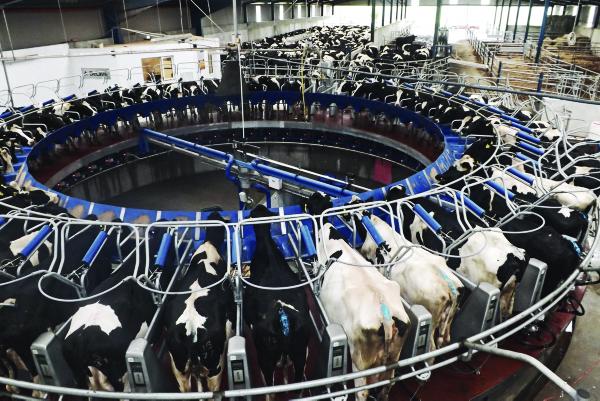
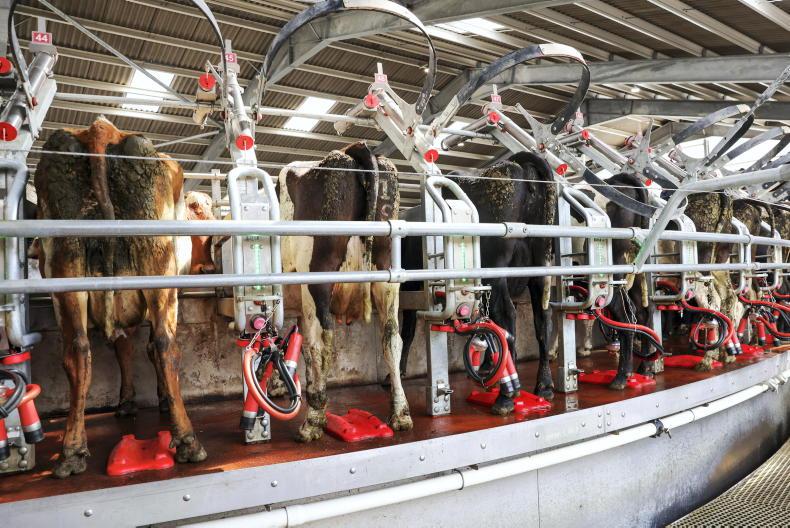
When I asked why they went rotary, Peter said: “This investment is long-term for the next 20 to 30 years and we are not getting any younger. It was either a rotary or a 30-unit herringbone.
“With the 30-unit herringbone and 300 cows, you have 10 rows of cows. We are both very hands-on and wanted a situation where we could all work comfortably. My biggest issue was trusting the technology and the rotary machine to do the job but I’m delighted I did and I wouldn’t take a present of another parlour now.”
The Keanes were milking in a 14-unit herringbone so they were up to 22 rows before they switched into the new 50-point rotary earlier this year.
The new development took over 18 months to complete as Peter did a lot of the work and project management himself. He also installed a 250-feet feeding passage and slatted tank adjacent to the new parlour and the covered collecting area.
I met Peter up in Northern Ireland last year when he was visiting another parlour to learn, look and see, and Peter told me he visited lots more parlours in Ireland, Northern Ireland and Britain before committing to a rotary parlour.
He said: “I’ve seen lots of different breeds of rotary parlours and, in fairness, they all seem to work well. Local service was as big an issue for me as cost and specification in my decision to go with this parlour.
“Traditionally, rotaries have a chequered history but with new technology and self-lubricating wheels, etc, they seem to have come on a lot.”
On the rotary, the cows have access to a feed trough in front but Peter said he has seen cows on rotaries with and without feeders and cows are equally content.
Pride of place
“Any rotary I have seen, I think cows are very content as they have their own little cubicle so to speak and there is no bullying for space,” he said.
The Keanes covered the collecting yard, the rotary, the exit and installed new calving pens. They also built a tunnel under the rotary into the centre of the rotary so a new shed covering 11 spans takes pride of place in the farmyard.
Working with Peter on the construction was local building contractor Bernard Tobin. “He did all the concrete work. The attention to detail was incredible. Two other local lads, Bernard Horan and Raphael Tobin, did all the roof and steel work,” said Peter.
When we talked about milking, Peter said that one person would milk away on their own at this time of the year but in spring, during calving and breeding, there are always two in the parlour.
One person has to get cows and then there are always jobs to do like treating fresh calvers or tail painting during breeding season, etc.
There is no dump line on this rotary so a bucket is attached for any cow that needs to be kept from the bulk tank.
Some people say individual cows don’t get enough attention on a rotary but Peter said: “I thought the same myself – you might only get a fleeting glance at the cows as they went around but if we want more time with an individual cow, we simply press a button and keep the retention bar down behind the cow and she passes around on the turntable a second time.”
Affordable
I asked Peter how many cows were going around a second time and he said less than 2% of cows, either because they are slow milkers or are not finished milking due to large volumes of milk. He said in the spring there would be more cows going around a second time.
I asked Peter has the rotary become more affordable?
He said: “I know of a few new installations locally at the planning stage and some are looking at 30-unit herringbones with either sequential baling or rapid exit and these jobs are up over €200,000 with individual feeders, etc, so I reckon for not too much more you could have a rotary.
“Once a farmer is happy with the running gear and that it will last and you trust the equipment he will get along fine.
“Not everyone will cover the collecting area, the drafting unit, etc, so there is a lot of additional concrete work and roof area in our yard that cost nearly as much as the rotary itself.
“We used almost 900 metres of concrete and the expensive part of this is the time in preparing and pouring, etc. We felt we had no option but to cover the collecting area because otherwise the volume of water collected would be phenomenal.”
Peter has no backing gate or yard scraper installed yet in the collecting yard. The yard is scraped with a tractor but the cows are standing on a slatted tank just before they get on the rotary.
George Moore, De Laval area sales manager, suggested the recommended retail cost today of just the milking equipment and turntable similar to Peter’s is around €6,500 per point or €325,000 for the 50-point rotary.
How long is milking taking at the moment? Peter said: “On Sunday, myself and Margaret went out after the hurling around 5.20pm and we were back inside for 10 past seven, so one hour and 50 minutes to go get the cows, milk and wash down.”
The herd is averaging about 21 litres at 3.33% protein and 3.80% fat (1.54kg MS) on 2kg of a 16% dairy nut and grazed grass.
The farm didn’t burn up too much during the drought so Peter didn’t have to feed any forage supplement for the last number of weeks.
Farm Summary
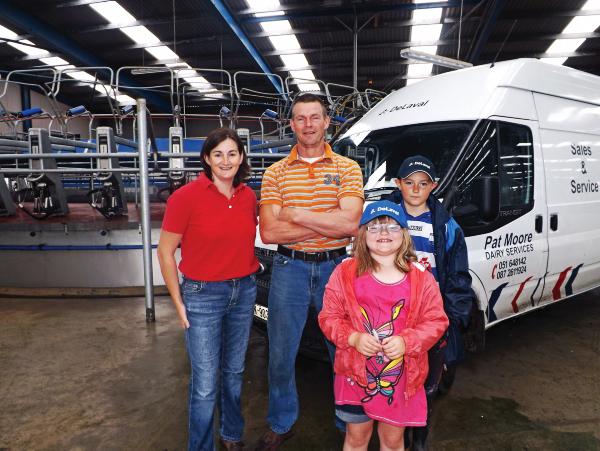
Peter and Margaret Keane are milking 300 cows near Carrick-on-Suir on the Tipperary/Waterford border with their four children Maeve (16), Emily (13), Peter (11) and Grace (7). They have recently installed a new 50-point rotary. They have 250 acres around the parlour and another 150 rented within a couple of miles of the farm. Peter purchased his first three pedigree cows in 1984 and began to build up the dairy herd on the home farm near Ahane, Castleconnell, Co Limerick. However, the new motorway cut the farm into four sections so Peter and Margaret purchased a new farm less than two miles from Carrick-on-Suir in 2003. The herd was build up to around 300 cows over recent years. Margaret is originally from Ardmore in west Waterford. She was Peter’s local vet in Limerick and worked for the Mulcair veterinary practice for seven years and with the Department of Agriculture for two years. Peter and Margaret have one full-time employee and David McNamara has been their herdsman for the past four years.
Auto cow ID.
ACR (auto cluster removal) system.
Milk recording.
MP 580 Alpro herd management system.
Harmony lightweight clusters.
DeLaval in parlour feeders and retention bars.
Drafting gates.
The whole building including calving facilities, drafting and holding pens is 220 x 104 feet and spans 11 bays.
Hygenius C200 auto plant washer.
24,000 litres DeLaval DXCEM bulk tank with a heat recovery system.
The parlour equipment includes two variable speed pumps, three-phase electricity and a back-up diesel generator (50 KVA).
Pat Moore is their local DeLaval dealer and George Moore is the DeLaval district sales manager (southeast).



SHARING OPTIONS