



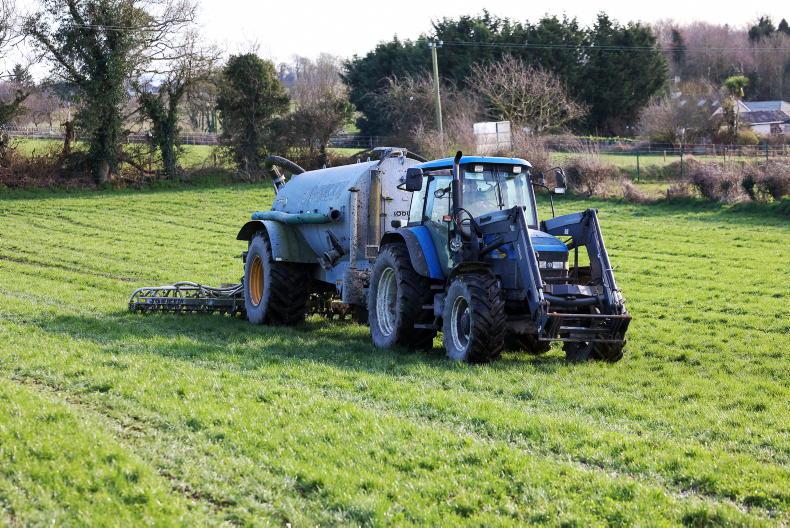
A two-year study from Teagasc published last year showed what many of us already knew; slurry storage on farms was lacking.
It showed the previous figures of 0.21m³/cow/week of soiled water storage and 0.33m³/cow/week of slurry storage (for dairy cows) was falling behind the actual requirements for an 18-week winter by approximately 30% and 20% respectively.
The study was commissioned by the Department of Agriculture, and as a result of the findings, soiled water storage and slurry storage minimum levels have been raised, with farmers having until October 2028 to secure sufficient storage.
As of 1 December 2025, all milk producers, irrespective of their system of production (spring or winter), must have had a minimum of 31 days soiled water storage on their farms.
This requirement is to coincide with the current prohibited application of soiled water on lands from 1 December to 31 December.
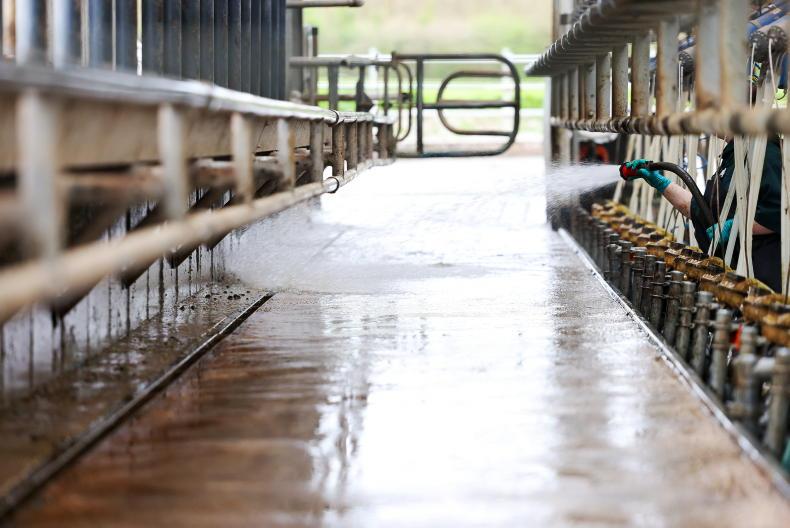
Soiled water is defined under the Good Agricultural Practice for the Protection of Water regulations as water from concreted areas, hard standing areas, holding areas for livestock and other farmyard areas where such water is contaminated by contact with any of the following substances:
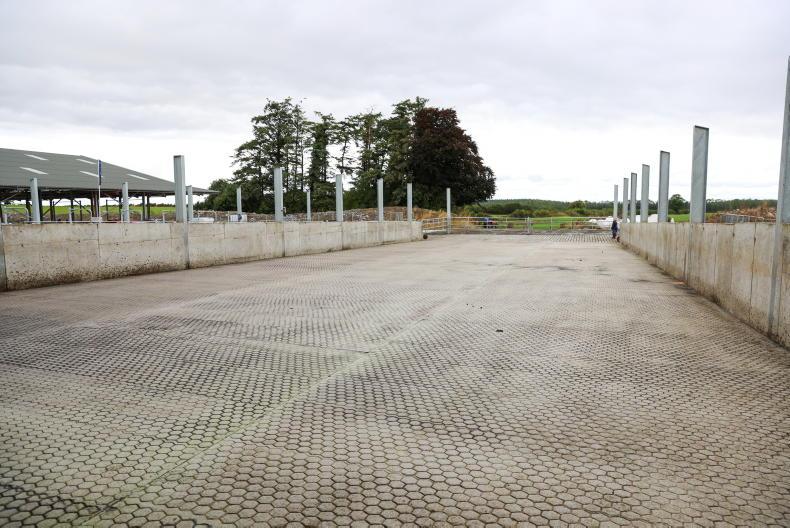
What’s soiled water and what’s slurry?
Under the regulations, soiled water does not include any liquid that has either:
Soiled water which is stored together with slurry, irrespective of the storage facility, is deemed to be slurry. All efforts should be taken to minimise the volume of soiled water produced.
All clean water in the farmyard must be diverted to a clean water outfall and prevented from entering storage facilities. This means that all roof gutters and downpipes must be in place and fully functional to prevent clean water mixing with yard pollutants.
The regulations also state that there shall be no direct runoff of soiled water from farm roadways to watercourses. With regard to general storage for soiled water and effluent, the Department have published a conditionality handbook which advises that “for soiled water storage facilities constructed before 1 January 2015, the required storage capacity for soiled water should equal or exceed the capacity required to store all soiled water likely to arise on the holding during a period of 10 days, or for a period of 15 days in the case of soiled water storage facilities constructed after the 1 January 2015”.
How much soiled water does dairy produce?
The current Department regulations point to a recommended figure of 30 litre/cow/day, which translates to 210 litres or 0.21m³/cow/week.
The below example is to be used as a guidance note and aid but is not a legal interpretation of the rules, even though it was published by the Department. By following the steps for each individual month farmers will be able to determine any potential shortfall in soiled water storage on farm.
Step 1: determine the cow numbers
Identify the maximum number of cows milked on any day during the relevant 15-day period. This figure is used for the full calculation to represent peak soiled water production
Example: 100 cows.
Step 2: calculate the soiled water produced over 15 days
Multiply the maximum number of cows by the standard soiled water production rate per cow and by 15 days.
((No. of cows from step 1 above x 0.3m³ per week) ÷ 7 days) x 15 days
Example: ((100 cows x 0.3m³ per week) ÷ 7 days) x 15 days.
Step 3: assess the available storage capacity (days)
To determine how many days’ soiled water production the tank can hold at peak cow number, compare the calculated 15-day volume with the usable capacity of the dedicated soiled water tank.
Capacity (m³) of the tank ÷ (volume of soiled water produced over 15 days from step 2 above ÷ 15 days).
For example: 50 ÷ (64.29 ÷ 15)= 11.7 days.
If this figure is at least 15 days there is sufficient soiled water storage capacity in the standalone tank that month, and there is no need for further calculations for the month in question.
Step 4: determine the management capacity during the month
As soiled water is stored in a dedicated tank and may be land spread, calculate how many full storage and spreading cycles are possible within the month, and the total volume of soiled water that can be managed through the tank over that period. Remember, land spreading is not applicable for the month of December.
i. Total volume of dairy soiled water produced in the month:
No. of cows x (0.3m³ ÷ 7 days) x total days in the month.
For example: ((100 cows x 0.3) ÷ 7 days) x 31 days in December = 132.86m³.
ii. Total volume of soiled water that can be managed through the tank over that period:
(No. of cows x 0.3m3) ÷ 7 days) x step 3 x no. of 15-day cycles in the month.
For example: ((100 x 0.3) ÷ 7 x 11.7) x 2.07 = 103.79m³.
Step 5: determine the soiled water tank storage deficit per month
To determine if and what the storage water deficit for the month based on volumes produced, subtract soiled water production (Step 4i) from that can be managed through the standalone tank (Step 4ii).
For example: 132.86m³ produced - 103.79m³ volume managed = 29.07m³.
Step 6: determine the total soiled water tank storage deficit
Follow steps 1 to 5 for each month, applying December’s criteria accordingly.
Sum the volume obtained in step five across the months of October, November, December and January to calculate the total soiled water tank deficit and volume of soiled water that requires alternative storage. Soiled water stored with slurry must comply with rules regarding the management of slurry.
In the steps and examples provided, a soiled water production figure of 0.3m³/cow/week production, effective from the 01/10/2028, is assumed.
This can be adjusted to 0.21m3/cow/week production for calculations prior to this date.
In the short-term the 15 days minimum requirement must be adjusted to 10 days where the soiled water tank was constructed before 01/01/2015.
However, a 10-day storage requirement will no longer be eligible from 01/10/2028, and in all cases, the calculation period must be increased to 15 days (for October, November and January) after this date.





SHARING OPTIONS