


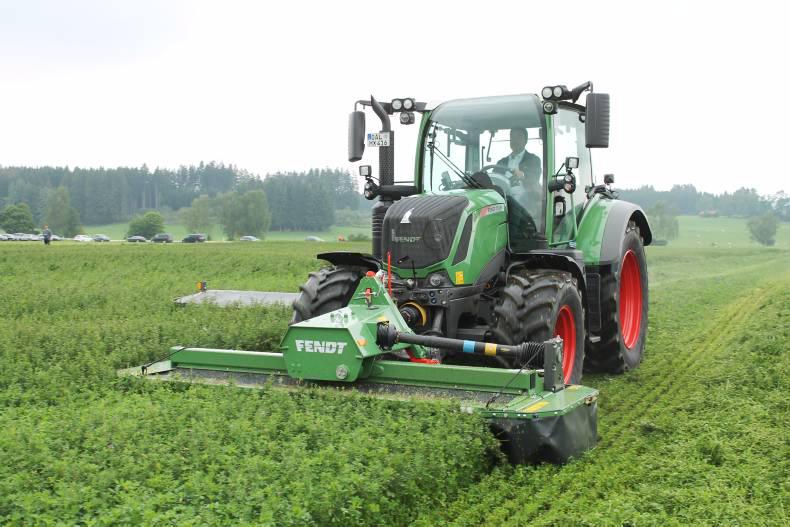

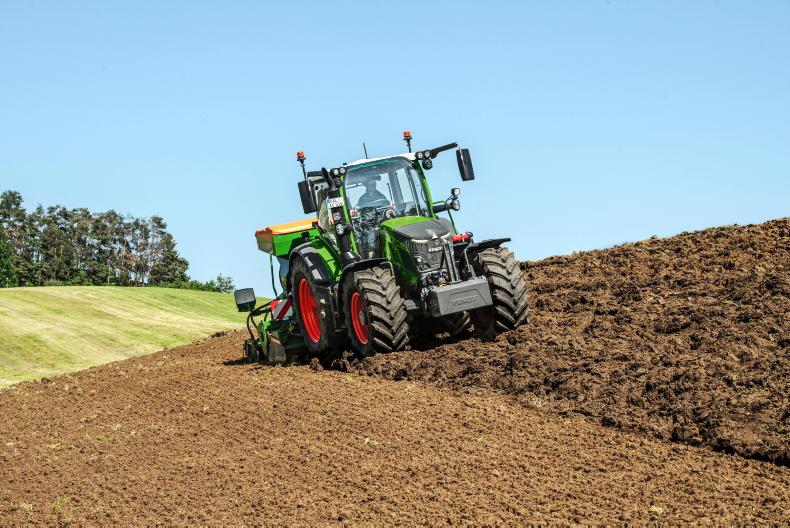
Last summer, German firm Fendt unveiled its replacement for the long-serving Fendt 300 series tractors. The Fendt 300 series is a very popular range, with farmers being the biggest customer for this compact series. It is Fendt’s second-best selling series after the 700 range.
The Fendt 300 series was originally introduced back in 1981. Imported into Ireland by Bill Doherty and Mahon & McPhilips, the 300 series proved to be relatively popular here despite its premium pricing.
It featured an engine from fellow German manufacturer MWM and novel features such as Turbomatic clutch. The clutch was in fact a fluid-flywheel, a sort of torque converter. This allowed for very soft take-off from standstill and in general provided a very smooth drive.
The Fendt 300 series became part of the Vario-family in 2006 when its mechanical transmission was replaced with a Vario unit to suit its size.
At that time, Fendt had been using Deutz engines in the majority of its tractors for many years, and this largely remains the case. The new 300 series does now buck the Deutz engine trend. When it was launched last summer, under the hood was an engine sourced in-house from Finnish sister firm AGCO-Power, formerly Sisu.
The new 300 brings not just an engine change. It is completely new, with the latest family styling and new Visio cab with curved front windscreen. Inside the cab, the 300 is now available with a multi-function joystick and electric spool valves/control.
In total, there are four models in the new Fendt 300 series. The 310, 311, 312 and 313, with respective horse-powers of 110hp, 119hp, 129hp and 138hp. All are powered by a 4.4-litre, four-cylinder AGCO Power engine with common rail, high-pressure injection system and electrically controlled waste-gate turbocharger.
The new series meets EU Stage 4/Tier 4 Final emissions standards, achieving this through a diesel oxidation catalyst (DOC), external exhaust gas recirculation and SCR exhaust after-treatment. The DOC is positioned directly after the turbo and is not part of the SCR unit.
AGCO claims that the new all-round tractor series is extremely fuel-efficient, with a low rated speed of 2,100rpm. Fendt says this efficiency is aided by a new air intake system with a new high-capacity air filter and large cooler unit. More fuel savings and noise reduction are achieved through a reduced cooling fan ratio, according to the firm. Diesel tank capacity and AdBlue tank capacity are 210 litres and 22 litres respectively.
The new engine sits into a new waisted half-sub frame. This also accommodates integrated front linkage (and pto) if specified plus the new front axle with suspension (Profi). A new bonnet design to match the frame allows for chunky front tyres to be fitted without compromising on manoeuvrability.
Wheelbase is longer than the series it replaces but AGCO says the new series is lighter.
Cab
Fendt’s new 300 series is available in two specification levels – Power and Profi. Both feature the firm’s Visio Plus cab which Fendt says offers a 77° field of vision and 6.2m2 of glazing. That basically translates into excellent visibility. The cab has an actual volume of 2,520 litres, which the firm describes as providing “an overwhelming sense of space”. And yes, it is very roomy.
The unique windscreen, which extends upwards curving into the roof, no doubt provides excellent visibility for loader work or visibility at height. For nighttime use, two “cross-eyed” work lights, as Fendt calls them, have been installed on the roof corner with their beams crossing over each other to maximise the width of illumination.
More work lights are optionally available at the front, rear and on the mudguards. These are also available as LED work lights.
In the comfort stakes, the steering wheel height and angle is adjustable, while cab suspension is also available as an option. Mechanical suspension is the option for the Power version and pneumatic suspension for the Profi version.
Comfort
The driver seat is available in different levels of comfort while a new ventilation and climate control concept should provide all that is necessary for the time of year. The system has automatic defrosting, designed to clear the windows fast.
Perhaps the biggest difference between Power and Profi versions is the tractor’s main controls on and around the armrest. Power versions feature mechanical spool valve control and Power Joystick. The latter controls the Vario transmission functions of speed and direction while also has buttons for rear linkage, pto and engine cruise modes.
Profi versions get Fendt’s more familiar Multi-Function joystick and the smaller 7-A Vario terminal. This is not a touchscreen terminal. Instead it uses the keypad and knob to dial into and set the various functions such as setting up sequences for headland management and cruise control.
The firm’s TMS, or Tractor Management System, manages the relationship between the engine, its speed and the transmission, always keeping the tractor driving at an economic optimum, according to the firm.
“In combination with the new engine, a lower operating temperature and a low engine speed at 40km/h, the 300 Vario is very fuel-efficient when driving on the road,” states Fendt.
Standard hydraulic pump on lower-spec Fendt 300 Vario Power versions is a fixed capacity, 83 litres/min tandem pump. Optionally available is a variable displacement, 110 litre/min axial piston pump which is standard on Profi variants.
With the front three-point linkage fully integrated, the half-frame allows for the fitting of Fendt’s own loader without extra side rails. AGCO says this makes the 300 Vario extremely manoeuvrable in that the adding of a loader does not hinder wheel lock and manoeuvrability.
The pivot point of the Fendt Cargo front loader 4X75C is located further back, so it is now attached closer to the middle of the vehicle, which the firm says means more stable driving and a lower load on the rear axle.
The CargoProfi front loader can be operated using the Variotronic operating interface in the Varioterminal of the 300 Vario Profi. Operators can limit the working height and the tilt angle.
The CargoProfi offers an integrated weighing function, weighing per pushbutton and a memo and shake function. For enhanced comfort and to minimise trickle losses, the front loader has end position and speed-dependent damping.
Loader work
The front lower links don’t need to be removed when doing loader work. They just fold in out of the way. Front linkage capacity is in excess of 3t, says Fendt. Optionally available on Profi versions with front linkage is load relief control, which can be set in the Vario terminal. This allows the double-acting rams that operate the front linkage to follow ground-contours when mowers or other ground contacting equipment is mounted up front.
Reducing noise levels from the front pto unit and potentially increasing longevity, Fendt has opted for a new front pto with wet clutch. An external disconnect lever up front disconnects the drive between the crankshaft and front pto unit when not in use. The idea is to reduce noise and vampire loading, the latter affecting fuel consumption.
With a revised rear axle and 70mm longer wheelbase (2,420mm), tyres to 600/65 R 38 (tyre diameter 1,770mm) can be fitted on the rear.
Production started in June/July of this year and the old model was phased out. Fendt expects to be at full production by September and the new Fendt 300 will be at this year’s National Ploughing Championships.
Read more




SHARING OPTIONS