Early lambing flocks need to be mindful to a possible risk of Schmallenberg virus.
The caution comes on the back of significant issues in some early lambing flocks in 2025.
These issues included higher barren rates and the birth of lambs with congenital deformities or malformations.
A high percentage of reports were in the northern half of the country. The first warnings of the problems were seen as far back as breeding and manifested in fertility issues in rams according to John McGee, Ram Testing Ireland.
John reports that Schmallenberg virus was not initially identified as a cause as it has been a few years since there were spikes in prevalence.
He says that the issues were first seen in rams testing with low fertility, followed by a higher barren rate in ewes –which hit sporadically – and then again by sporadic birth defects in lambs. There was no official spike in cases recorded as many flocks knew what the issues were with word spreading quickly.
Virus recap
The virus is spread from animal to animal by biting midges. Cattle, sheep and goats are all susceptible to the disease. The high-risk period for spread of the disease is during the vector season (midges active), which is normally April to November in Ireland.
The most susceptible time for infected animals to pass the virus through to a foetus is during month two and into month three of gestation in sheep, while in cattle it is months three and four (also possibly month five).
This means that early lambing flocks are typically most at risk. The risk will also be influenced by midge activity in the area which is also largely influenced by climatic conditions. Animals which are infected develop a natural immunity which is thought to be long-lasting.
Management practices
John says that with the virus in the environment, it is possible that there could be occasional problems again this season. There is no vaccine available in Ireland for the virus and no management practices that can be taken to guard against it, with the exception of pushing lambing dates back which may reduce the risk, but this is not a runner in early lambing flocks.
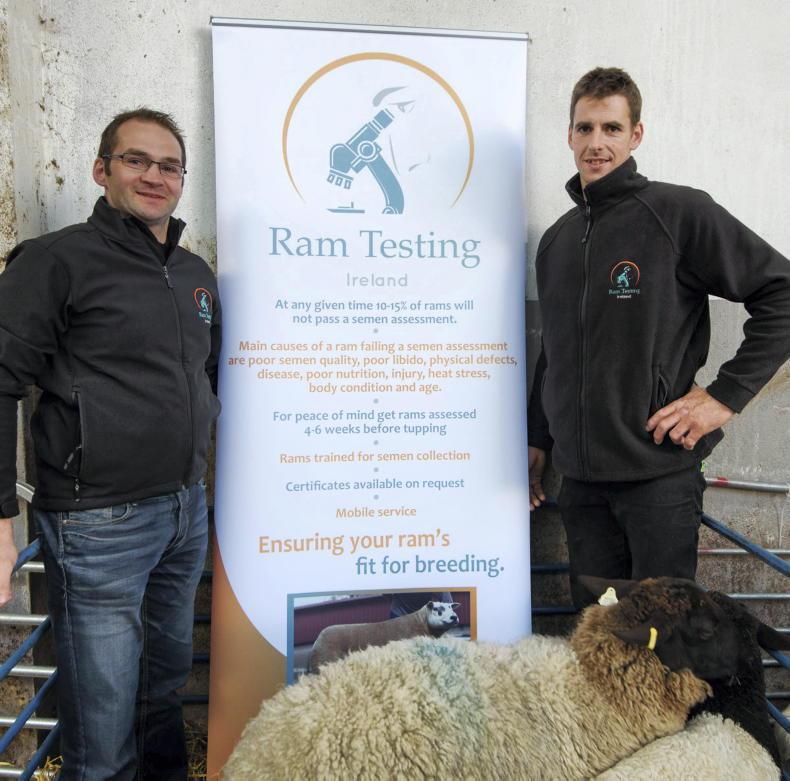
John McGee, left, from Ram Test Ireland withwell-known shearer, Ivan Scott laun. \ Clive Wasson
One practice which can be taken to reduce possible implications is to have back-up rams available if sponging ewes or carrying out AI and to monitor repeat activity. Scanning early lambing ewes in good time can also provide an opportunity for empty ewes to be mated to lamb mid-season.
Ram management
John adds that it is good practice, where rams are being used in a synchronised breeding programme, to take steps to ensure rams are producing optimum quality semen. Allowing rams to mate with a couple of synchronised cull ewes, for example in advance of breeding, will help to flush out any lower-quality semen. This should be done a few weeks in advance of when rams are required.
The peak temperatures experienced over the weekend could have resulted in fertility issues where a ram’s body temperature exceeded 40°C. Carrying out a fertility test in advance of breeding may be warranted where rams are required in the next six to eight weeks.
It is also worth noting that this may be the reason for rams recording poor-quality semen in a test and to carry out repeat tests before condemning a ram.
Purchasing early
Purchasing rams early and affording rams the maximum opportunity to acclimatise to their new environment before breeding is also preferential. John advises that the most critical period with a newly purchased ram is the first 10 days post-purchase.
“The greatest challenge is where a ram is experiencing a massive change in diet and energy intake. The aim is to keep the rumen active during this period and this includes continuing to offer a level of concentrate.
“Beet pulp works well as it is a good source of energy and is a balanced fibre source that is not packed with protein. A sudden change from an intensive diet to a ram being turned out to a grass paddock, or worse still, straight to ewes, is often the reason we end up with so many fertility issues in newly purchased ram lambs,” he says.
John also highlights the importance of mineral supplementation. He says the most important aspect is to purchase early, and ideally at least six to seven weeks before the breeding season begins. This will also allow rams to lose excessive weight and transition into a more suitable physique for breeding.
In terms of selecting rams for optimum sperm production, he says that a visual measurement that can be used to assess breeding soundness is a scrotal circumference measurement.
“The size of a ram’s testes is directly linked to sperm production. Taking a measuring tape or using a piece of string or cord as an aid, measure the circumference of the testes at the widest part. The reading should be a minimum of 30cm with a general range of 30cm to 36cm,” he says.
Early lambing flocks need to be mindful to a possible risk of Schmallenberg virus.
The caution comes on the back of significant issues in some early lambing flocks in 2025.
These issues included higher barren rates and the birth of lambs with congenital deformities or malformations.
A high percentage of reports were in the northern half of the country. The first warnings of the problems were seen as far back as breeding and manifested in fertility issues in rams according to John McGee, Ram Testing Ireland.
John reports that Schmallenberg virus was not initially identified as a cause as it has been a few years since there were spikes in prevalence.
He says that the issues were first seen in rams testing with low fertility, followed by a higher barren rate in ewes –which hit sporadically – and then again by sporadic birth defects in lambs. There was no official spike in cases recorded as many flocks knew what the issues were with word spreading quickly.
Virus recap
The virus is spread from animal to animal by biting midges. Cattle, sheep and goats are all susceptible to the disease. The high-risk period for spread of the disease is during the vector season (midges active), which is normally April to November in Ireland.
The most susceptible time for infected animals to pass the virus through to a foetus is during month two and into month three of gestation in sheep, while in cattle it is months three and four (also possibly month five).
This means that early lambing flocks are typically most at risk. The risk will also be influenced by midge activity in the area which is also largely influenced by climatic conditions. Animals which are infected develop a natural immunity which is thought to be long-lasting.
Management practices
John says that with the virus in the environment, it is possible that there could be occasional problems again this season. There is no vaccine available in Ireland for the virus and no management practices that can be taken to guard against it, with the exception of pushing lambing dates back which may reduce the risk, but this is not a runner in early lambing flocks.

John McGee, left, from Ram Test Ireland withwell-known shearer, Ivan Scott laun. \ Clive Wasson
One practice which can be taken to reduce possible implications is to have back-up rams available if sponging ewes or carrying out AI and to monitor repeat activity. Scanning early lambing ewes in good time can also provide an opportunity for empty ewes to be mated to lamb mid-season.
Ram management
John adds that it is good practice, where rams are being used in a synchronised breeding programme, to take steps to ensure rams are producing optimum quality semen. Allowing rams to mate with a couple of synchronised cull ewes, for example in advance of breeding, will help to flush out any lower-quality semen. This should be done a few weeks in advance of when rams are required.
The peak temperatures experienced over the weekend could have resulted in fertility issues where a ram’s body temperature exceeded 40°C. Carrying out a fertility test in advance of breeding may be warranted where rams are required in the next six to eight weeks.
It is also worth noting that this may be the reason for rams recording poor-quality semen in a test and to carry out repeat tests before condemning a ram.
Purchasing early
Purchasing rams early and affording rams the maximum opportunity to acclimatise to their new environment before breeding is also preferential. John advises that the most critical period with a newly purchased ram is the first 10 days post-purchase.
“The greatest challenge is where a ram is experiencing a massive change in diet and energy intake. The aim is to keep the rumen active during this period and this includes continuing to offer a level of concentrate.
“Beet pulp works well as it is a good source of energy and is a balanced fibre source that is not packed with protein. A sudden change from an intensive diet to a ram being turned out to a grass paddock, or worse still, straight to ewes, is often the reason we end up with so many fertility issues in newly purchased ram lambs,” he says.
John also highlights the importance of mineral supplementation. He says the most important aspect is to purchase early, and ideally at least six to seven weeks before the breeding season begins. This will also allow rams to lose excessive weight and transition into a more suitable physique for breeding.
In terms of selecting rams for optimum sperm production, he says that a visual measurement that can be used to assess breeding soundness is a scrotal circumference measurement.
“The size of a ram’s testes is directly linked to sperm production. Taking a measuring tape or using a piece of string or cord as an aid, measure the circumference of the testes at the widest part. The reading should be a minimum of 30cm with a general range of 30cm to 36cm,” he says.
SHARING OPTIONS