



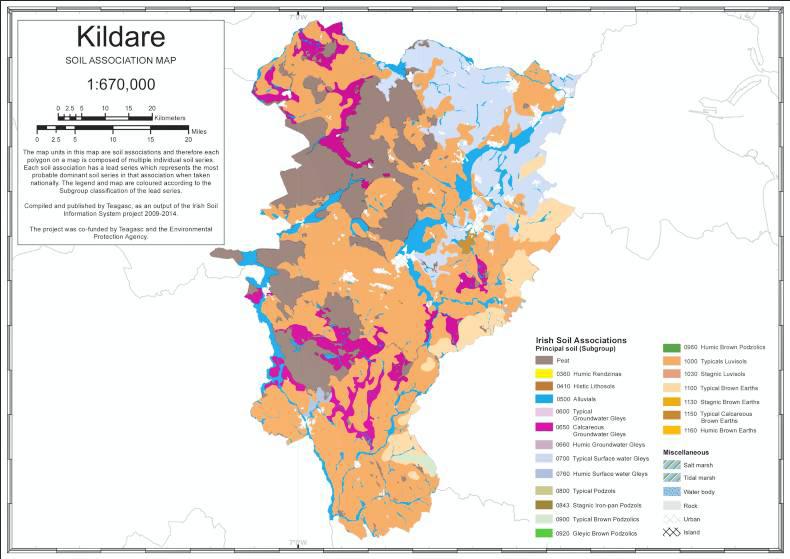
Co Kildare is home to the Pollardstown fen series (wetland), which is the largest remaining calcareous spring-fed fen in Ireland. Located to the west of Newbridge, this was declared a national nature reserve in 1986. Historically, fens have been drained for agriculture. However, this fen is internationally recognised as an important fen ecosystem, providing a home for unique and endangered plant communities.
Fens are distinct from bogs as they have a high pH, resulting here due to the calcium-rich springs, fed in from the Curragh. The Curragh is part of the central plain of Ireland and is a fertile plain of central lowlands that extends through most of the county. Thus, as an inland county, Kildare is largely considered a lowland landscape broken with some hills, such as the Hill of Allen.
Limestone glacial till
In general, Kildare is mostly comprised of limestone glacial till, but is found associated with different soil types across the county. In the south, around Athy and stretching north towards Kildare and Naas, this landscape is characterised predominantly by luvisols (movement of clay down the soil profile).
In the northeast, towards Straffan and Cellbridge, along with luvisols, the presence of surface-water gleys can be found. Surface-water gleys are found on heavy glacial till, which gives rise to a slowly permeable sub-surface layer and as a result, are poorly drained, making them difficult to work with. Towards the west, the lowland limestone glacial till landscape still exists, but is found with basin peat. Here, luvisols are commonly found associated with gleys and basin peat in the lower lying areas. The Bog of Allen extends into Kildare and the majority of bogland resources can be found in the northwest and southwest of the county, some of which is used for industrial extraction.
Overall, luvisols are the most commonly found soil in Kildare. These are soils where clay has moved from the topsoil and been deposited further down the soil profile. These are good agricultural soils due to the higher clay content, along with their good nutrient-retention capacity. However, the higher clay content can result in the slow movement of water through the soil profile, meaning that they can be moderately to poorly draining, depending on soil texture. These are found throughout the county, but are dominant from Castledermot north to Kildare and Naas, the majority of which are the ‘Elton’ series (found in association 1000a led by subgroup 1000).
After luvisols, surface-water gleys are the second most prevalent soil type, the majority of which are the ‘Straffan’ series (found in association 0700d led by subgroup 0700). Unsurprisingly, these are readily found in the northeast of the county, particularly around Straffan, where this soil series was originally identified in the national soil survey by An Foras Talúntais in 1970. Surface-water gleys are poorly drained and as a result they can be difficult to work with.




SHARING OPTIONS