Aptly known as the Garden of Ireland, Co Wicklow boasts some remarkable historical and geographical features on its landscape. Probably most remarkable are the famed Wicklow Mountains that stretch from south Co Dublin to Co Wexford.
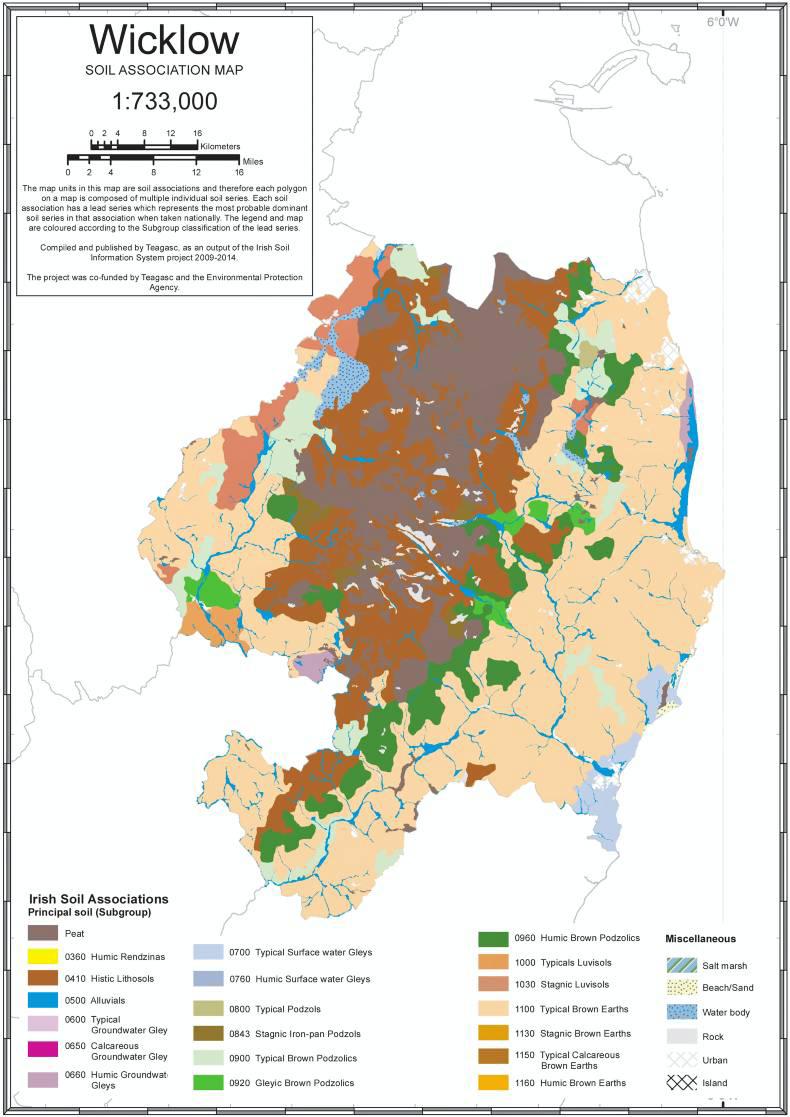
While the majority of Ireland has limestone bedrock, the parent materials of these mountains include granite, gneiss and schist, accompanied by glacial drift derived from these rock types. The soils here are typical of mountainous areas, with upland peat and some deep blanket bogs associated with the cold wet conditions, lithosols (shallow soils) found on the steep exposed slopes and podzols (acidic nutrient poor soils) are all found at the highest altitudes.
Moving downslope, brown podzolics (slightly acidic) are more prevalent and these graduate to brown earths (free-draining) further downslope. To the west of the mountains, as the landscape becomes less mountainous, it reflects a more undulating hilly appearance. These hills are comprised of shale and slate bedrock and the soils in this area include brown earths over bedrock, luvisols (downward clay movement) on slopes and some groundwater gleys (perched water tables) found in depressions. To the east of the Wicklow Mountains, the landscape is also undulating hills comprised of shale and slate with a mix of shale-derived glacial drift.
Outside of primary productivity, Wicklow represents an important home for several soil functions. The preservation of heritage is an important soil function and Glendalough (the valley of two lakes) is an important landmark in this regard. Set up by St Kevin in the 6th century, Glendalough represents one of Ireland’s most visited monastic settlements.
Moreover, it is situated in the Wicklow Mountains National Park, which is approximately 20,000ha in size. Due to the unique geology and landscape found here, much of this area is designated as a special area of conservation (SAC) – indicative of another vital soil function, biodiversity. The provision of raw materials, another soil function, can also be found here. Historically, mining for lead and zinc ores was carried out here, but this was discontinued in the 1950s.
In general, peat soils dominate the upland mountainous areas. Outside of these, brown earth soils dominate the Wicklow landscape and are widely found in the areas that are not at high altitude, especially stretching from the border of Co Dublin in the north down to Carnew in the south of the county.
The majority of brown earths found in Wicklow are the ‘Clonroche’ series (found in association 1100a led by subgroup 1100). These are well-drained soils and have a loam to clay loam texture. These soils have a wide use-range and are excellent for tillage and the production of a wide range of farm, fruit and vegetable crops. Their easy cultivation properties and their ability to respond well to nutrient amendments means that these are good agricultural soils. Given the topography of Wicklow, it is unsurprising that histic lithosols are also commonly found. These are shallow soils that commonly overlie hard rock on steep slopes that have a peaty surface horizon.
Aptly known as the Garden of Ireland, Co Wicklow boasts some remarkable historical and geographical features on its landscape. Probably most remarkable are the famed Wicklow Mountains that stretch from south Co Dublin to Co Wexford.
While the majority of Ireland has limestone bedrock, the parent materials of these mountains include granite, gneiss and schist, accompanied by glacial drift derived from these rock types. The soils here are typical of mountainous areas, with upland peat and some deep blanket bogs associated with the cold wet conditions, lithosols (shallow soils) found on the steep exposed slopes and podzols (acidic nutrient poor soils) are all found at the highest altitudes.
Moving downslope, brown podzolics (slightly acidic) are more prevalent and these graduate to brown earths (free-draining) further downslope. To the west of the mountains, as the landscape becomes less mountainous, it reflects a more undulating hilly appearance. These hills are comprised of shale and slate bedrock and the soils in this area include brown earths over bedrock, luvisols (downward clay movement) on slopes and some groundwater gleys (perched water tables) found in depressions. To the east of the Wicklow Mountains, the landscape is also undulating hills comprised of shale and slate with a mix of shale-derived glacial drift.
Outside of primary productivity, Wicklow represents an important home for several soil functions. The preservation of heritage is an important soil function and Glendalough (the valley of two lakes) is an important landmark in this regard. Set up by St Kevin in the 6th century, Glendalough represents one of Ireland’s most visited monastic settlements.
Moreover, it is situated in the Wicklow Mountains National Park, which is approximately 20,000ha in size. Due to the unique geology and landscape found here, much of this area is designated as a special area of conservation (SAC) – indicative of another vital soil function, biodiversity. The provision of raw materials, another soil function, can also be found here. Historically, mining for lead and zinc ores was carried out here, but this was discontinued in the 1950s.
In general, peat soils dominate the upland mountainous areas. Outside of these, brown earth soils dominate the Wicklow landscape and are widely found in the areas that are not at high altitude, especially stretching from the border of Co Dublin in the north down to Carnew in the south of the county.
The majority of brown earths found in Wicklow are the ‘Clonroche’ series (found in association 1100a led by subgroup 1100). These are well-drained soils and have a loam to clay loam texture. These soils have a wide use-range and are excellent for tillage and the production of a wide range of farm, fruit and vegetable crops. Their easy cultivation properties and their ability to respond well to nutrient amendments means that these are good agricultural soils. Given the topography of Wicklow, it is unsurprising that histic lithosols are also commonly found. These are shallow soils that commonly overlie hard rock on steep slopes that have a peaty surface horizon.






SHARING OPTIONS