



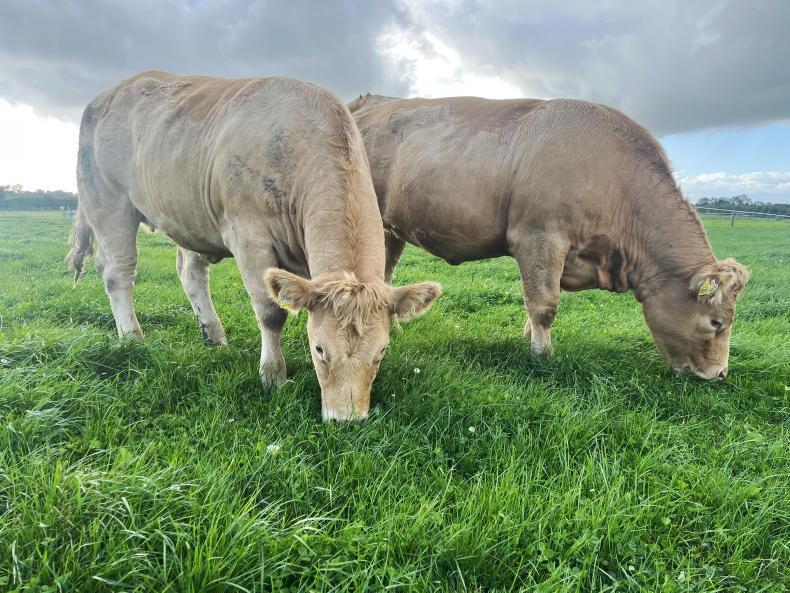
Incorporating red and white clover into suckler-to-beef production systems has the potential to increase net margin by €170/ha on a well-run farm, stocked at 170kg organic nitrogen per hectare, compared to a grass-only system. On a per cow-progeny unit it has the potential to increase net margin by €137 per production unit – that is the cow plus her calf and finishing animal.
The findings are part of the current objectives set for the Teagasc Grange Derrypatrick herd. The research taking place in the herd has two main objectives:
To evaluate the inclusion of red and white clover on beef animal and farm system performance.
To evaluate low finishing age systems (19 months of age).
These objectives are being evaluated across three production cycles with an update for the first two production cycles delivered by Peter Doyle, Teagasc research officer on a webinar last week. Walsh scholars Peter Bennett and Sarah Armstrong are also working closely with the herd.
Study metrics
The objectives are being evaluated across two pasture treatments. Approximately 32.3ha (82 acres) of the Derrypatrick herd farm area is a grass-only system, comprising high-performing perennial ryegrass swards allocated 150kg chemical nitrogen per hectare (120 units N/acre). The same area is farmed in a grass-clover system, with an allocation of 75kg chemical N/ha (60 units/acre).
Paddocks were randomly selected to rule out any bias on location within the farmlet. Approximately 15% of the grass-clover area is under red clover/grass for the production of silage for this system.
The farm is stocked to the maximum level of 170kg organic N/ha for a conventional system. The low finishing age objective is using two sire treatments – Aberdeen Angus and Charolais genetics.
Sire selection
Peter explained that sires were selected to try and best meet the objectives of early finishing. The maximum calving difficulty figure was less than 8% with sire selection matched with cow age and calving ability. The predicted transmitting ability (PTA) figure for carcase weight was set at five-star on a within breed basis, with a PTA also set at four- or five-star for age to slaughter on a within or across breed basis.
There was also a focus on the PTA for carcase fat with sires selected on one or two stars within or across breed. This trait is not regularly assessed by farmers when selecting sires. In contrast to other traits, where a four- or five-star figure is the target, for the carcase PTA a four- or five-star figure would be increased lean meat. Hence the objective in the study is for animals to lay down fat to be in a position to reach a minimum fat score of 2+ at slaughter off grass at 19 months of age.
Production system
The production system is identical across the two pasture treatments. Cows calve in a spring-calving system, with 40 cows randomly allocated to the two pasture treatments. Calves are weaned at approximately eight months of age and are housed on high feed value ad-lib silage and supplemented with 1.5kg concentrates over the first winter.
Early turnout of yearling cattle is targeted from late February/early March and progeny are finished off grass at 19 months of age, with no concentrates fed at grass pre-slaughter.
The performance of cattle across the first two production cycles are outlined in Figure 1 and Table 1. Progeny on the grass-clover treatment achieved a 0.08kg higher average daily liveweight gain of 1.26kg from birth to weaning, resulting in such animals being 14kg heavier at weaning. While on this stage of production it should be noted that cows grazing grass-clover swards were 16kg heavier than cows grazing the grass-only pasture treatment.
Animals grazing clover swards were 13kg heavier at housing. Red clover silage sustained higher performance over the first winter, with progeny achieving a 0.11kg higher DLWG figure of 0.72kg over the first winter.
Peter comments that the allocation of 1.5kg concentrate along with red clover silage was probably not warranted, with animals turned out to grass with a greater fat cover and weighing 25kg higher than their grass-silage counterparts. A total of 241kg concentrates was fed pre-weaning to the end of the first winter.
Compensatory growth
The yearling animals wintered on grass silage and 1.5kg concentrates achieved greater compensatory growth once turned out to grass in their second grazing season and this underpinned a 0.06kg higher DLWG figure of 0.94kg.
While the performance of grass-only cattle was higher, the strong start in life in the grass-clover treatment maintained a significant difference in performance of 15kg heavier (601kg) at slaughter at 19 months of age.
There was no significant difference in killout (53.4% v 53.7%), with grass-clover animals delivering a 10.4kg heavier carcase. Peter said that at a base price of €7.40/kg, this is worth over €80/head higher carcase value. There was no significant difference in carcase grade and fat cover in animals in the two pasture treatments.
Age at slaughter
Heifers and bullocks were finished on the same day at the end of the grazing season to allow for a fair comparison. All Angus heifers achieved a fat score of 2+ or greater. The average carcase weight was 301kg, with an average conformation score of R- and a fat score of 4-.
For the Charolais heifers 93% met the minimum fat score of 2+ or higher. The average carcase weight was 312kg, with an average conformation score of R= and fat score of 3-.
Angus-sired bullocks achieved a similar average carcase weight to Charolais bullocks, with the average Angus carcase weight of 335kg, just one kilo shy of the average Charolais carcase weight. Of the Angus bullocks, 98% achieved a fat score of 2+ or greater, with the average fat score at 3= and average conformation score of 3=.
The percentage of Charolais steers meeting minimum slaughter targets was significantly lower, with 78% of bullocks achieving a fat score of 2+. The average conformation score was R=, with the average fat score at 2+. This is not surprising, given the higher terminal base in Charolais genetics.
Doreen Corridan, CEO of the National Cattle Breeding Centre, commented that the finishing system is not exploiting the terminal genetics that the Charolais breed offers. As will be discussed later, the study metrics are being altered slightly in the future with the introduction of concentrates at grass. It is hoped that this can underpin all Charolais bullocks meeting the desired slaughter specification.
System profitability
Table 2 details the financial performance of the two systems. Gross output in the grass-clover system was €3,286, €111 per hectare lower than the grass-only system. The gross margin in the grass-clover system is €169/ha higher in the grass-clover system, stemming mainly from a lower spend on fertiliser. This gave rise to a higher net margin of €170/ha.
If this is based on a 66ha farm, as is the case in Derrypatrick herd, it would be worth in the region of €11,200 if the entire farm incorporated grass-clover. On a per cow unit, the return from incorporating clover into swards is €137/cow unit.
Comment: profit can still be made without clover
There were numerous questions on the webinar regarding the role of clover on heavier or marginal soils, or the challenges facing farmers in incorporating clover into their grassland. While there is a benefit in incorporating clover, the study shows that a good net margin of €1,000/ha can still be achieved from a well-run grass-based system operated at a high stocking rate and which does not readily lend itself to clover incorporation. This system can be replicated regardless of farm size.
As mentioned above, the study on reducing age of slaughter needs tweaking in terms of increasing the percentage of Charolais bullocks meeting minimum slaughter specifications. The plan is to introduce concentrates at grass pre-slaughter and see what effect this has on animal performance and meeting slaughter requirements.
Peter explained that the level of concentrates fed over the first winter may also be able to be reduced in the grass-clover system without having any negative effect on performance. The theory is that this will free up concentrates to be fed pre-slaughter and keep the overall concentrate input at a relatively low level.


SHARING OPTIONS