



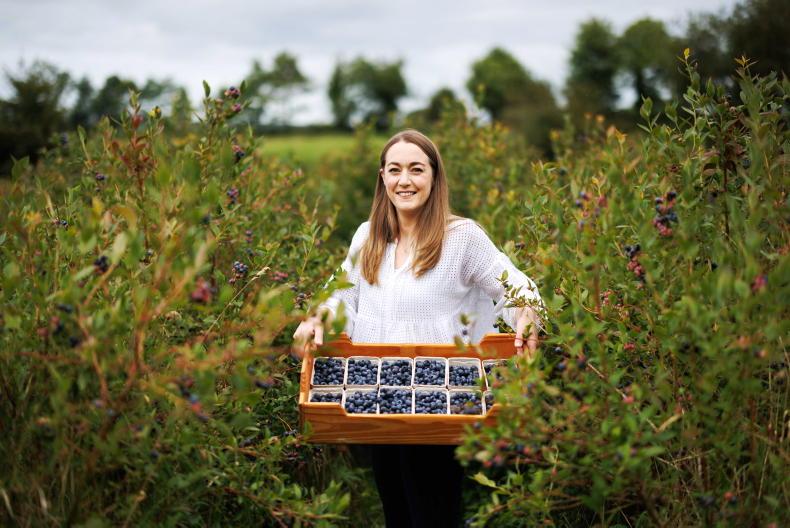
Did you collect any bilberries for Fraughan Sunday this year?
Coinciding with the ancient harvest festival of Lughnasa, Fraughan Sunday is traditionally a day for hill-walking or pilgrimage. It is also heavily associated with the picking of bilberries; those delightfully sweet, deeply purple berries which grow wild in our upland regions.
In bygone times, children would climb the hills to collect bilberries, and young women might bake them into a cake for a fellow who had caught their eye. There would be parties and, often, a special meal.
Today, Fraughan Sunday isn’t as significant as other traditional feast days, like Pancake Tuesday, but it still holds meaning for many rural Irish dwellers who like to celebrate in their own way.
Irish Country Living columnist Margaret Leahy marks Fraughan Sunday each year, but also recalls what her father used to say about it: “My father, who was from west Cork, remembers specifically that, while there was always a bit of craic around it and they’d always have a big meal, his parents would also always talk about maybe bringing some [fraughans] to an older person who wasn’t feeling well. People had great belief in the [healing] power of the fraughan.”

They weren’t wrong to consider the fraughan a healing food. Modern-day research tells us bilberries are high in antioxidants, Vitamins C and K and may be useful for preventing and treating chronic inflammatory disorders. Similar things can be said about the bilberry’s North American cousin, the blueberry.
Blueberries come in many different varieties but are generally distinguished as either wild (low bush) or cultivated (high bush). High bush blueberries were first introduced to Europe in the 1930s. They look nearly identical to bilberries – especially the smaller, wild blueberries – but bilberries are red or purple throughout, while blueberries are light green on the inside. Otherwise, the flavour and nutritional benefits are largely the same.
While bilberries grow wild, blueberries have been commercially – but not widely – grown in Ireland for the past 30 years. These perennial plants thrive in acidic soil and were originally planted on old cutover bogs, but today, you will find them planted throughout the country. Margaret isn’t baking cakes for a special fellow or bringing bilberries to ailing neighbours, but she has found her own unique way to celebrate Fraughan Sunday each year.
“This is a very modern version,” she says, laughing, “but I just met Sian [McInerney] from Banner Berries and got my [usual] 10kg of blueberries. It seems to me every year it’s the same – I’ve been buying from her for three or four years, now – we just happen to end up meeting on Fraughan Sunday. So now I have a freezer-full of blueberries, which will do me for the winter.”
Banner Berries
Similar again to bilberries, Irish blueberry season begins in the weeks preceding Fraughan Sunday, with the month of August its busiest period. At Banner Berries in Co Clare, Sian has been growing berries with support from her husband, Daniel, for approximately eight years. As she also has an off-farm career, she wanted to utilise their land in a way which would best suit their lifestyle. Prior to settling on their farm, which is where Daniel grew up, the pair spent time in mainland Europe, where they developed a grá for seasonal, fresh foods.
“We were living abroad for four years – mainly in Italy – and we really gained an appreciation for market-fresh fruit and vegetables,” Sian says. “They really eat with the seasons over there, and they also eat foods from within their locality.

On the farm, Daniel’s father had been testing things that might have seemed a bit ‘outside the box’ and had planted blueberry bushes in the late 1980s. Whenever we were there, we would pick them and keep them in the freezer – they always grew really well.
“When we moved home, I wondered how we could diversify. I thought of how, over the past 20 years, I would have been picking those blueberries and thought maybe I could do it on a larger scale.
"So, I did the market research, spoke with local shops and asked if they would sell my berries and everyone was really encouraging.”
Sian took a business course through their Local Enterprise Office (LEO) and applied for a capital grant from the Department of Agriculture, Food and the Marine (DAFM), which helped with start-up costs. They used natural inputs, like pine needles, to adjust the acidity of the soil and became organically certified through the Irish Organic Association. Working with blueberries in an organic system has been both rewarding and challenging, with weed and pest control being the main challenge they face.
“The problem here is rushes,” she says. “The field the berries are in would have originally been covered in rushes, and they would love to reestablish. When it comes to biodiversity, all that life in the field with our berries can be beautiful and scary in equal measure. In some ways, they’re competing, but there is a balance, as well.”
According to Teagasc, it takes three to four years for blueberries to provide a substantial harvest, but once established, the crop can provide good yields for up to 30 years.
This has proven true for Sian, who hand-picks the berries when ready to harvest. She extends the relatively short season of just a few weeks by planting different varieties which ripen at different times. There is plenty of work to be done around the time of harvest, but Sian takes time off from her off-farm career during the summer.
“This is done completely in my spare time, and it works really well,” she explains. “We have two children, aged nearly 13 [daughter Lelia] and nearly 11 [son Hugo]. Hugo is our chief taster, and Lelia is very business-orientated – she is all about quality control. We all have our little jobs to do, and the children really enjoy it. It’s a nice way to spend time together.”
In the first three years of production, Sian says the yield was small – enough to deliver a few crates of berries to local shops each week. Then, it increased exponentially – so much so, she had to establish alternate routes to market.

“I was like, ‘What on earth are we going to do?’” Sian recalls, laughing. “We got in touch with one chef, and he put out the word saying, ‘This farm has a huge glut of blueberries.’ I was lucky that this coincided with an appreciation of food provenance and an increase in artisanal bakers looking for local produce.
"It took a while – and a lot of vegetation management – to ensure the bushes grew high enough above the weeds to fruit on a commercial scale, and now they’re well established.”
Quality control
Sian is strict on quality control, especially when it comes to their fresh berries sold into local shops and food service operations. This means there are berries which aren’t making the final cut but are still perfectly fine to eat.
Over the past three years, she has been making blueberry juice from the remaining berries.
“The juice is made in October from the berries picked over the summer, it’s one batch per year and it’s juiced at The Apple Farm [Con Traas] in Co Tipperary. Con also gave us a lot of advice when we were setting up. Aside from the blueberries and blueberry juice, I''m also now growing blackcurrants. These have grown relatively well, but they aren’t on the same scale [as the blueberries].”
In terms of financial viability, Teagasc says there are opportunities for new entrants into blueberry growing. There are capital grants available through the Department of Agriculture, Food and the Marine (DAFM). For an established 1ha crop, they estimate a yield of around 20t of berries with a potential farmgate value of approximately €35,000 per annum. This is likely based on a fully mechanised, conventional blueberry farm rather than an organic farm like Banner Berries.
“I don’t have the specialised [harvesting] rig, unfortunately,” she says. “That’s one thing which would be very useful: an automatic, mechanised system. That would be the dream, but right now, it’s not the reality.
"I went through the organic certification process, applied for the DAFM grant, put a plan together and planted our blueberry bushes. It was all a big learning curve and I''m still learning, even eight years in.
"But the inspiration for it all – that understanding and appreciation for good, organic, local food, and a desire to do something on the farm that was manageable – that is still what drives the business.”
Fore more details check out Banner Berries on Instagram: @bannerberries
Amended on 7 August.


SHARING OPTIONS