There are two things that often spring to mind when people think of Parkinson’s disease – old and male. Most people diagnosed with Parkinson’s disease are over the age of 60 and the neurological disease has become associated with prominent figures like Neil Diamond, Alan Alda and the late Ozzy Osbourne.
But the assumption that women and younger people are less likely to develop Parkinson’s is absolutely untrue.
Although Parkinson’s is slightly more common in men, Professor David Bradley, consultant neurologist in St James’s Hospital Dublin stresses that he sees plenty of female patients in his clinic as well as “a reasonable number of younger onset patients”.
“And often it is a case that they’ll come in with symptoms, and it won’t be the first thing on their mind or the GP’s mind. But it absolutely is a diagnosis we make.”
Parkinson’s is a progressive neurodegenerative disease that affects movement, with a variety of motor symptoms (slowness, stiffness and tremors) and non-motor symptoms (low blood pressure, fatigue and poor sleep). Professor Bradley explains both kinds of symptoms can be missed in a younger person.
“The big thing about Parkinson’s is we think of a tremor, a shake in the hand, or stiffness, and slowness of movement. In an older person who presents like that, one of the first things a GP might think is ‘maybe this is a hint of Parkinson’s.’ That isn’t what gets thought of in younger people.”
The way that some Parkinson’s symptoms present is not obvious either. Patients can feel slower, sluggish, lightheaded or even have vivid dreams.
“People might say they act out their dreams, kicking and punching, knocking over the lamp,” Dr Bradley explains. “So younger people end up going to the GP wondering about psychology or psychiatry, or wonder about a joint specialist because they say they feel sick, and there’s a bit of a delay getting to somebody who can recognise what’s happening. Young people don’t think of Parkinson’s.”
Ignoring the symptoms
This is what happened to Catriona Kinnevey, who started noticing Parkinson’s symptoms at 31 during one of the most exciting chapters of her life. Catriona, who is from Rosscahill, Co Galway and now living in Dublin, initially confused the symptoms with anxiety or over-exercising.
“I had just started working at LinkedIn and was getting married in 2016. I began my wedding prep by increasing my exercise, and I noticed a tremor after working out. I chalked it up to lifting weights. Then I noticed my left shoulder becoming very stiff, like a brick.
“The next thing I noticed was my walk. I started finding it hard to lift my feet, every step was laboured. It was so exhausting to walk. I wasn’t making full strides. I was hitting my toes off the ground.
“I remember the day of my wedding being worried about walking down the aisle and holding things. I knew it was more than normal jitters. Then, I remember watching back my wedding video, and I was shaking all the way through that as well.”
Looking back, Catriona now identifies these as typical symptoms of Parkinson’s disease. But, at that time, she ignored them because she was “way, way too scared to do anything about it.”
“The dominant emotion was fear. Deep down, I knew something was going on, but I thought if I ignored it, maybe it would go away.”
In 2019, Catriona and her husband Barry started trying for a baby, and that’s “when things got tricky,” she recalls.
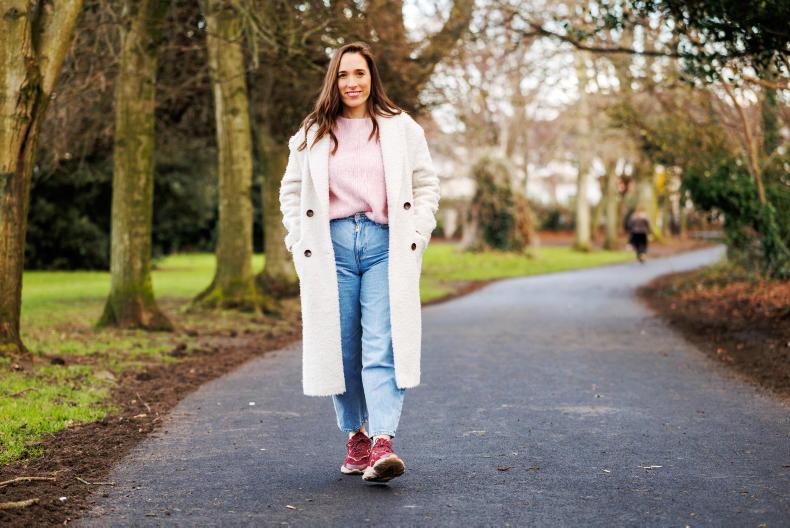
The assumption that women and younger people are less likely to develop Parkinson's is absolutely untrue. \ Philip Doyle
“I knew I could no longer avoid medical appointments. I realise this might sound irrational, but it was a huge source of anxiety for me. As you might guess, the baby thing wasn’t happening. I went to a very kind doctor who could see how stressed I was and recommended Cognitive Behavioural Therapy (CBT) to help with everything going on.
“Six weeks after starting CBT, I fell pregnant. It was a lovely time. My symptoms reduced during pregnancy, I was taking care of myself, and I felt amazing for the first time in a long while.”
Catriona’s daughter, Olivia, arrived in January 2020, but when she returned to work later in the year “things started to ramp up”.
Catriona and Barry were trying to have a second baby and started doing IVF. “I was really scared to do IVF because I didn’t want a doctor to see me, they’ll know there was something wrong.
“The first cycle in the new clinic didn’t go well. The doctor, known for his curtness, said, ‘You can stop shaking now,’ and added, ‘You really need counselling because stress impacts the results.’ I was devastated and felt like I was completely failing.”
Turning point
In December 2022, Catriona was closing out the year at her lowest. But that same month, she received a call from her brother, David, who had experienced similar Parkinson’s symptoms for some time. “His walk was really bad,” she explains, “and in 2020, just after I had my baby, he told me: ‘you have whatever I have’.
David told Catriona that he had good news and bad news. “We have Parkinson’s,” he said. “The good news is that the outlook for young onset Parkinson’s is often pretty good, because it progresses slower.
“He was very positive, saying we know what it is and how to manage it. In July 2023, I went to see my brother’s neurologist. I was very nervous. His advice was to park the Parkinson’s for now, go ahead, and try to have my second baby, and that’s exactly what I did.”
After welcoming her second baby Maia in May 2024, Caitriona, now 40, had her first appointment at Beaumont Hospital.
“Even though I knew what was coming, I was overcome with emotion when the doctor said: I see Parkinson’s. It was upsetting. But the next day, we had Maia’s christening, and my uncle said, ‘It’s all about how you manage it up here now,’ pointing to his head, and that really stuck with me.”
Once Catriona finished breastfeeding Maia, she started on medication and has responded very well. “I hardly notice my symptoms now, and life is just so much easier.”
In February of last year, Catriona also posted her first TikTok. She continues to post updates on social media about what living with early onset Parkinson’s disease is like. “The main reason I do it is because I was so scared,” she explains. “Someone would have mentioned Parkinsons, and my whole body would have seized up.
“I just had never seen anyone talk about it in a positive way. It a real older person’s disease. The thing that I wanted to share was the freedom that I got from the diagnosis of knowing what it was.”
One of the reasons why people fear the diagnosis of Parkinson’s is because it is a progressive condition that can get worse over time.

Professor David Bradley, consultant neurologist at St James’s Hospital Dublin says that he sees patients with younger onset Parkinson's Disease in clinic.
Don’t be afraid
However, Professor Bradley adds that: “it changes extremely slowly, such that we can respond and control it very, very well.” He also stresses that everyone is different. “If people go looking online, generally, what you find are people who have had worse experiences or who are not doing well. You can get this very scary view of the condition.
“But what I tend to find is once you get to meet an expert and if you understand what’s going on, that takes a lot of the anxiety out.
“I would encourage someone not to put it off too long, just because you’re missing out on the next step where everything is explained.
While every single Parkinson’s patient is assessed individually and given a treatment plan that is unique to them, medications and lifestyle modifications generally play a role in managing the condition. Professor Bradley mentions the importance of exercise, sleep, nutrition and hydration.
“In the vast majority of cases, Parkinson’s disease is a condition we control and treat extremely well,” he concludes. “Think of it a bit like if you had blood pressure or diabetes. None of those things go away. But you learn to manage them to keep you well. That is something we can do extremely well for Parkinson’s disease.”
Early onset Parkinson’s disease is a charity founded by people with early onset Parkinson’s for those with the same condition. They raise awareness of early onset Parkinson’s and have free information and resources available on their website. They also host in-person events and workshops. See eopd.ie.
Parkinson’s Ireland is a charity which offers a range of online and in-person services, with 21 branches throughout Ireland. Their Parkinson’s nurse helpline is available Monday to Friday, 9am to 5pm, at 1800 359 359. See parkinsons.ie.It is estimated that between 16,000 and 18,000 people have Parkinson’s disease in Ireland. “That’s probably an underestimate,” says Prof Bradley, “but it’s the best estimate we might apply given UK data. Anywhere between 5%-20% of those people would be considered younger onset, so it is not small.”
There are two things that often spring to mind when people think of Parkinson’s disease – old and male. Most people diagnosed with Parkinson’s disease are over the age of 60 and the neurological disease has become associated with prominent figures like Neil Diamond, Alan Alda and the late Ozzy Osbourne.
But the assumption that women and younger people are less likely to develop Parkinson’s is absolutely untrue.
Although Parkinson’s is slightly more common in men, Professor David Bradley, consultant neurologist in St James’s Hospital Dublin stresses that he sees plenty of female patients in his clinic as well as “a reasonable number of younger onset patients”.
“And often it is a case that they’ll come in with symptoms, and it won’t be the first thing on their mind or the GP’s mind. But it absolutely is a diagnosis we make.”
Parkinson’s is a progressive neurodegenerative disease that affects movement, with a variety of motor symptoms (slowness, stiffness and tremors) and non-motor symptoms (low blood pressure, fatigue and poor sleep). Professor Bradley explains both kinds of symptoms can be missed in a younger person.
“The big thing about Parkinson’s is we think of a tremor, a shake in the hand, or stiffness, and slowness of movement. In an older person who presents like that, one of the first things a GP might think is ‘maybe this is a hint of Parkinson’s.’ That isn’t what gets thought of in younger people.”
The way that some Parkinson’s symptoms present is not obvious either. Patients can feel slower, sluggish, lightheaded or even have vivid dreams.
“People might say they act out their dreams, kicking and punching, knocking over the lamp,” Dr Bradley explains. “So younger people end up going to the GP wondering about psychology or psychiatry, or wonder about a joint specialist because they say they feel sick, and there’s a bit of a delay getting to somebody who can recognise what’s happening. Young people don’t think of Parkinson’s.”
Ignoring the symptoms
This is what happened to Catriona Kinnevey, who started noticing Parkinson’s symptoms at 31 during one of the most exciting chapters of her life. Catriona, who is from Rosscahill, Co Galway and now living in Dublin, initially confused the symptoms with anxiety or over-exercising.
“I had just started working at LinkedIn and was getting married in 2016. I began my wedding prep by increasing my exercise, and I noticed a tremor after working out. I chalked it up to lifting weights. Then I noticed my left shoulder becoming very stiff, like a brick.
“The next thing I noticed was my walk. I started finding it hard to lift my feet, every step was laboured. It was so exhausting to walk. I wasn’t making full strides. I was hitting my toes off the ground.
“I remember the day of my wedding being worried about walking down the aisle and holding things. I knew it was more than normal jitters. Then, I remember watching back my wedding video, and I was shaking all the way through that as well.”
Looking back, Catriona now identifies these as typical symptoms of Parkinson’s disease. But, at that time, she ignored them because she was “way, way too scared to do anything about it.”
“The dominant emotion was fear. Deep down, I knew something was going on, but I thought if I ignored it, maybe it would go away.”
In 2019, Catriona and her husband Barry started trying for a baby, and that’s “when things got tricky,” she recalls.
The assumption that women and younger people are less likely to develop Parkinson's is absolutely untrue. \ Philip Doyle
“I knew I could no longer avoid medical appointments. I realise this might sound irrational, but it was a huge source of anxiety for me. As you might guess, the baby thing wasn’t happening. I went to a very kind doctor who could see how stressed I was and recommended Cognitive Behavioural Therapy (CBT) to help with everything going on.
“Six weeks after starting CBT, I fell pregnant. It was a lovely time. My symptoms reduced during pregnancy, I was taking care of myself, and I felt amazing for the first time in a long while.”
Catriona’s daughter, Olivia, arrived in January 2020, but when she returned to work later in the year “things started to ramp up”.
Catriona and Barry were trying to have a second baby and started doing IVF. “I was really scared to do IVF because I didn’t want a doctor to see me, they’ll know there was something wrong.
“The first cycle in the new clinic didn’t go well. The doctor, known for his curtness, said, ‘You can stop shaking now,’ and added, ‘You really need counselling because stress impacts the results.’ I was devastated and felt like I was completely failing.”
Turning point
In December 2022, Catriona was closing out the year at her lowest. But that same month, she received a call from her brother, David, who had experienced similar Parkinson’s symptoms for some time. “His walk was really bad,” she explains, “and in 2020, just after I had my baby, he told me: ‘you have whatever I have’.
David told Catriona that he had good news and bad news. “We have Parkinson’s,” he said. “The good news is that the outlook for young onset Parkinson’s is often pretty good, because it progresses slower.
“He was very positive, saying we know what it is and how to manage it. In July 2023, I went to see my brother’s neurologist. I was very nervous. His advice was to park the Parkinson’s for now, go ahead, and try to have my second baby, and that’s exactly what I did.”
After welcoming her second baby Maia in May 2024, Caitriona, now 40, had her first appointment at Beaumont Hospital.
“Even though I knew what was coming, I was overcome with emotion when the doctor said: I see Parkinson’s. It was upsetting. But the next day, we had Maia’s christening, and my uncle said, ‘It’s all about how you manage it up here now,’ pointing to his head, and that really stuck with me.”
Once Catriona finished breastfeeding Maia, she started on medication and has responded very well. “I hardly notice my symptoms now, and life is just so much easier.”
In February of last year, Catriona also posted her first TikTok. She continues to post updates on social media about what living with early onset Parkinson’s disease is like. “The main reason I do it is because I was so scared,” she explains. “Someone would have mentioned Parkinsons, and my whole body would have seized up.
“I just had never seen anyone talk about it in a positive way. It a real older person’s disease. The thing that I wanted to share was the freedom that I got from the diagnosis of knowing what it was.”
One of the reasons why people fear the diagnosis of Parkinson’s is because it is a progressive condition that can get worse over time.
Professor David Bradley, consultant neurologist at St James’s Hospital Dublin says that he sees patients with younger onset Parkinson's Disease in clinic.
Don’t be afraid
However, Professor Bradley adds that: “it changes extremely slowly, such that we can respond and control it very, very well.” He also stresses that everyone is different. “If people go looking online, generally, what you find are people who have had worse experiences or who are not doing well. You can get this very scary view of the condition.
“But what I tend to find is once you get to meet an expert and if you understand what’s going on, that takes a lot of the anxiety out.
“I would encourage someone not to put it off too long, just because you’re missing out on the next step where everything is explained.
While every single Parkinson’s patient is assessed individually and given a treatment plan that is unique to them, medications and lifestyle modifications generally play a role in managing the condition. Professor Bradley mentions the importance of exercise, sleep, nutrition and hydration.
“In the vast majority of cases, Parkinson’s disease is a condition we control and treat extremely well,” he concludes. “Think of it a bit like if you had blood pressure or diabetes. None of those things go away. But you learn to manage them to keep you well. That is something we can do extremely well for Parkinson’s disease.”
Early onset Parkinson’s disease is a charity founded by people with early onset Parkinson’s for those with the same condition. They raise awareness of early onset Parkinson’s and have free information and resources available on their website. They also host in-person events and workshops. See eopd.ie.
Parkinson’s Ireland is a charity which offers a range of online and in-person services, with 21 branches throughout Ireland. Their Parkinson’s nurse helpline is available Monday to Friday, 9am to 5pm, at 1800 359 359. See parkinsons.ie.It is estimated that between 16,000 and 18,000 people have Parkinson’s disease in Ireland. “That’s probably an underestimate,” says Prof Bradley, “but it’s the best estimate we might apply given UK data. Anywhere between 5%-20% of those people would be considered younger onset, so it is not small.”





SHARING OPTIONS