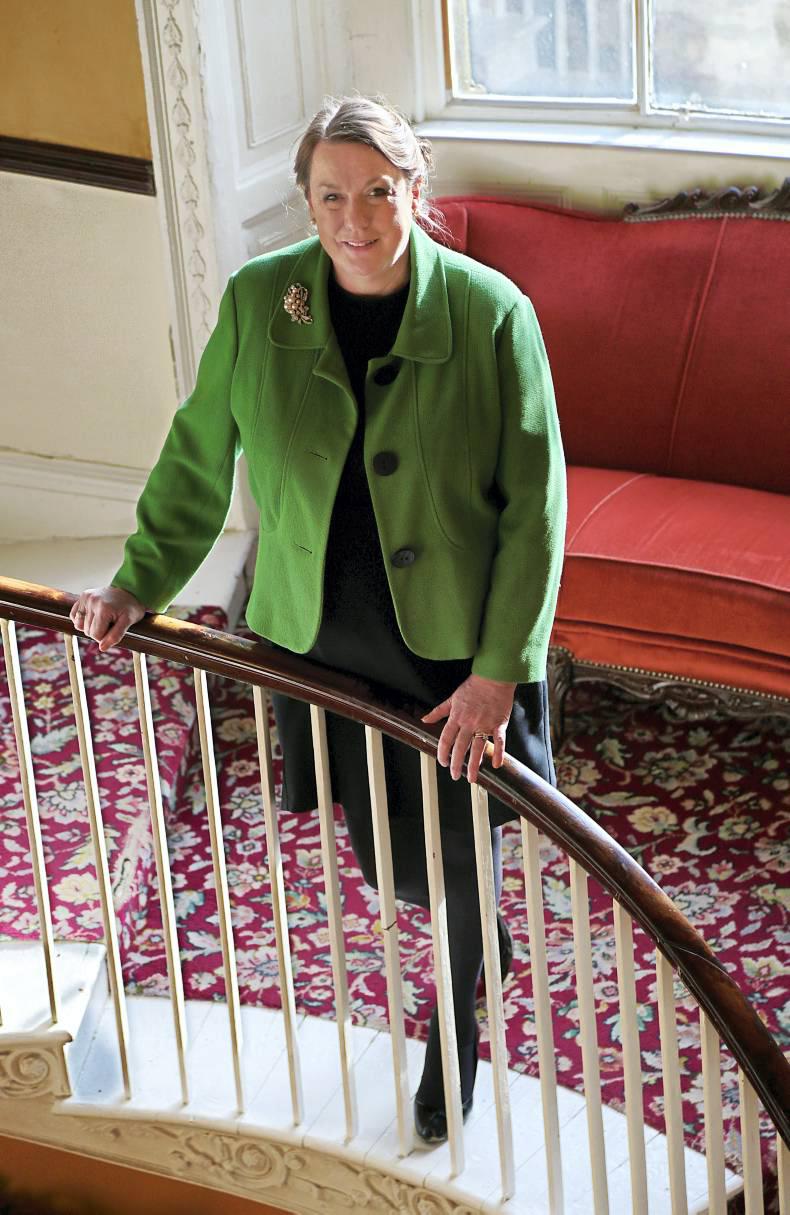
Maura Walsh is an imposing woman and standing at 5’10’’ she’s not someone to mess with. Yet over the past year Irish Country Living has on more than one occasion seen Maura shed tears of frustration as she fought for the very existence of bottom-up rural development.
Maura Walsh (nee Stack) grew up on a small farm near Banna in north Kerry, the eldest of 11 children.
“A work ethic was my biggest inheritance. Growing up on a farm gives you a ‘will do, must be done’ attitude. It’s an attitude farming fosters, but doesn’t recognise.”
Maura was educated by the Presentation nuns in Tralee and she speaks highly of them. The school offered a broad range of subjects, including economics, which Maura sat for the Leaving Certificate in 1975.
A stint in Dublin as a clerical officer with the Department of Social Welfare followed. She stayed with her uncle and aunt and the highlight of her few years was not having to share a bed or room for the first time in her life.
“I never settled and the pull to home was huge. I especially missed the two youngest (siblings) who were only six-months-old at the time. Every Friday night I headed home to Kerry and there’d always be tears on Sundays.”
After two years, Maura packed it in and got a job with the ESB in Tralee where she was to remain for the next 13 years.
“I started in revenue, went into cash then stores and support, and I learned a lot. All the managers were men and of the 300 or so working in the yard only three of us were female. I remember when the first female apprentice electrician was recruited. There was lots of foreboding, but of course it all went grand.”
Self-development was encouraged in the ESB and this is where Maura’s introduction to economics proved useful.
Jim Enright, who was head of Kerry VEC, convinced the London School of Economics to run an out-reach degree in economics in Tralee and she was one of the 26 who signed up.
“It was four years of hard slog – three nights a week and one weekend a month – and I was holding down a job and had a new baby.”
Around this time the ESB began to focus on customer service and as part of the process started community awards.
One of the entrants was a group from Duhallow in north Cork. Their plan won a prize of £1,000 and 1,000 hours of management time from the ESB to help implement it.
“My boss got the mentoring job and he got me involved, and that changed my life.”
The focus of the Duhallow group was on angling, but they had come together to do something to save their community.
The place was going backwards. Coillte was buying up land for forestry, people were leaving and there had been a continuous population decline in the area since the foundation of the State.
They were afraid the situation would reach tipping point and they wouldn’t be able to get it back.
They knew the answer had to be jobs and tourism. And they knew they needed a manager to bring their plan together.
“I got the job and the ESB allowed me a career break for a year, that went into five years and I’m still here today.
“There was just myself, with one room, a phone, no desk, no headed notepaper, nothing. I had to learn to work with a voluntary board. My wages were funded by local effort.
“The promise was that for every £1 raised locally IRD Duhallow would bring in up to £5 more. They raised £30,000 and the first tranche of LEADER funding came to £1.8m. It was massive.”
In the intervening 23 years, LEADER has pumped €22,2m of direct funding into the area and in its first year helped create 74 fulltime and 75 part-time jobs.
“Existing businesses on the tipping point were sustained and are still going strong. LEADER has been a real agent of change, with over 1,200 new jobs created in Duhallow”.
Head and heart
LEADER benefited those who were capable, but what about other sections of the community? In the early 1990s, no part of Cork was designated as disadvantaged under the area-based partnership scheme, so in 1994 IRD Duhallow actively went after the first Social Inclusion Programme.
By the following year they were operating both LEADER and social programmes, and with the addition of the EU Youth Training Programme they cut their teeth on managing multi funded programmes.
“There was a push to keep the programmes separate as the feeling was you couldn’t have a head and a heart, and that men would be better with enterprise while women could look after social inclusion.What rubbish.”
Managing social inclusion and enterprise meant the board had to operate differently. Up until then they knew the detail of everything, but that had to change. Sub-groups became multi-disciplinary teams.
So the agriculture team looked after LEADER diversification, small-holder and environment, and they became client driven.
Defining essence of LEADER
By 1998, and the end of the second LEADER programme, Maura Walsh was getting more involved at EU level.
“We were passing on the knowledge and that’s when I realised that from a small corner in Duhallow you could influence not just Irish, but EU policy.”
Part of the work was to define the essence of LEADER and seven key points emerged:
It was a local action group – people came together, a participatory democracy.It was bottom-up and not imposed.It’s a natural area of development not realigned for political, county or municipal boundaries.It’s integrated development working across various sectors.Funding goes directly to the local action group and how it is spent rests solely with it.There’s co-operation across LEADER boundaries.There’s been several assaults on that structure and LEADER groups are currently defending their position, and none stronger than Duhallow and Maura Walsh.
“I firmly believe that local action groups have to be more than think-tanks. That’s not enough. You need to follow through. That’s why LEADER worked and why it’s been acknowledged as such a success.”
Maura is fiercely proud of what LEADER has achieved and is confident in saying that Duhallow is among the top 10 groups across the EU and can be joined by at least another four Irish groups in the top 10.
“It’s something we’ve taken for granted and, even worse, some people and agencies have done everything in their power to discredit LEADER. But despite this, successful LEADER groups enjoy huge support in their local areas.”
A good place to be
In terms of the future, Maura says success is about more than creating jobs. Strategy also has to be about making rural communities good places in which to live.
“What’s important is whether you live in Ballyfermot or Ballydesmond is access to healthcare, good schools, broadband and a job.
“Millstreet had more jobs than any part of Duhallow, yet it was losing people faster than the rest of the area. We need to get people living here and they can work locally or further afield. Having good affordable childcare is an attraction and now no part of Duhallow is more than eight miles from a crèche.”
She say it was outrageous of economist Moore McDowell to say that people in rural areas couldn’t expect to have an ambulance service.
“The treatment of rural areas in the past five years has been appalling and without the work of LEADER in building strong, resilient communities I shudder to think of how things would be.
“Building urban at the expense of rural is madness. Rural areas didn’t cause or see the boom. Four years ago we took 18 teenagers to Sweden and we had to get passports for 12 of them – they’d never been out of the country.
“There’s a resilience in rural areas. We have the skills and the work ethic. Now let us get on with the work.” CL
Factbox
Married: to Mark with two adult children, Marcus and Bríghid Íde.Watches: Downton Abbey, Foyle’s War and Damages box sets. Wears: knee-length dresses in black, navy, blue and rust. Prefers jackets that sit on the hip, in strong bright colours or striped.Shops: “In Hannon’s in Castleisland for my decent stuff, Long Tall Sally for length, M&S, Dunnes for work and Jasmine in Tralee for wedding outfits.”Favourite feature: “I have long hair for two reasons: my husband and daughter like it. Electric rollers do a quick-fix and I have inherited a family gene that means I do not have to get it coloured.”Hobbies: “Duhallow is both my work and hobby, however, our dog Rambo gets walks on the beach, I love cooking and going for drives with Mark.” Memorable event: “I was in Glash at my first meeting in the old school. I was giving it welly with my projector and screen, when a crow’s nest landed and quenched the fire and filled the place with smoke. We couldn’t use the other room because of rotten floorboards. Now that school has been completely redone and is a fully functioning community centre.”
Maura Walsh is an imposing woman and standing at 5’10’’ she’s not someone to mess with. Yet over the past year Irish Country Living has on more than one occasion seen Maura shed tears of frustration as she fought for the very existence of bottom-up rural development.
Maura Walsh (nee Stack) grew up on a small farm near Banna in north Kerry, the eldest of 11 children.
“A work ethic was my biggest inheritance. Growing up on a farm gives you a ‘will do, must be done’ attitude. It’s an attitude farming fosters, but doesn’t recognise.”
Maura was educated by the Presentation nuns in Tralee and she speaks highly of them. The school offered a broad range of subjects, including economics, which Maura sat for the Leaving Certificate in 1975.
A stint in Dublin as a clerical officer with the Department of Social Welfare followed. She stayed with her uncle and aunt and the highlight of her few years was not having to share a bed or room for the first time in her life.
“I never settled and the pull to home was huge. I especially missed the two youngest (siblings) who were only six-months-old at the time. Every Friday night I headed home to Kerry and there’d always be tears on Sundays.”
After two years, Maura packed it in and got a job with the ESB in Tralee where she was to remain for the next 13 years.
“I started in revenue, went into cash then stores and support, and I learned a lot. All the managers were men and of the 300 or so working in the yard only three of us were female. I remember when the first female apprentice electrician was recruited. There was lots of foreboding, but of course it all went grand.”
Self-development was encouraged in the ESB and this is where Maura’s introduction to economics proved useful.
Jim Enright, who was head of Kerry VEC, convinced the London School of Economics to run an out-reach degree in economics in Tralee and she was one of the 26 who signed up.
“It was four years of hard slog – three nights a week and one weekend a month – and I was holding down a job and had a new baby.”
Around this time the ESB began to focus on customer service and as part of the process started community awards.
One of the entrants was a group from Duhallow in north Cork. Their plan won a prize of £1,000 and 1,000 hours of management time from the ESB to help implement it.
“My boss got the mentoring job and he got me involved, and that changed my life.”
The focus of the Duhallow group was on angling, but they had come together to do something to save their community.
The place was going backwards. Coillte was buying up land for forestry, people were leaving and there had been a continuous population decline in the area since the foundation of the State.
They were afraid the situation would reach tipping point and they wouldn’t be able to get it back.
They knew the answer had to be jobs and tourism. And they knew they needed a manager to bring their plan together.
“I got the job and the ESB allowed me a career break for a year, that went into five years and I’m still here today.
“There was just myself, with one room, a phone, no desk, no headed notepaper, nothing. I had to learn to work with a voluntary board. My wages were funded by local effort.
“The promise was that for every £1 raised locally IRD Duhallow would bring in up to £5 more. They raised £30,000 and the first tranche of LEADER funding came to £1.8m. It was massive.”
In the intervening 23 years, LEADER has pumped €22,2m of direct funding into the area and in its first year helped create 74 fulltime and 75 part-time jobs.
“Existing businesses on the tipping point were sustained and are still going strong. LEADER has been a real agent of change, with over 1,200 new jobs created in Duhallow”.
Head and heart
LEADER benefited those who were capable, but what about other sections of the community? In the early 1990s, no part of Cork was designated as disadvantaged under the area-based partnership scheme, so in 1994 IRD Duhallow actively went after the first Social Inclusion Programme.
By the following year they were operating both LEADER and social programmes, and with the addition of the EU Youth Training Programme they cut their teeth on managing multi funded programmes.
“There was a push to keep the programmes separate as the feeling was you couldn’t have a head and a heart, and that men would be better with enterprise while women could look after social inclusion.What rubbish.”
Managing social inclusion and enterprise meant the board had to operate differently. Up until then they knew the detail of everything, but that had to change. Sub-groups became multi-disciplinary teams.
So the agriculture team looked after LEADER diversification, small-holder and environment, and they became client driven.
Defining essence of LEADER
By 1998, and the end of the second LEADER programme, Maura Walsh was getting more involved at EU level.
“We were passing on the knowledge and that’s when I realised that from a small corner in Duhallow you could influence not just Irish, but EU policy.”
Part of the work was to define the essence of LEADER and seven key points emerged:
It was a local action group – people came together, a participatory democracy.It was bottom-up and not imposed.It’s a natural area of development not realigned for political, county or municipal boundaries.It’s integrated development working across various sectors.Funding goes directly to the local action group and how it is spent rests solely with it.There’s co-operation across LEADER boundaries.There’s been several assaults on that structure and LEADER groups are currently defending their position, and none stronger than Duhallow and Maura Walsh.
“I firmly believe that local action groups have to be more than think-tanks. That’s not enough. You need to follow through. That’s why LEADER worked and why it’s been acknowledged as such a success.”
Maura is fiercely proud of what LEADER has achieved and is confident in saying that Duhallow is among the top 10 groups across the EU and can be joined by at least another four Irish groups in the top 10.
“It’s something we’ve taken for granted and, even worse, some people and agencies have done everything in their power to discredit LEADER. But despite this, successful LEADER groups enjoy huge support in their local areas.”
A good place to be
In terms of the future, Maura says success is about more than creating jobs. Strategy also has to be about making rural communities good places in which to live.
“What’s important is whether you live in Ballyfermot or Ballydesmond is access to healthcare, good schools, broadband and a job.
“Millstreet had more jobs than any part of Duhallow, yet it was losing people faster than the rest of the area. We need to get people living here and they can work locally or further afield. Having good affordable childcare is an attraction and now no part of Duhallow is more than eight miles from a crèche.”
She say it was outrageous of economist Moore McDowell to say that people in rural areas couldn’t expect to have an ambulance service.
“The treatment of rural areas in the past five years has been appalling and without the work of LEADER in building strong, resilient communities I shudder to think of how things would be.
“Building urban at the expense of rural is madness. Rural areas didn’t cause or see the boom. Four years ago we took 18 teenagers to Sweden and we had to get passports for 12 of them – they’d never been out of the country.
“There’s a resilience in rural areas. We have the skills and the work ethic. Now let us get on with the work.” CL
Factbox
Married: to Mark with two adult children, Marcus and Bríghid Íde.Watches: Downton Abbey, Foyle’s War and Damages box sets. Wears: knee-length dresses in black, navy, blue and rust. Prefers jackets that sit on the hip, in strong bright colours or striped.Shops: “In Hannon’s in Castleisland for my decent stuff, Long Tall Sally for length, M&S, Dunnes for work and Jasmine in Tralee for wedding outfits.”Favourite feature: “I have long hair for two reasons: my husband and daughter like it. Electric rollers do a quick-fix and I have inherited a family gene that means I do not have to get it coloured.”Hobbies: “Duhallow is both my work and hobby, however, our dog Rambo gets walks on the beach, I love cooking and going for drives with Mark.” Memorable event: “I was in Glash at my first meeting in the old school. I was giving it welly with my projector and screen, when a crow’s nest landed and quenched the fire and filled the place with smoke. We couldn’t use the other room because of rotten floorboards. Now that school has been completely redone and is a fully functioning community centre.” 





SHARING OPTIONS