



A favourite wish proffered for good health is sláinte an bhradáin ‘the health of the salmon’. It is at this time of the year that the salmon displays its vibrancy and heroic gusto as it propels itself over impossibly rocky rapids to make its way upriver to its place of origin to spawn.
It was the late Peter Woodman, then professor of archaeology at UCC, who first outlined that in the diet of our Mesolithic ancestors of some 9,000 years ago, salmon were a core and constant component. We have a long history with the ‘King of the Fish’ and it is little wonder that salmon reside deep in the Irish psyche.
Our respect and due deference to the fish comes in part from its role in our mythology and folklore of how the great warrior-seer hero Fionn Mac Cumhaill, was granted his imbas ‘complete knowledge’. While almost every Irish child has grown up with the great legend of An Bradán Feasa, ‘the salmon of knowledge’, it is worth sharing some of the fine detail.
When Fionn was born, his mother named him Demne ‘little stag’. Despite on one occasion losing his hair to a mange-like disease – he was called Demne Maol ‘the bald’ – his hair grew back and he stood out from everyone, sporting a fine head of blond hair and was casually known as Fionn ‘the bright’.
In Irish mythology the somewhat interchangeable Irish names Fionn, Finn and Find are all loaded with significance and mean white, brightness, wisdom, along with the ability to see and foretell.
Fionn the bright
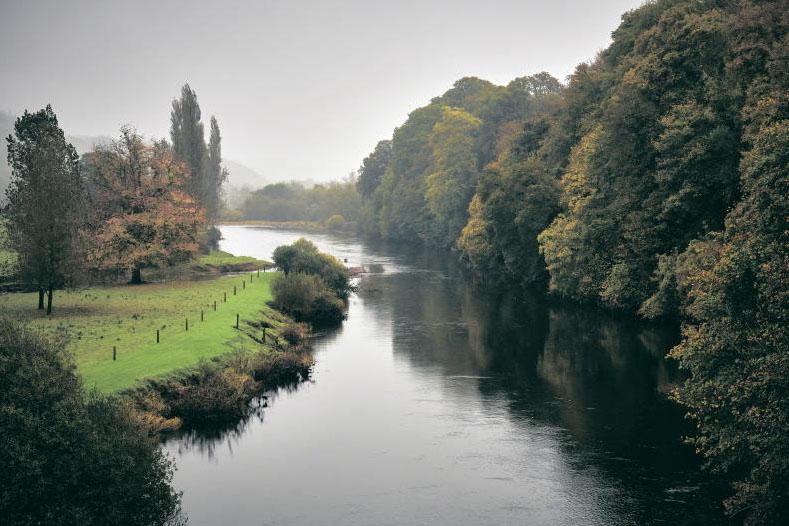
In addition to the above, there is in Irish mythology a core cosmogenic image in the form of the sacred well of knowledge. There are numerous versions of this but one in particular involves Fionn. We are told that Fionn’s uncle, a druid called Crimall, was the one who tended the nine hazel trees that surrounded Tobar Segais ‘the well of wisdom’. This well was the source of the sacred rivers of Ireland, including the Boyne. The cosmic hazel trees would bear their leaves, blossoms and hazelnuts all at once in one magical moment, and in a purple mist the hazelnuts would drop down into the well. The well had five salmon and each nut they ate resulted in a red spot on their skin. The King of Leinster, Nechtain, left no one near this sacred well and only allowed his chosen three cup bearers to bring him its water. His wife Bofind, who was forbidden, like all others, to go near it, secretly went to see the well. When she came upon it, its waters spilled out violently, consuming her and flowing out to the sea and hence Bofind – also Boann – gives her name to the River Boyne.
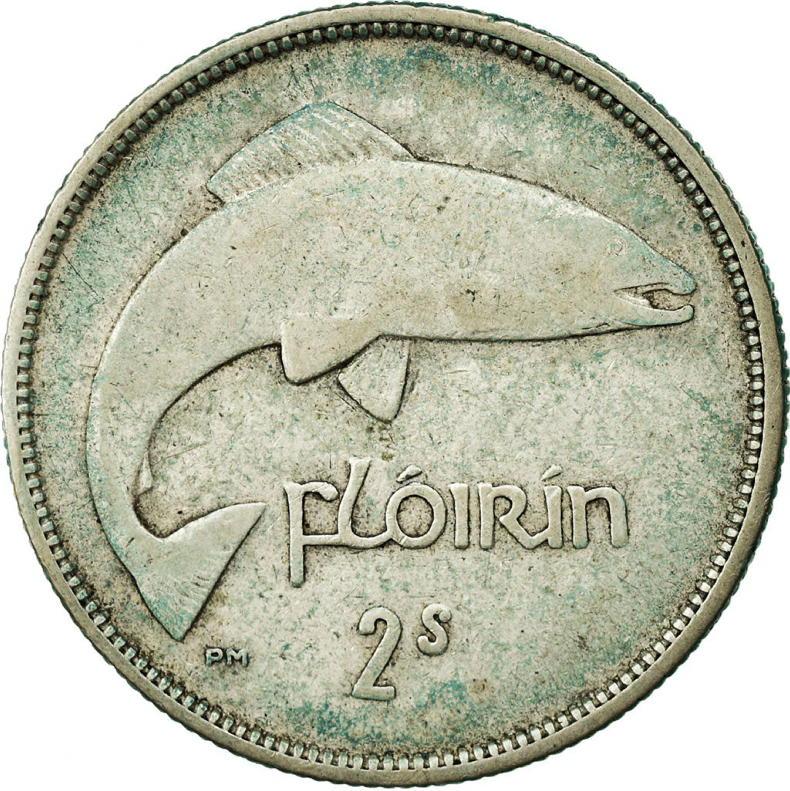
The well itself was destroyed, but the River Boyne remained, and red-spotted salmon who had eaten the knowledge-bearing hazelnuts swam in the river.
To catch the salmon and eat it meant that one would receive all the knowledge in the world but the prophecy foretold that only someone named ‘Fionn’ could catch it.
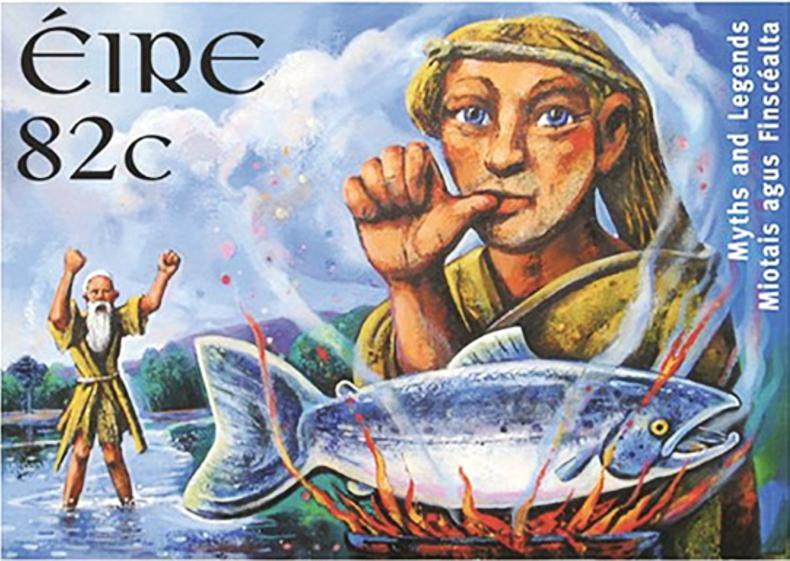
The young bright-haired Demne was only seven years of age when he left his two female minders in the Slieve Bloom Mountains to go on his travels. Having first visited his uncle Crimall in Connacht, he headed to the Boyne Valley and there met up with druid Finnéigeas ‘Fionn-the-seer’ in order to learn poetry. In keeping with the prophecy, this old, mystical seer Finnéigeas was the one who succeeded in catching the elusive salmon. Acting as his subordinate gillie, Demne was given the job of roasting the precious fish but was given clear instructions not to eat any of it!
Salmon of knowledge
The salmon of knowledge was put on a spit to roast in front of the fire. There is a lovely account from one of our saga tales, Táin bó Fraích, of such salmon cooking, using honey as a sort of honey glaze, but whatever way Demne used, a large heat blister appeared on the side of the salmon.
Perhaps, it was on one of the red hazelnut spots, and placing his thumb on the bubbling skin to break it, he burnt his thumb and intuitively put it in his mouth to cool it. It was at that moment that he was granted the all-knowing, all-seeing imbas and Finnéigeas decreed he should be called Fionn, the seer and wise one.
Sadly, salmon are no longer the plentiful species that were once such a feature of our summer pleasures. If you do have the luxury of one this summer, and you fire up that barbecue, look out for any red spots and let that skin bubble and you know what to do.
Shane Lehane is a folklorist who works in UCC and Cork College of FET, Tramore Road Campus. Contact: slehane@ucc.ie


SHARING OPTIONS