Robert Wallace was just one year old when he was given his first donkey, Muffin, as a gift from a neighbour. Now, he has 26 donkeys living in the family farm in Co Down, and has built an entire business around his appreciation for these four-legged animals.
His mother and father, Amanda and Richard, used to breed pedigree Jersey cows and pedigree Suffolk sheep on the same land in Ballynahinch where Robert now runs his heritage and wellness business, Kinedale Donkeys.
Against the backdrop of Slieve Croob and the rolling Dromara Hills, Robert hosts donkey treks, cuddle sessions, donkey date nights and sunset donkey picnics, and the animals also regularly visit care homes, hospitals and palliative care facilities.
Growing up, Robert laughs that his family “were known as the mad donkey family locally”. When he was five years old, financial pressure meant his parents sold their cattle – but the land didn’t stay empty for long and Robert started filling the space with donkeys and goats.
“I grew up on a farm, but without the pressure of farming, which was quite nice,” Robert explains. “I was able to explore and have fun with the donkeys. And we were always showing. That’s where I got seen doing things with donkeys. I was a young person actively selecting donkeys for their breed, to be easily handled and to train them. And I was riding them and I started carriage driving with them. I did dressage with the donkeys. I did small jumps around the yard and hacking.
“My whole summer and my whole life just revolved around my donkeys and going to events. My mum would collect me on a Friday afternoon from primary school with my donkey Denis in the cart, and then we would go to Ballynahinch town, get ice cream, lozenges for Denis, and then back to the farm.”
Robert and the donkeys began attracting attention in the local area, leading to invitations from care homes to visit the residents and even a trip to Stormont where Robert drove the former Minister of Agriculture Michelle Gildernew around in a cart with a pair of donkeys. His hobby also caught the eye of broadcasters in the UK.
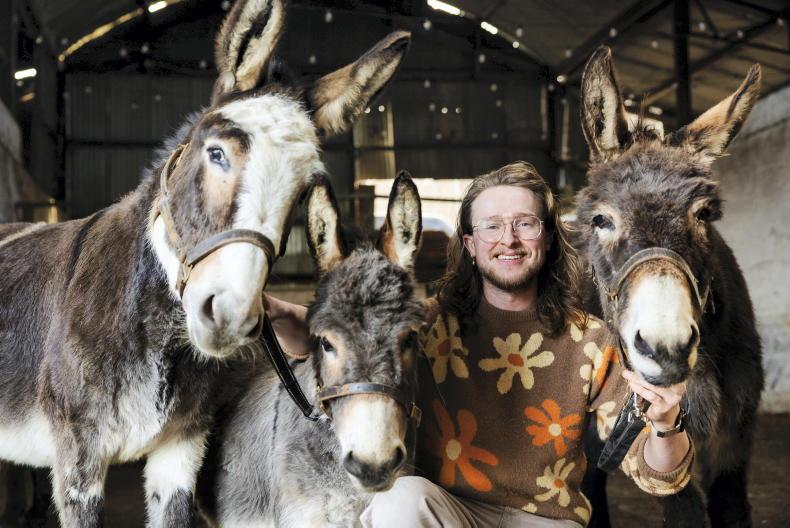
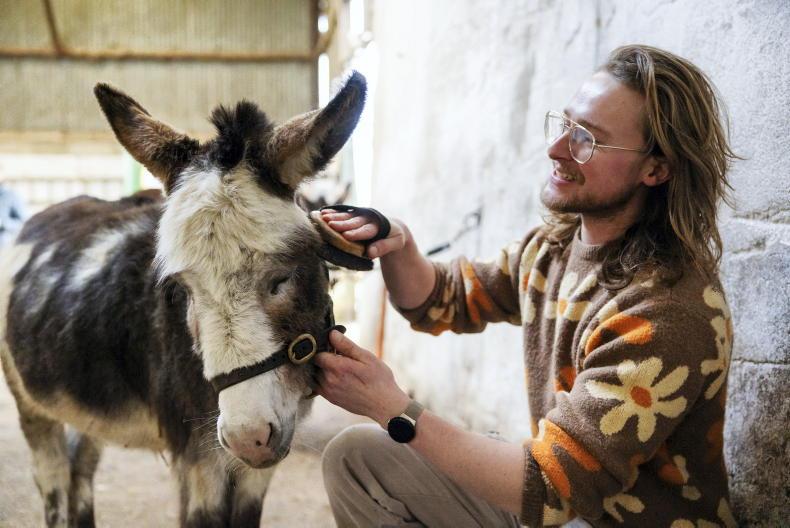
Robert runs his heritage and wellness business, Kinedale Donkeys against the backdrop of Slieve Croob in Co Down. \Claire Nash
Trekking into stardom
“I was on Blue Peter with the donkeys when I was about 10,” Robert recalls. “The show was about children with unusual lives. They followed a kid who lived in a circus, a girl who lived in a castle and when they told me that they thought I’d be interesting, I remember thinking: but I’m not interesting, I just live with donkeys.
“I thought it was totally normal. I didn’t realise that this wasn’t the normal thing for most kids, being surrounded by donkeys and going to care homes.”
Robert also featured on Country File, TG4 – and most recently on The Repair Shop where he got his great grandmother’s saddle repaired. He uses media appearances to spread his message about the place of the donkey in society.
“The donkey was domesticated 7,000 years ago, 2,000 years before the horse and he’s been alongside us throughout humanity. He’s mentioned in the Bible 444 times. And even if you just take that as historical context, that donkeys have been there for such a long time, yet nowadays, what do you do the donkey? Stick him in a field, ignore him, then say he’s stubborn.
“Donkeys can do whatever ponies can do,” Robert insists. “Denis has been a ploughing champion. We faced a lot of hardship when we would go to shows, because some people think donkeys are dirty, diseased, untrained, stubborn. When we went to shows, we were directed to the far end of the field, we got constant sneers and complaints about the donkeys being beside the horses.
“The problem with donkeys is they flip between two worlds. They’re not quite agriculture and they’re not quite equestrian.”
Despite the local profile that Robert had built for himself and the donkeys, he wasn’t sure that he could build a full-time career working with them. He decided to pursue a degree in equine management in CAFRE Enniskillen, with the intention of working with horses and keeping donkeys as a hobby.
“That was 2019 and about that time, I had 17 donkeys,” Robert recalls.
“Then suddenly lockdown happened, and instead of spending time in Enniskillen, I was up here at the farm, I was doing my classes and my work in the barn with the donkeys.
“I realised how lucky I was because a lot of people were really struggling. They couldn’t get outside. I had an entire yard to wander around, and I could go for walks along the roads. I took more videos and photos of what I was doing and put it on a Facebook page.
“I started recording story time with the donkeys, because I’d heard in the news that kids were struggling with literacy.
“Then people were starting to ask, ‘can we come and visit the donkeys?’ I’d never thought I could do a petting farm. I didn’t want the donkeys just getting constantly harassed and pawed up by hundreds of people.”
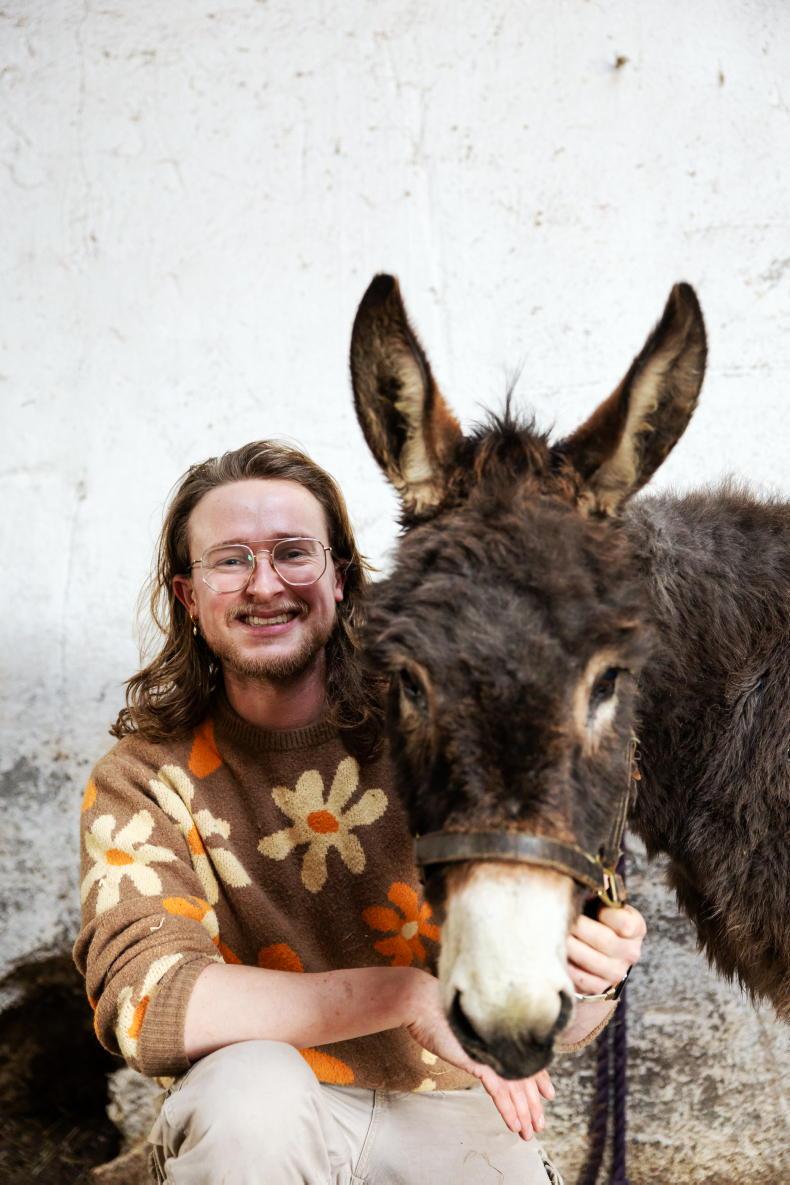
Robert Wallace turned his passion for donkeys into a heritage business in Northern Ireland. \Claire Nash
But Robert did see opportunity for smaller groups. Because he lost his job as a receptionist in a hotel during lockdown, he needed to find a way of generating income.
“I had no money and 17 donkeys to feed coming into the winter. I thought I’ll do a cuddle session, and we could go for a ride in the cart, and do a trek. I created the website just to make these bookings happen and it got me through the winter.”
Things really started to grow legs when Robert enrolled in a tourism development programme with Newry Mourne and Down District Council, and he was approached by a child psychologist to do therapy work with the donkeys.
“I got registered with the Education Authority and the southeastern board of the NHS. I didn’t have to do the therapy. I just had to look after the animals. Kids start to learn how to look after the donkeys regarding their health and care, keeping them clean, brushing them, feeding them. All the things we need, donkeys need too.
“We did it once a week in a school and then we won an award through the Southeastern Trust.” This was when Robert truly believed that he could make it into a business.
Robert keeps each session on the farm small, to around 16-20 people. “I’ve got a paint and sip event coming up around Valentine’s Day. I do Halloween and Christmas events, amongst others.
Donkey experiences
“I don’t just cater for kids – having adult experiences is something that I’m quite passionate about. So many people love animals, and we still need that outdoor time.
“Animals were a big security net for me during university because I had to repeat my second year twice. Just down to anxiety, I got so bogged down with fear myself and I suffer from poor mental health, and I’ve been on antidepressants as well. I just wanted to be around animals that love me if I love them.”
Having amassed 43.8k followers on TikTok, Robert also shares life on the farm with people across the globe, which he says has been “phenomenal”.
“The way the algorithm works is it just gets the right people. I don’t know how it does it, but it’s so good at it. And I learnt that people don’t want me just promoting the donkeys. They don’t want a business saying: come to my farm, spend money, come and do this. They want to see my life.
“People love what I do, and I’ve never known anything different. I’ve always grown up with animals. But I’ve now learned a newfound sense of appreciation for it, because I’m able to share it just on TikTok, and the feedback you get is so heartwarming.”
See kinedaledonkeys.co.uk.
Robert Wallace was just one year old when he was given his first donkey, Muffin, as a gift from a neighbour. Now, he has 26 donkeys living in the family farm in Co Down, and has built an entire business around his appreciation for these four-legged animals.
His mother and father, Amanda and Richard, used to breed pedigree Jersey cows and pedigree Suffolk sheep on the same land in Ballynahinch where Robert now runs his heritage and wellness business, Kinedale Donkeys.
Against the backdrop of Slieve Croob and the rolling Dromara Hills, Robert hosts donkey treks, cuddle sessions, donkey date nights and sunset donkey picnics, and the animals also regularly visit care homes, hospitals and palliative care facilities.
Growing up, Robert laughs that his family “were known as the mad donkey family locally”. When he was five years old, financial pressure meant his parents sold their cattle – but the land didn’t stay empty for long and Robert started filling the space with donkeys and goats.
“I grew up on a farm, but without the pressure of farming, which was quite nice,” Robert explains. “I was able to explore and have fun with the donkeys. And we were always showing. That’s where I got seen doing things with donkeys. I was a young person actively selecting donkeys for their breed, to be easily handled and to train them. And I was riding them and I started carriage driving with them. I did dressage with the donkeys. I did small jumps around the yard and hacking.
“My whole summer and my whole life just revolved around my donkeys and going to events. My mum would collect me on a Friday afternoon from primary school with my donkey Denis in the cart, and then we would go to Ballynahinch town, get ice cream, lozenges for Denis, and then back to the farm.”
Robert and the donkeys began attracting attention in the local area, leading to invitations from care homes to visit the residents and even a trip to Stormont where Robert drove the former Minister of Agriculture Michelle Gildernew around in a cart with a pair of donkeys. His hobby also caught the eye of broadcasters in the UK.

Robert runs his heritage and wellness business, Kinedale Donkeys against the backdrop of Slieve Croob in Co Down. \Claire Nash
Trekking into stardom
“I was on Blue Peter with the donkeys when I was about 10,” Robert recalls. “The show was about children with unusual lives. They followed a kid who lived in a circus, a girl who lived in a castle and when they told me that they thought I’d be interesting, I remember thinking: but I’m not interesting, I just live with donkeys.
“I thought it was totally normal. I didn’t realise that this wasn’t the normal thing for most kids, being surrounded by donkeys and going to care homes.”
Robert also featured on Country File, TG4 – and most recently on The Repair Shop where he got his great grandmother’s saddle repaired. He uses media appearances to spread his message about the place of the donkey in society.
“The donkey was domesticated 7,000 years ago, 2,000 years before the horse and he’s been alongside us throughout humanity. He’s mentioned in the Bible 444 times. And even if you just take that as historical context, that donkeys have been there for such a long time, yet nowadays, what do you do the donkey? Stick him in a field, ignore him, then say he’s stubborn.
“Donkeys can do whatever ponies can do,” Robert insists. “Denis has been a ploughing champion. We faced a lot of hardship when we would go to shows, because some people think donkeys are dirty, diseased, untrained, stubborn. When we went to shows, we were directed to the far end of the field, we got constant sneers and complaints about the donkeys being beside the horses.
“The problem with donkeys is they flip between two worlds. They’re not quite agriculture and they’re not quite equestrian.”
Despite the local profile that Robert had built for himself and the donkeys, he wasn’t sure that he could build a full-time career working with them. He decided to pursue a degree in equine management in CAFRE Enniskillen, with the intention of working with horses and keeping donkeys as a hobby.
“That was 2019 and about that time, I had 17 donkeys,” Robert recalls.
“Then suddenly lockdown happened, and instead of spending time in Enniskillen, I was up here at the farm, I was doing my classes and my work in the barn with the donkeys.
“I realised how lucky I was because a lot of people were really struggling. They couldn’t get outside. I had an entire yard to wander around, and I could go for walks along the roads. I took more videos and photos of what I was doing and put it on a Facebook page.
“I started recording story time with the donkeys, because I’d heard in the news that kids were struggling with literacy.
“Then people were starting to ask, ‘can we come and visit the donkeys?’ I’d never thought I could do a petting farm. I didn’t want the donkeys just getting constantly harassed and pawed up by hundreds of people.”

Robert Wallace turned his passion for donkeys into a heritage business in Northern Ireland. \Claire Nash
But Robert did see opportunity for smaller groups. Because he lost his job as a receptionist in a hotel during lockdown, he needed to find a way of generating income.
“I had no money and 17 donkeys to feed coming into the winter. I thought I’ll do a cuddle session, and we could go for a ride in the cart, and do a trek. I created the website just to make these bookings happen and it got me through the winter.”
Things really started to grow legs when Robert enrolled in a tourism development programme with Newry Mourne and Down District Council, and he was approached by a child psychologist to do therapy work with the donkeys.
“I got registered with the Education Authority and the southeastern board of the NHS. I didn’t have to do the therapy. I just had to look after the animals. Kids start to learn how to look after the donkeys regarding their health and care, keeping them clean, brushing them, feeding them. All the things we need, donkeys need too.
“We did it once a week in a school and then we won an award through the Southeastern Trust.” This was when Robert truly believed that he could make it into a business.
Robert keeps each session on the farm small, to around 16-20 people. “I’ve got a paint and sip event coming up around Valentine’s Day. I do Halloween and Christmas events, amongst others.
Donkey experiences
“I don’t just cater for kids – having adult experiences is something that I’m quite passionate about. So many people love animals, and we still need that outdoor time.
“Animals were a big security net for me during university because I had to repeat my second year twice. Just down to anxiety, I got so bogged down with fear myself and I suffer from poor mental health, and I’ve been on antidepressants as well. I just wanted to be around animals that love me if I love them.”
Having amassed 43.8k followers on TikTok, Robert also shares life on the farm with people across the globe, which he says has been “phenomenal”.
“The way the algorithm works is it just gets the right people. I don’t know how it does it, but it’s so good at it. And I learnt that people don’t want me just promoting the donkeys. They don’t want a business saying: come to my farm, spend money, come and do this. They want to see my life.
“People love what I do, and I’ve never known anything different. I’ve always grown up with animals. But I’ve now learned a newfound sense of appreciation for it, because I’m able to share it just on TikTok, and the feedback you get is so heartwarming.”
See kinedaledonkeys.co.uk.
SHARING OPTIONS