



When we were small everything seemed so big. The door to Miss Quill’s classroom was tall and wide and had a little window. Like a senseless clutch of meandering newborn chicks, we were gently cajoled into the first days of our education.
Low, yellow tubular metal chairs with wooden seats and a wooden back were spotted around clusters of tables. There were alphabets and numbers on the wall, a map of Ireland, Dáithí Lacha [a cartoon series], a crucifix, flowers before an altar, a lined blackboard with coloured chalk and in the corner by the door, a box of sand.
The múinteoir’s desk had books and papers, a melodica, a tuning fork and the large, long, grey-covered leabhair rolla.
Every morning started with a prayer followed by the ritual of calling the roll. We soon all learned to say anseo when our name was called or as láthair when someone was sick. By far the most memorable early activity was playing with ‘mala’ (a variant of marla ‘clay’) which was our word for plasticine.
The many different colours would eventually combine to produce a worrying brown lump that we rolled fastidiously on the table to make mala balls and mala snakes. As the year progressed and on to ‘high babies’ we learned to make our letters with our peann luaidh, pencil on our pink and blue-lined copybooks.
Playing tig
At the morning break designed to expend our youthful energies, we were let outside to go running mad around the yard to play ‘tig’. Our school yard was surfaced with large concrete squares, delineated by joints of thick black tar. Our inherited game of chasing demanded we ran only along the ‘lines’. This was a complex pursuit, geometrically labyrinthine and whoever was ‘on it’, might end up running around frustratingly in square circles. The reprise came in the form of ‘up-off-ground is den’ when you could perch, feet up, upon the slatted seats within the open-sided covered sheds surrounding the yard.
When the bell rang, we had to line up two-by-two, holding hands, in our líne.Back in the class we took our first steps into the enigmatic world of mathematics, utilising the most ancient of apparatus, the abacus. We would twiddle, spin and slide the beads of the abacus making it more a toy than anything else.
Similarly, the differently sized, multi-coloured cuisenaires sticks or blocks – a novel way of teaching numbers – were stacked into towers and knocked down with glee. Many of them found their way into one’s mouth, which was the natural childish mechanism for the full sensual discovery of the world.
I remember licking and tasting the desk and eating the tops off numerous pencils and in later years, plastic biros. When we progressed to the higher classes, we sat in the old two-by-two school desks with inkwells that were covered by small sliding brass lids. One day we all went home with dark blue lips after sipping on one with ink in it.
Old jotter
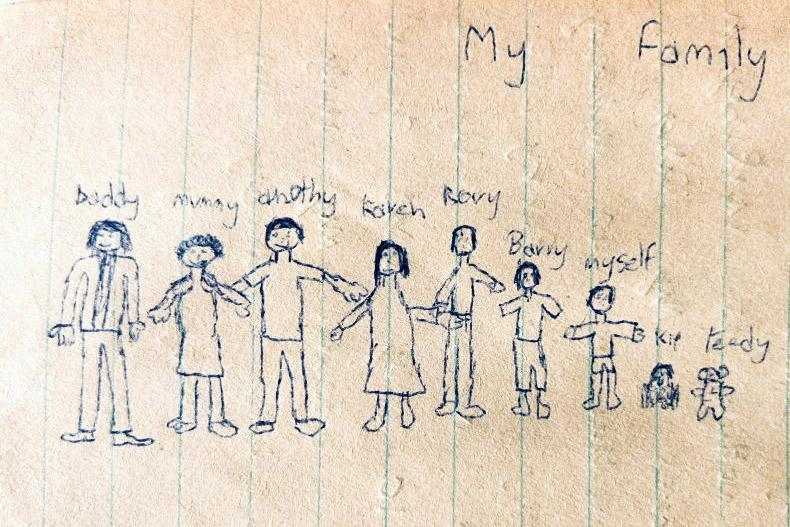
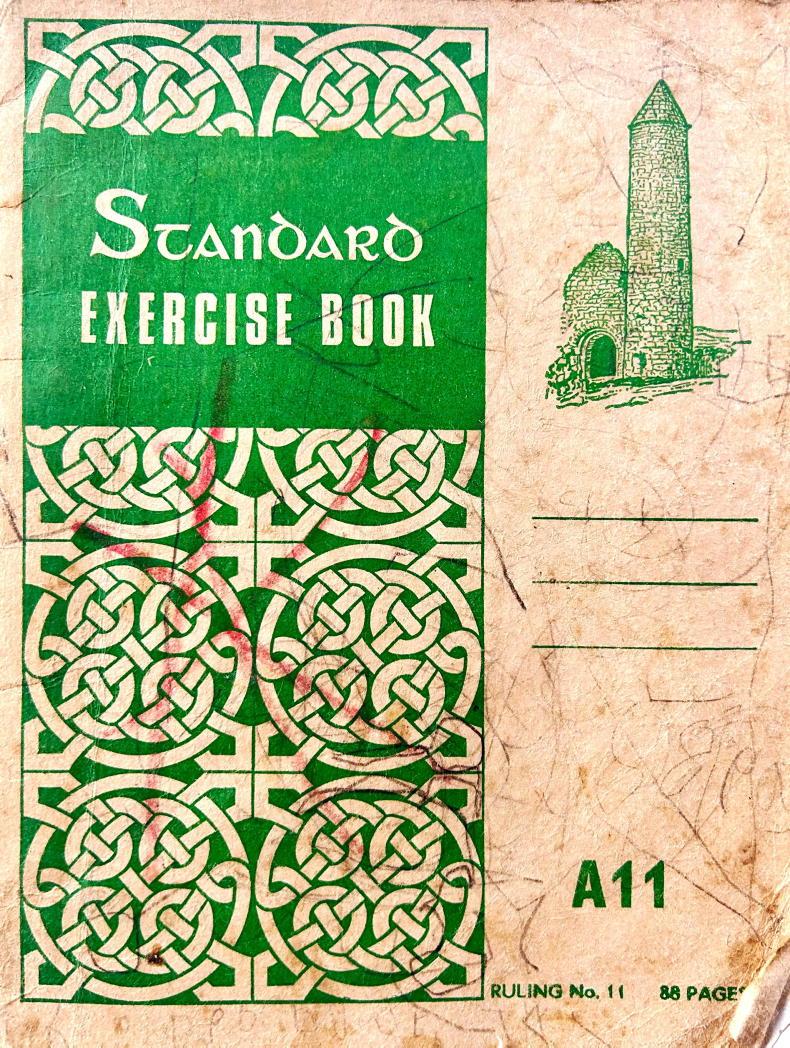
I found one of my old jotters that had survived from my schooldays. It is full of drawings, along with complex sums that contained fractions: ‘I have 111 balls, Barry took 36 ½ , we have 74 ½ !’ Each day we wrote the ‘news’ and every second day we wrote ‘an nuacht’ in Irish.
A few examples from April 1973 are full of innocence and practicality: “Today is Monday. It is dry and windy. Barry was at the zoo on Saturday. He saw a lot of animals and birds. Eoin was at a party. David, Kevin and Barry got new shoes. Fuair Eoin agus Pádraig bróga nua. Tá siad dubh. Fuair Don cota nua donn.”
In between different classes, we had to adhere to the command ‘téigh a chodladh’ where you had to feign sleep and bury your head in your folded arms on the desk. This allowed the teacher to prepare the next lesson.
My favourite subject was art and we created unhindered magical creations with crepe paper, glue, newsprint, crayons, gum and cotton wool. I can still vividly remember the feel of each. It fuelled our imaginations and creativity.
Another favourite was our nature study table, full of tory tops [pine cones], hazelnuts, acorns and chessies, leaves from all the trees and tadpoles in a bowl.
I think back to those first days of wonder and express my thanks to all the marvellous teachers who invested their time and incredible patience, to start us all on the never-ending journey of education.
Shane Lehane is a folklorist who works in UCC and Cork College of FET, Tramore Road Campus. Contact: slehane@ucc.ie


SHARING OPTIONS