



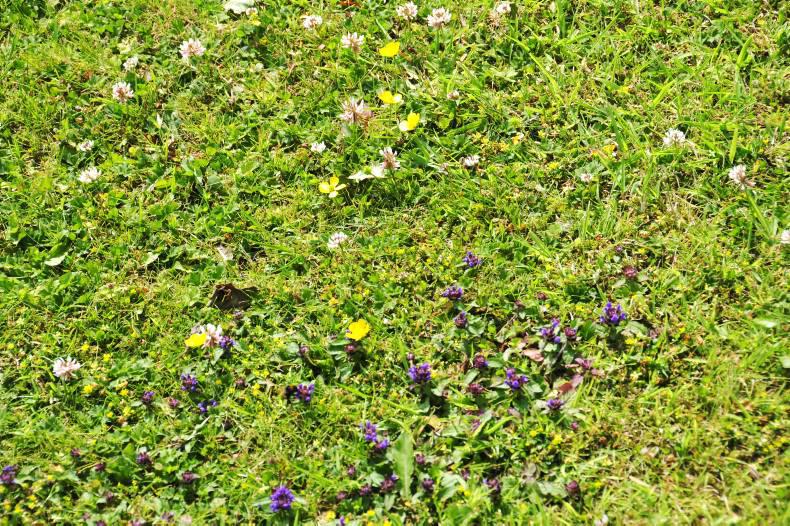
The traditional green-velvet approach requires frequent mowing, at least once a week, feeding at least twice each year and the control of moss and lawn weeds by spraying with lawn weedkillers every two to three years. But there are two separate approaches that can be undertaken for more eco-friendly lawn care: a wild flower lawn or a wild flower meadow.
A wild flower meadow is treated very much like a traditional hay meadow – it is allowed to grow from March or April until the end of June or early July, before mowing and the removal of the cut grass. Then it’s mown once each month until October.
While this approach is suitable for large areas of lawn, especially those with lots of spring bulbs, by allowing them to die back, it has the drawback of requiring a mowing machine capable of cutting tall grass and the inconvenience of having to remove the mown grass. This management system might not be suitable for a farm garden because the area involved is too small, or access is poor, or the soil too soft to allow machinery over it, and wild flower meadows are really only suitable for parks or large estates.
However, a wild flower lawn offers a good alternative to a high-maintenance lawn. Its management system mimics old-style grazed pasture, but the lawnmower does the grazing.
The advantage of this approach is that an ordinary lawnmower can be used with ease of access and manoeuvrability. It is easy enough to convert an existing lawn into a lawn managed to encourage wild flowers. Many lawns are already halfway to being wild flower lawns anyway, so why not go the rest of the way with it.
To manage a wild flower lawn, the key point is to place the emphasis on broad-leaved plants in the sward rather than on the grasses, and weedkillers are never used on a wild flower lawn. Fertilizers are not used on a pasture lawn either, except very occasionally if the growth of the sward becomes very weak. But if fertilizer is used it should not be the high-nitrogen kinds, but a balanced, general fertilizer, such as 10-10-20 at 15g per square metre.
Daisies, white and red clover, buttercups, dandelions, self-heal, hawkweed and bird’s foot trefoil will thrive, while coarse weeds such as nettles and docks will struggle under regular mowing. Raise the level of the mowing blades to the second highest stop on the height adjuster.
Mowing should start with one cut in January, February and March. When growth picks up, mowing will be required more regularly, between fortnightly and three-week intervals – depending on the rate of growth of the lawn.
As the wild flower lawn matures and the rate of grass growth declines, it will be easier to mow and the lawn will require less frequent mowing. The regular cutting away of flower heads keeps the plants flowering much longer than they would naturally.
The mown grass should be removed from the wild flower lawn until about the middle of May. A wild flower lawn would suit many rural gardens, especially those with an informal atmosphere.
A sward of wild flowers, not mown too tight, is much more natural and there is the considerable advantage of the wild flower lawn that it is actually easier to maintain, along with reduced expense.





SHARING OPTIONS