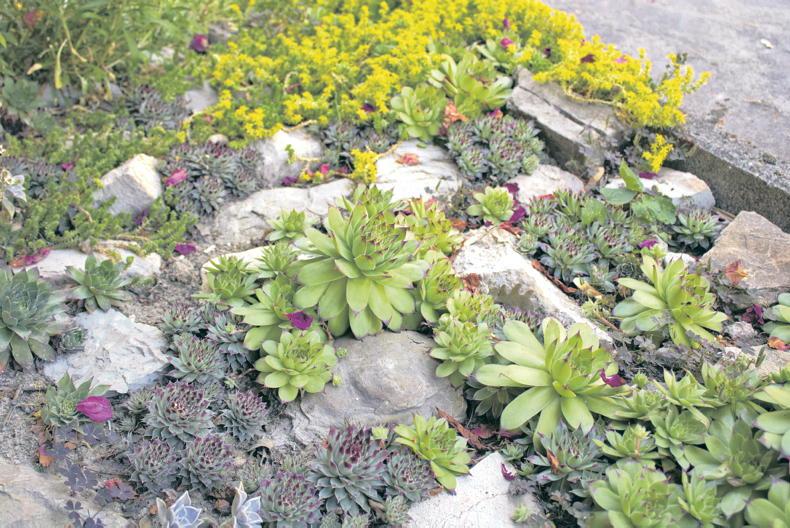
During late spring and early summer, one of the most colourful areas of our garden is the rockery embankment featuring a display of alpines, dwarf shrubs, miniature conifers and low-growing perennials.
Rock or gravel features suit gardens of all sizes and can be adapted to many spaces – an alpine trough, an old stone wall, a challenging steep slope, a downward-sloping garden or a sunny border can all be used to create a form of rock garden.
For those with busy lives, being low maintenance and easy to care for adds to the appeal, and they can provide year-round interest with minimal effort.
A rock garden is more than a bed or pile of soil with scattered stones – it is a carefully designed feature where rocks and plants are equally important. Inspired by alpine or Mediterranean landscapes, plants are nestled between stones, often with gravel paths weaving through.
To build a rock garden, choose a sunny, well-drained site and use a mix of rock sizes, gravel and a gritty, free-draining planting medium. Locally sourced stone will help the feature sit naturally in its surroundings.
Start by clearing any weeds from the area. If your site is completely flat, consider bringing in additional topsoil to create height and interest with varying levels and contouring. Then, position the largest rocks first to establish the shape and foundation of your design.
Set the rocks so that about a third of their depth is buried in the ground, tilting them slightly back and with the grain or strata of each one aligned and running the same way for natural effect. Add smaller rocks and use them to form ledges and crevices, infilling behind and around them with a gritty planting medium, ideally made up of equal parts loam, horticultural grit and leaf mould.
Arrange plants before planting to refine their layout. Some of the easiest and most reliable rock garden plants include cultivars of aubretia, helianthemum, saxifraga, sedums, Campanula portenschlagiana, Persicaria affinis, Euphorbia myrsinites, Iberis sempervirens or candytuft, and succulents, like sempervivums.
For extra colour, add early spring and summer bulbs, such as crocus, dwarf narcissi, species tulips and Iris reticulata.
To punctuate a predominance of low, spreading plants, and introduce height, focal points and contrasting textures, include dwarf ornamental grasses like Hakonechloa macra ‘Aureola’, miniature conifers and compact shrubs. Finish with a mulch of gravel or pebbles to suppress weed growth and reduce moisture evaporation, and consider decorative touches such as driftwood or a water feature.
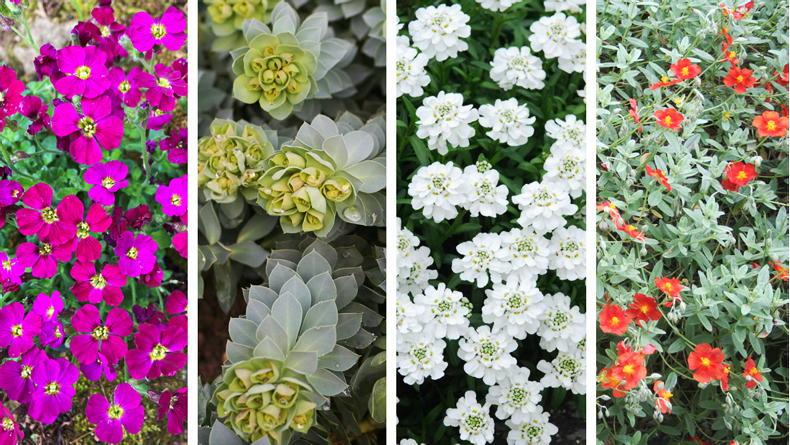
Left to right: Aubretia Axcent Burgundy, Euphorbia myrsinites, Iberis sempervirens, Helianthemum ‘Firedragon’
Feeding roses
Last year, some of our hybrid tea and floribunda roses were a bit lacklustre. To improve their performance this season, I plan to give them a regular foliar feed with liquid seaweed extract, applying it about once a month during the growing season.
Early April, as the young leaves unfurl, is the ideal time to make the first application.
Seaweed extract is an excellent organic feed and, when applied as a foliar spray to roses, it can be highly beneficial. The foliage becomes a deeper green, flowering is enhanced with more and better-quality blooms, stems are stronger, pest and disease resistance is improved, and overall growth is healthier.
Applying seaweed extract as a foliar feed involves spraying it as a dilute liquid onto the leaves of the plant rather than applying it the soil.
The plant’s leaves absorb the feed directly via the leaf surface and through tiny pores (stomata) mostly located on their undersides. Foliar feeds are best applied late in the evening or early in the morning (before 9am or after 4pm) when the leaf pores are open and it is cooler.
Never apply during the hottest part of the day. Use a sprayer to mist both the top and underside of the leaves until leaves are wet but not dripping. Young, tender leaves absorb the spray more efficiently than mature, waxy leaves. Avoid spraying immediately before or during rain.
Q&A: Will my bulbs flower next year?

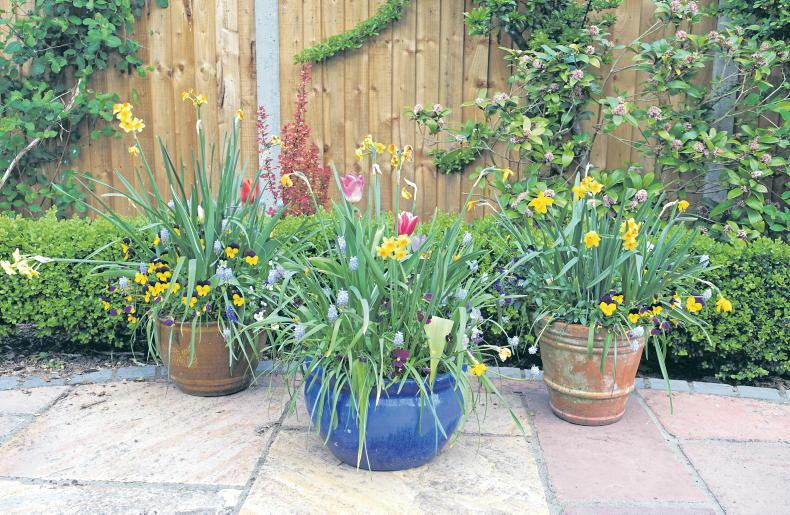
Potted spring flowers. \iStock
I want to leave some bulbs in containers for next year – but will they flower? – Mary, Co Donegal
Yes. Hardy bulbs, like daffodils, tulips and crocus, can stay outdoors in their containers all year round. For a good display of blooms next year, feed with a high-potash fertiliser after flowering. Deadhead the faded flowers and allow the foliage to die back naturally.
Move pots to a less prominent position and reduce watering as the foliage fades. Store in a cool, dry place through summer while the bulbs are dormant.
Consider removing the bulbs from the pot in early autumn, separating them if they are too crowded, and replanting with fresh compost. If you leave the bulbs undisturbed in the pots, top up or replace the top layer of compost with fresh, new compost. While hardy bulbs can stay outside over winter, keeping them in a sheltered spot protects them from freezing solid.
Lawns: clear away all grass and weeds from a circle of 1.5m diameter around young trees to lessen competition for moisture and nutrients which can reduce growth in the early years by up to 50%.
Growth: tie in vigorous new growth on
climbers like clematis, rambling roses and honeysuckle.
Support: put supports in place early for perennials that tend to flop over, such as delphiniums, lupins, peonies, tall campanulas and alstroemerias, before there is too much growth. The plants will then grow through the support and hide it from view.
Mary Keenan and Ross Doyle run Gash Gardens, Co Laois. See gashgardens.ie

During late spring and early summer, one of the most colourful areas of our garden is the rockery embankment featuring a display of alpines, dwarf shrubs, miniature conifers and low-growing perennials.
Rock or gravel features suit gardens of all sizes and can be adapted to many spaces – an alpine trough, an old stone wall, a challenging steep slope, a downward-sloping garden or a sunny border can all be used to create a form of rock garden.
For those with busy lives, being low maintenance and easy to care for adds to the appeal, and they can provide year-round interest with minimal effort.
A rock garden is more than a bed or pile of soil with scattered stones – it is a carefully designed feature where rocks and plants are equally important. Inspired by alpine or Mediterranean landscapes, plants are nestled between stones, often with gravel paths weaving through.
To build a rock garden, choose a sunny, well-drained site and use a mix of rock sizes, gravel and a gritty, free-draining planting medium. Locally sourced stone will help the feature sit naturally in its surroundings.
Start by clearing any weeds from the area. If your site is completely flat, consider bringing in additional topsoil to create height and interest with varying levels and contouring. Then, position the largest rocks first to establish the shape and foundation of your design.
Set the rocks so that about a third of their depth is buried in the ground, tilting them slightly back and with the grain or strata of each one aligned and running the same way for natural effect. Add smaller rocks and use them to form ledges and crevices, infilling behind and around them with a gritty planting medium, ideally made up of equal parts loam, horticultural grit and leaf mould.
Arrange plants before planting to refine their layout. Some of the easiest and most reliable rock garden plants include cultivars of aubretia, helianthemum, saxifraga, sedums, Campanula portenschlagiana, Persicaria affinis, Euphorbia myrsinites, Iberis sempervirens or candytuft, and succulents, like sempervivums.
For extra colour, add early spring and summer bulbs, such as crocus, dwarf narcissi, species tulips and Iris reticulata.
To punctuate a predominance of low, spreading plants, and introduce height, focal points and contrasting textures, include dwarf ornamental grasses like Hakonechloa macra ‘Aureola’, miniature conifers and compact shrubs. Finish with a mulch of gravel or pebbles to suppress weed growth and reduce moisture evaporation, and consider decorative touches such as driftwood or a water feature.

Left to right: Aubretia Axcent Burgundy, Euphorbia myrsinites, Iberis sempervirens, Helianthemum ‘Firedragon’
Feeding roses
Last year, some of our hybrid tea and floribunda roses were a bit lacklustre. To improve their performance this season, I plan to give them a regular foliar feed with liquid seaweed extract, applying it about once a month during the growing season.
Early April, as the young leaves unfurl, is the ideal time to make the first application.
Seaweed extract is an excellent organic feed and, when applied as a foliar spray to roses, it can be highly beneficial. The foliage becomes a deeper green, flowering is enhanced with more and better-quality blooms, stems are stronger, pest and disease resistance is improved, and overall growth is healthier.
Applying seaweed extract as a foliar feed involves spraying it as a dilute liquid onto the leaves of the plant rather than applying it the soil.
The plant’s leaves absorb the feed directly via the leaf surface and through tiny pores (stomata) mostly located on their undersides. Foliar feeds are best applied late in the evening or early in the morning (before 9am or after 4pm) when the leaf pores are open and it is cooler.
Never apply during the hottest part of the day. Use a sprayer to mist both the top and underside of the leaves until leaves are wet but not dripping. Young, tender leaves absorb the spray more efficiently than mature, waxy leaves. Avoid spraying immediately before or during rain.
Q&A: Will my bulbs flower next year?

Potted spring flowers. \iStock
I want to leave some bulbs in containers for next year – but will they flower? – Mary, Co Donegal
Yes. Hardy bulbs, like daffodils, tulips and crocus, can stay outdoors in their containers all year round. For a good display of blooms next year, feed with a high-potash fertiliser after flowering. Deadhead the faded flowers and allow the foliage to die back naturally.
Move pots to a less prominent position and reduce watering as the foliage fades. Store in a cool, dry place through summer while the bulbs are dormant.
Consider removing the bulbs from the pot in early autumn, separating them if they are too crowded, and replanting with fresh compost. If you leave the bulbs undisturbed in the pots, top up or replace the top layer of compost with fresh, new compost. While hardy bulbs can stay outside over winter, keeping them in a sheltered spot protects them from freezing solid.
Lawns: clear away all grass and weeds from a circle of 1.5m diameter around young trees to lessen competition for moisture and nutrients which can reduce growth in the early years by up to 50%.
Growth: tie in vigorous new growth on
climbers like clematis, rambling roses and honeysuckle.
Support: put supports in place early for perennials that tend to flop over, such as delphiniums, lupins, peonies, tall campanulas and alstroemerias, before there is too much growth. The plants will then grow through the support and hide it from view.
Mary Keenan and Ross Doyle run Gash Gardens, Co Laois. See gashgardens.ie

SHARING OPTIONS