



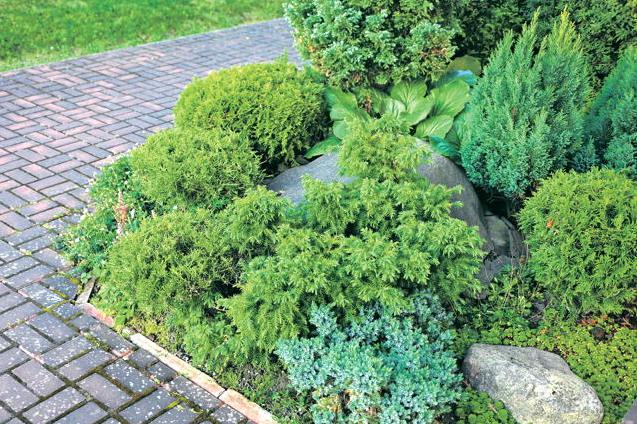
Conifers are cone-bearing trees and we are most familiar with tall, stately examples such as pine, fir and monkey puzzle. Many are parkland trees and have a presence commanding attention.
Beautiful as they are, few gardens can accommodate such large specimens. But conifers can have a place in our gardens too, even in areas that are small.
We frequently see these small spaces left abandoned because the perfect specimens cannot be found to create a pleasant scene, possibly around the edges of a driveway or adjacent to patios.
But dwarf conifers can be a solution in this instance. Many are small rounded plants or have a creeping habit. They have an all year-round presence and blend well with a huge range of other miniature plants.
These dwarf conifers also work well in pots and planters.
Abies is commonly known as the Fir and is capable of reaching enormous heights, regularly used as Christmas trees in our homes.
However, the dwarf conifer Abies koreana ‘Brilliant’ grows to a maximum height of 40cm forming a round small shrub with bright olive-green leaves that remind me of miniature bottle-brushes.
A. koreana ‘Green Carpet’ is a neat spreading mound 50cm high and a little over 1m wide. Its foliage is densely packed, light green in spring and darker during summer. At maturity its foliage tips are adorned with upright small cones violet-pink in colour. Both of these do well in a bright area but need some shade from scorching summer sun.
Tsuga canadensis is commonly called Hemlock and again a tall stately tree. T canadensis ‘Cole’s Prostrate’ is a prostrate version of that very large Canadian Hemlock. It is a slow-growing conifer achieving 50cm in height, hugging the ground with stems covered in dark-green needles.
Likewise, Cedrus deodara, is an elegant parkland tree renowned for its pendulous tips at the end of its branches.
C. deodara ‘Feelin Blue’ is a recent introduction and is in stark contrast to its parent. It is low growing to 50cm with trailing branches of silvery blue needle-like foliage, truly beautiful.
Prickly to touch
Juniper is the most commonly used conifer when we want dense ground cover. Juniperus communis ‘Green Carpet’ is a prostrate creeping plant growing to 30cm in height. Its bright green foliage is somewhat prickly to touch. If keeping people to the path is required this does the job well.
J. squamata ‘Blue Carpet’ is also prostrate, growing to 30cm in height. It differs from the former in that its foliage is silvery-blue, one of its major selling points. It is bright and cheery all year long. If that is hard to find, look for J. horizontalis ‘Blue Chip’, another prostrate grower spreading to 3m wide and 50cm high. It has blue-green foliage that adopts purple tones in cool winter weather.
Juniperus horizontalis ‘Pancake’ is well named, I have seen it described as the ‘flattest evergreen conifer on the planet’ growing to approximately 8cm high with a spread of 3m. It is well suited to rockeries, gravel gardens and slopes. One of its charming features is that it can root as it grows, providing you with extra plants to use or to share, always handy to have.
Dwarf conifers are relatively trouble free once some basic preparations are made in advance of planting. Now is a great time of the year to do this work as the soil is still warm from summer heat and workable.
The site should be open and well drained, the soil should be dug over and made weed free, particularly of perennial weeds. The site can be level or sloped and usually close to the home. Alternatively, it could be a garden feature perhaps by a seating area within the garden itself.
My advice is to feature them on their own as they can get easily overgrown by other garden shrubs or perennials. Having said that I do not suggest that a planting bed in isolation is wise but rather use the idea to extend other planted beds, creating a feature.
After planting, mulch the bed with round washed pebble to a depth of 6cm. To cater for this, plant all specimens a little higher than normal. All plants mentioned are available from wholesale nurseries in Ireland so your local garden centre should be able to source them for you.
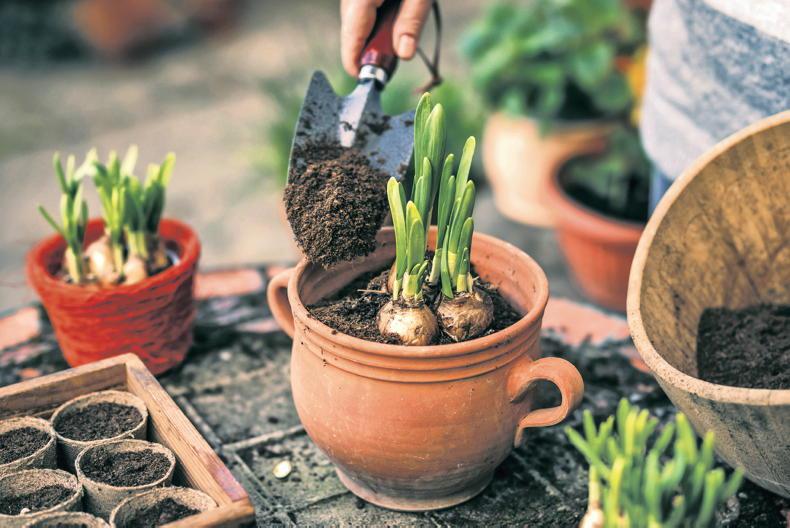
I plan to plant up pots and planters with bulbs this year instead of in the ground, can you advise as to a good compost to use – Julie, Co. Wexford.
What a nice idea and it is important for a good outcome to get the compost right. What bulbs need is a good quality free draining compost, so my recommendation is, 50% John Innes Potting Compost No. 2, 30% Horticultural Grit and 20% of very fine bark mulch.
Mix that well and pot up the bulbs in that, firming as you go. Bear in mind that the most up-to-date recommendation is to plant bulbs deep, three times their size.
Cover the top of the pots with a layer of grit to retain moisture and keep weeds a bay.
Lawns: lawns are now in full growth and overcoming the drought of summer. Any bare patches can be lightly dug and levelled ready for sowing now while the soil is still warm.
Perennials: late flowering perennials are still in full flower, early flowering ones can now be reduced by half. Now is a good time to start lifting and dividing. Make sure to safeguard labels.
Annuals: as they are now past their best, all pots and planters should be cleared and fresh compost added to prepare for spring displays. Check out your local garden centre for bulbs.
Trees & Shrubs: soil is warm after the summer heat so continue with plans for planting and transplanting.
Do you have a gardening question? Email icl@farmersjournal.ie or post to Irish Country
Living, Irish Farm Centre, Bluebell, Dublin 12.



SHARING OPTIONS