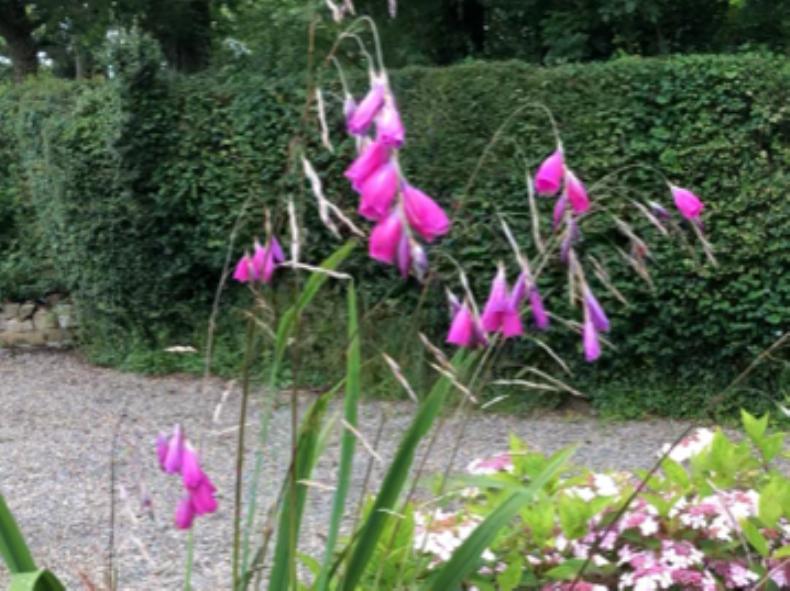
Dierame is alos known as angel’s fishing rod, fairybell and wandflower.
ADVERTISEMENT
I well remember the very first thing I ever grew. I was living in Sandymount with a gang of friends and the house we were in had a big front garden. The only thing it grew was grass. At home I had been used to creating a border of those sturdy annuals – blue lobelia and white assylum – so I gave them a shot and they turned out great. Everyone in the house thought I was mad, but I was delighted with myself.
When I came to live in Ballyanne the first thing I grew was a tray of bright orange marigolds and it took me a while to graduate to the next class and try growing some herbaceous perennials. There was one special plant that I really wanted to grow only I didn’t think I’d succeed or had the soil to suit it.
The flower in question is dierama and I only began growing it three years ago. They say you know a good plant by the number of common names it has and if that’s the case, then this plant is a winner. It’s also known as .
ADVERTISEMENT
It’s native to the southern part of Africa and is one of the iris family. It has to be one of the most elegant flowers you can grow with its arching flower stems and bell shaped blooms that range in colour from pink to deep red.
It likes a nice sunny spot with free-draining soil that doesn’t dry out. I have two clumps which produced just one or two flower stems each in their first year. They are now producing more than a dozen stems each. I haven’t divided them yet and don’t intend to until they get stronger. But when the time comes just lift an established clump and cut it into sections and replant. Give it a go.
Register for free to read this story and our free stories.
This content is available to digital subscribers and loyalty code users only. Sign in to your account, use the code or subscribe to get unlimited access.
The reader loyalty code gives you full access to the site from when you enter it until the following Wednesday at 9pm. Find your unique code on the back page of Irish Country Living every week.
CODE ACCEPTED
You have full access to the site until next Wednesday at 9pm.
CODE NOT VALID
Please try again or contact support.
I well remember the very first thing I ever grew. I was living in Sandymount with a gang of friends and the house we were in had a big front garden. The only thing it grew was grass. At home I had been used to creating a border of those sturdy annuals – blue lobelia and white assylum – so I gave them a shot and they turned out great. Everyone in the house thought I was mad, but I was delighted with myself.
When I came to live in Ballyanne the first thing I grew was a tray of bright orange marigolds and it took me a while to graduate to the next class and try growing some herbaceous perennials. There was one special plant that I really wanted to grow only I didn’t think I’d succeed or had the soil to suit it.
The flower in question is dierama and I only began growing it three years ago. They say you know a good plant by the number of common names it has and if that’s the case, then this plant is a winner. It’s also known as .
It’s native to the southern part of Africa and is one of the iris family. It has to be one of the most elegant flowers you can grow with its arching flower stems and bell shaped blooms that range in colour from pink to deep red.
It likes a nice sunny spot with free-draining soil that doesn’t dry out. I have two clumps which produced just one or two flower stems each in their first year. They are now producing more than a dozen stems each. I haven’t divided them yet and don’t intend to until they get stronger. But when the time comes just lift an established clump and cut it into sections and replant. Give it a go.
If you would like to speak to a member of our team, please call us on 01-4199525.
Link sent to your email address
We have sent an email to your address. Please click on the link in this email to reset your password. If you can't find it in your inbox, please check your spam folder. If you can't find the email, please call us on 01-4199525.
ENTER YOUR LOYALTY CODE:
The reader loyalty code gives you full access to the site from when you enter it until the following Wednesday at 9pm. Find your unique code on the back page of Irish Country Living every week.
SHARING OPTIONS