



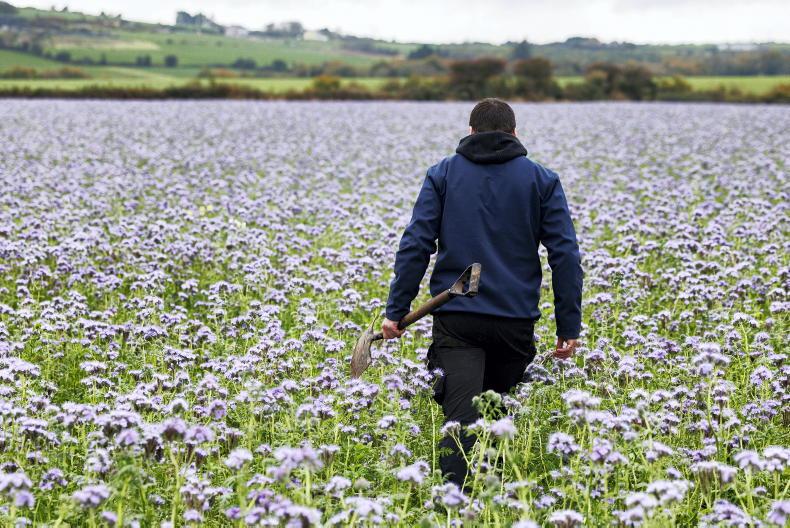
Across the country at present, there are fields of colourful crops - many of them look purple or blue and in the coming weeks we are likely to see more colour fill the horizon with yellow and pink flowers.
These crops are catch crops and while farmers grow them each year, this year has seen an explosion of colour across the main tillage regions of the country as the Farming for Water European Innovation Partnership (EIP) project has piloted a new scheme for farmers to grow these crops.
The scheme pays farmers significantly more money for growing these crops than the Department of Agriculture’s ACRES scheme and there has been huge uptake.
Why grow these crops?
Farmers are paid to grow these crops to have a cover on land after the main crop has been harvested and before the next crop is planted.
This cover, or catch, crop covers the ground to protect it from bad weather and erosion and to catch nutrients that may be left in the ground that could otherwise be lost in wet periods or heavy rainfall and make its way to streams and rivers.
Many farmers have planted these crops for years and, in recent times, some have been paid to grow these crops under environmental schemes.

However, some farmers have found the rules around these schemes too restrictive, as they had to plant the crops in years where the weather was extremely bad, for example.
However, the new scheme gives farmers the option to plant when conditions are suitable and to grow both short- and long-term crops on their farms.
The farmers will then be paid for whatever area they grow, as opposed to having to sow crops in poor conditions when they could possibly still be trying to harvest crops or move straw.
The higher payments also offer farmers some bit of profit from growing the crops and so provide a bigger incentive to grow them.
What are the plants being grown?
How much are farmers paid?
Under ACRES, farmers are paid €173.20/ha and must plant by 15 September and leave crops in place until 1 January.
Under the Farming for Water pilot, farmers have two options.
The first is to plant by 1 August, leave the crop in place until 30 September and be paid €173/ha. The second option is to plant by 1 September, leave in place until 1 January and be paid €229/ha.

The cost of growing these crops varies significantly across farms, depending on machinery available and the seed chosen. Farmers must grow certain types of seed mixes on farms. Their machinery costs could be significantly lower than below.
Seed can cost around from €25 to €60/ha (€10 to €24/ac). Tilling and sowing could be €100/ha (€40/ac) for a contractor and €45/ha for rolling.





SHARING OPTIONS