



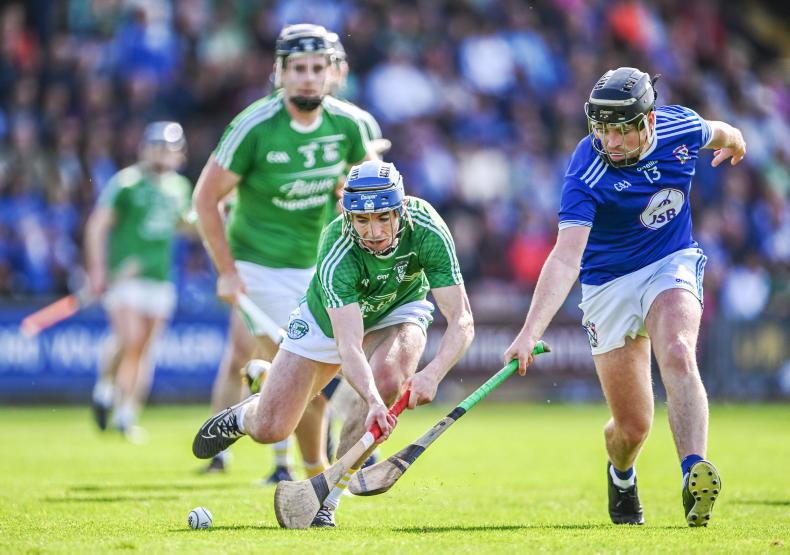
It would be a marvellous thing if the clear demarcation of the GAA season meant that the club action now taking place received the same level of coverage as the inter-county season, but the realists in us all know that that is not the case.
Rightly or wrongly, inter-county is what sells, so if John Kiely or Jack O’Connor make an utterance about something or other, it will generate column inches. Of course, the GAA being the GAA, high-profile people don’t talk unless there’s something they specifically want out there.
In soccer, the transfer market is a golden goose that will never stop laying golden eggs – fans love to be sold the future; especially articles like: “This is what Liverpool will look like if they sign Kylian Mbappé, Lionel Messi and Erling Haaland!”.
However, that avenue is blocked off bar certain exceptions here – witness the collective craziness when Seánie Johnston looked to move to Cavan from Kildare – so the handiest thing to fill the news cycle is the managerial merry-go-round.
It wasn’t always thus, primarily because managers didn’t exist. A selection committee would be appointed by each county board, usually chaired by a representative from the county champions, and they in turn would appoint a ‘trainer’.
Power of personality
The 1970s was when the idea of a proper figurehead began to emerge, thanks in no small part to the power of personality of Kevin Heffernan in Dublin and Kerry’s Mick O’Dwyer.
Now, when players are rarely interviewed unless they’re being paid by a company looking to promote something, the managers are the media conduits and their profiles are higher than ever before.
So, the levels of intrigue around job changes do attract the collective curiosity.
Last year, the hurling occurrences – when Liam Cahill moved to Tipperary, who dispensed with Colm Bonnar, and Davy Fitzgerald filled the vacancy that arose in Waterford as a result, Pat Ryan took the Cork job and Derek Lyng was appointed as Brian Cody’s successor in Kilkenny – was box-office stuff.
As was the year before, when Fitzgerald looked to be heading to Galway only for the job to go to Henry Shefflin.
Because most managers are appointed on two or three-year terms, such a feast is by definition followed by something of a famine and the pickings are slimmer this time around.
Exclusive club
Wexford opted not to offer a new term to outgoing manager Darragh Egan – the Tipperary man is in an exclusive club in hurling history in that his last match was a win over Kilkenny – but the Model County moved quickly to avoid too much speculation about a successor as Keith Rossiter was appointed after a good tenure as the county’s U20 boss.
Such a pathway was always quite common but, nowadays, with the advent of county development squads keeping players in a system from a younger age, there does seem to be more of this.
Of the 2023 managerial class, Cahill, Ryan and Lyng have all won All-Ireland U20 titles with their counties while John Kiely, inevitably, was in charge for Limerick’s U21 title of 2017.
There is of course a dual benefit – they pick up experience of managing inter-county sides and work with players who they will be able to reconnect with at senior level, if and when they make the jump.
Rossiter’s appointment comes just as the Wexford senior championship came to an end – Naomh Éanna won their second title, both coming in the past five years, as they denied Oylegate-Glenbrien the chance to end a wait dating back to 1963.
No doubt he will have been watching the games from the point of view of possibly taking over, ready to put his ideas into place. It’s an exciting prospect and no doubt a scary one, but the former full-back is not likely to be short of goodwill.
Quiet
Things had been fairly quiet on the football front, but Declan Bonner’s departure from Donegal had left a vacancy and on Monday night that was filled in a properly dramatic fashion.
Bonner was in his second stint in charge of his native county, returning in 2017, 17 years after his first spell ended. His successor is bridging a gap of ‘only’ nine years, but the fact that Jimmy McGuinness was the man who led to the county to the 2012 All-Ireland means that expectations will automatically be raised upon his return to the hot seat.
Donegal reached the preliminary All-Ireland quarter-finals this year but were well beaten there by Tyrone. The county hasn’t won the Ulster U20 football title since 2017 and last won the provincial minor championship the previous year – while they were outside of the top tier of counties when McGuinness first got the job, the county had reached the 2010 All-Ireland U21 final under him, a team led by the generational talent of Michael Murphy.
It might be harder to reach the pinnacle of the sport second time around, but if anybody can engineer it for Donegal, it’s McGuinness.
With the Rugby World Cup just around the corner, it was interesting to see the players of the Australia women’s rugby team engage in a co-ordinated social media campaign to highlight the disparity between their treatment and that of the men’s team.
The message starts off with the line, “You told us flying anything beyond economy was too costly. Then you flew the Wallabies business class on a trip shorter than ours,” and draws attention to various other incidences of favourable treatment, while pointing out how the success of the Australia women’s soccer team in reaching the World Cup semi-finals shows how women’s sport can be successfully harnessed.
Their grievances mirror those raised in the past by Ireland women’s soccer and rugby teams and show how it is a constant struggle for recognition. Going public might not be the preferred method but sometimes it’s the only way, shaming the decision-makers into action.


SHARING OPTIONS