Whether it’s with the intention of better utilising slurry storage or reducing ash content coming back into the centre passage in silage, the topic of slurry separation is one that’s raising a lot of eyebrows, particularly over the last 12-18 months.
With almost all solutions on the market costing well into the tens of thousands and even into the hundreds of thousands for larger-capacity machines, Kilkenny-based machinery dealer Castle Agri believe they have a novel, lower-cost solution. It is a compact seperator unit designed for in-line use with a slurry tanker vacuum hose, powered via the tractor’s hydraulics.
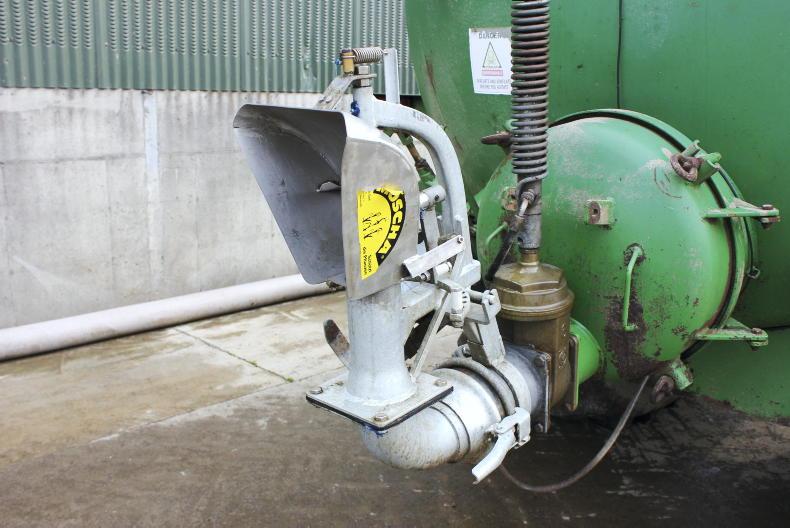
To date, Castle Agri has sold over 2,000 swivel spreaders across Ireland and the UK.
Background
With the idea of reducing grass contamination in mind, it was at Agritechnica in 2013 when Dermot Tobin of Castle Agri first spotted the German-designed Moscha swivel spout slurry applicator.
The simple Moscha system uses the momentum of the pressurised slurry to swivel its outlet in a pendulum manner (similar to a sprinkler system) to effectively throw the slurry in larger droplets onto the surface as opposed to the way in which a splash plate works, spraying the slurry onto the surface with higher force and causing more atomisation.
An internal diverter plate is designed to achieve a consistent spread pattern at widths between 12m and 18m, which can be increased further with a twin and triple applicator on rear T-bar setups. According to Moscha, slurry is ejected from its swivel spreader at approximately 29km/h compared to 42km/h with a traditional splash plate.
Having taken on Irish and UK distribution for the Moscha spreader, Castle Agri has sold over 2,000 units.

The separator works by means of a stainless steel auger.

Moscha currently offer screens/sieves from 2mm to 7mm.
Although there was a drop in sales a few years back due to TAMS funding for dribble bars and trailing shoe systems, the Moscha has recently seen a real renaissance, according to Dermot Tobin.
How it works
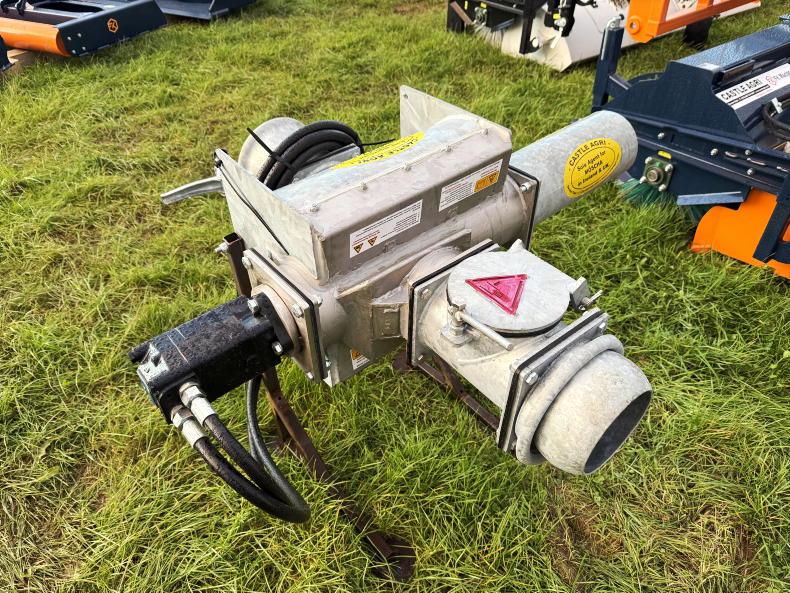
Now, Castle Agri has another novel solution within its arsenal, the Moscha in-line slurry separator. The compact, novel unit is fully constructed from stainless steel and is designed to sit stationary in the farm yard at the tank’s manhole.
It is fitted in line with the vacuum hose between the farm tank (inlet side) and slurry tanker (outlet side). It operates during the vacuuming phase as the slurry is sucked through, like an inline filter.
A single hydraulic motor, run off the tractor’s spools, requiring 10-15l/min works to squeeze out the liquid element.
Meanwhile, the solid element is deposited on the surface or into a bucket/trailer depending on how the unit is set up. Instead of long hydraulic hoses running the length of the tanker, a neater solution would be to route the hydraulic hoses down through the chassis of the tanker to a quick-release coupling at the rear.
For each load, the operator would simply connect up the coupling and engage the spool on constant during the vacuum or filling phase. The unit has an inspection flap as standard for easy cleaning.

The Moscha swivel spreaders are designed to throw the slurry onto the surface in larger droplets causing less leaf contamination compared to traditional splash plates.
The benefits
Dermot’s vision is that hire work will see the unit transported to each farm by the tractor towing the slurry tanker, but it remains stationary in the yard during spreading.
Since slurry is separated upon entering the tanker, Dermot believes that this is a solution that should, in theory, suit Irish farmers as many don’t have additional storage capacity on farm for the separated liquid fraction.
“One separator unit on a farm could keep three to four tankers going no issue, as they all pull off the same unit,” Dermot outlines.
He also notes that he has had farmers asking about its potential already in various types of scenarios, like those with small underground holding tanks and using the Moscha separator during the transfer process to the overground silo every few days and having only the liquid fraction going into the tower. It would mean a gain in storage capacity, reduction in odours and less volatilisation as no agitation would be required.
“All this, along with easy application in the springtime and no worries with sward contamination, is what’s creating the most interest. Farmers that are zero grazing and following on with slurry tankers are interested too, as this system will reduce grass contamination issues with summer sunshine drying out the slurry on the ground,” Dermot noted.
Moscha claims fast separation of up to 2,000 l/min, but Dermot stresses this will clearly depend on a host of various factors.
“The reality is that it needs to work along with the tanker and keep up with it, but cattle fed round bales compared to cattle on a precision chop silage and TMR diets generally means totally different slurry consistency. Other influential factors include different tanks, PTO speed, sieve size, vacuum pump wear, how well agitated it is, head height of slurry etc.”
Moscha offer sieves from 2mm–7mm, depending on customer requirements.
Castle Agri hopes to retail the unit for under €10,000 plus VAT.
If the unit gets TAMS approval, as Dermot hopes it will, he believes that it should allow farmers to get real value from slurry,in an affordable manner without some of the current issues being seen.
Our comment
While the Moscha separator has the potential to be a budget-friendly solution for smaller farms, it will not achieve the same performance as a higher-end screw press. In addition, we would be curious to find out how long extra the tanker would take to fill while separating and how much extra wear would it place on the vacuum pump over time?
Whether it’s with the intention of better utilising slurry storage or reducing ash content coming back into the centre passage in silage, the topic of slurry separation is one that’s raising a lot of eyebrows, particularly over the last 12-18 months.
With almost all solutions on the market costing well into the tens of thousands and even into the hundreds of thousands for larger-capacity machines, Kilkenny-based machinery dealer Castle Agri believe they have a novel, lower-cost solution. It is a compact seperator unit designed for in-line use with a slurry tanker vacuum hose, powered via the tractor’s hydraulics.
To date, Castle Agri has sold over 2,000 swivel spreaders across Ireland and the UK.
Background
With the idea of reducing grass contamination in mind, it was at Agritechnica in 2013 when Dermot Tobin of Castle Agri first spotted the German-designed Moscha swivel spout slurry applicator.
The simple Moscha system uses the momentum of the pressurised slurry to swivel its outlet in a pendulum manner (similar to a sprinkler system) to effectively throw the slurry in larger droplets onto the surface as opposed to the way in which a splash plate works, spraying the slurry onto the surface with higher force and causing more atomisation.
An internal diverter plate is designed to achieve a consistent spread pattern at widths between 12m and 18m, which can be increased further with a twin and triple applicator on rear T-bar setups. According to Moscha, slurry is ejected from its swivel spreader at approximately 29km/h compared to 42km/h with a traditional splash plate.
Having taken on Irish and UK distribution for the Moscha spreader, Castle Agri has sold over 2,000 units.
The separator works by means of a stainless steel auger.
Moscha currently offer screens/sieves from 2mm to 7mm.
Although there was a drop in sales a few years back due to TAMS funding for dribble bars and trailing shoe systems, the Moscha has recently seen a real renaissance, according to Dermot Tobin.
How it works
Now, Castle Agri has another novel solution within its arsenal, the Moscha in-line slurry separator. The compact, novel unit is fully constructed from stainless steel and is designed to sit stationary in the farm yard at the tank’s manhole.
It is fitted in line with the vacuum hose between the farm tank (inlet side) and slurry tanker (outlet side). It operates during the vacuuming phase as the slurry is sucked through, like an inline filter.
A single hydraulic motor, run off the tractor’s spools, requiring 10-15l/min works to squeeze out the liquid element.
Meanwhile, the solid element is deposited on the surface or into a bucket/trailer depending on how the unit is set up. Instead of long hydraulic hoses running the length of the tanker, a neater solution would be to route the hydraulic hoses down through the chassis of the tanker to a quick-release coupling at the rear.
For each load, the operator would simply connect up the coupling and engage the spool on constant during the vacuum or filling phase. The unit has an inspection flap as standard for easy cleaning.
The Moscha swivel spreaders are designed to throw the slurry onto the surface in larger droplets causing less leaf contamination compared to traditional splash plates.
The benefits
Dermot’s vision is that hire work will see the unit transported to each farm by the tractor towing the slurry tanker, but it remains stationary in the yard during spreading.
Since slurry is separated upon entering the tanker, Dermot believes that this is a solution that should, in theory, suit Irish farmers as many don’t have additional storage capacity on farm for the separated liquid fraction.
“One separator unit on a farm could keep three to four tankers going no issue, as they all pull off the same unit,” Dermot outlines.
He also notes that he has had farmers asking about its potential already in various types of scenarios, like those with small underground holding tanks and using the Moscha separator during the transfer process to the overground silo every few days and having only the liquid fraction going into the tower. It would mean a gain in storage capacity, reduction in odours and less volatilisation as no agitation would be required.
“All this, along with easy application in the springtime and no worries with sward contamination, is what’s creating the most interest. Farmers that are zero grazing and following on with slurry tankers are interested too, as this system will reduce grass contamination issues with summer sunshine drying out the slurry on the ground,” Dermot noted.
Moscha claims fast separation of up to 2,000 l/min, but Dermot stresses this will clearly depend on a host of various factors.
“The reality is that it needs to work along with the tanker and keep up with it, but cattle fed round bales compared to cattle on a precision chop silage and TMR diets generally means totally different slurry consistency. Other influential factors include different tanks, PTO speed, sieve size, vacuum pump wear, how well agitated it is, head height of slurry etc.”
Moscha offer sieves from 2mm–7mm, depending on customer requirements.
Castle Agri hopes to retail the unit for under €10,000 plus VAT.
If the unit gets TAMS approval, as Dermot hopes it will, he believes that it should allow farmers to get real value from slurry,in an affordable manner without some of the current issues being seen.
Our comment
While the Moscha separator has the potential to be a budget-friendly solution for smaller farms, it will not achieve the same performance as a higher-end screw press. In addition, we would be curious to find out how long extra the tanker would take to fill while separating and how much extra wear would it place on the vacuum pump over time?







SHARING OPTIONS