



Growing up on a mixed dairy, beef and tillage farm, Brian Roche had a passion for farming and engineering from a very young age. He recalls using equipment in the farm workshop at the age of nine, and his father asking him to stop while he was milking, as it was drawing too much current from the milking parlour.
After leaving school, Brian was successful in his application for an apprenticeship with Bord na Móna on plant fitting with machinery manufacturing. Brian acknowledges that, at the time, it was a sought-after programme, and that he was lucky to get in.
“The Bord na Móna apprenticeship was excellent,” he said. “The work varied from repairs right through to full-scale machine manufacturing.
“The job taught me to do a job right, with the focus being on high-quality work rather than output. We worked on a lot of unique machinery, and built many machines from scratch, such as ridgers and peat harvesters.
“The in-house workshop had lathes, milling gear, presses and gas equipment that would pre-date the modern-day lasers and plasma cutters. It was a real eye-opener for me and I learned a lot of what I know today in Bord na Móna,” Brian said.
Opportunity
“Once qualified in 2004/05, I decided to go to Australia for a year,” he said.
“I worked on sites for a few months and then went to work on a 120,000-acre tillage farm, which offered a brilliant experience. I came home to do the green cert, with the intention of going back to Australia again afterwards.
“While I was home, an opportunity came up to buy the equipment and rent the premises belonging to the highly regarded John Perry in Tynagh, a local engineering repairs business. I took out a loan from the bank, and it started from there in 2006.
“The business was focused on repairing turf gear and general agricultural machinery, as well as manufacturing hydraulic cylinders. I learned a lot about common failures on different types of machinery, in particular trailers. In 2007, a local customer asked me to build a bale trailer for him, and our trailer business developed from there really. In the early years, it was bale trailers and jeep-drawn builders and livestock trailers. As the business grew over the following years, it outgrew the initial premises and, in 2009, we built a large purpose-built engineering workshop at the edge of the home farm to increase capacity,” said Brian.
Products
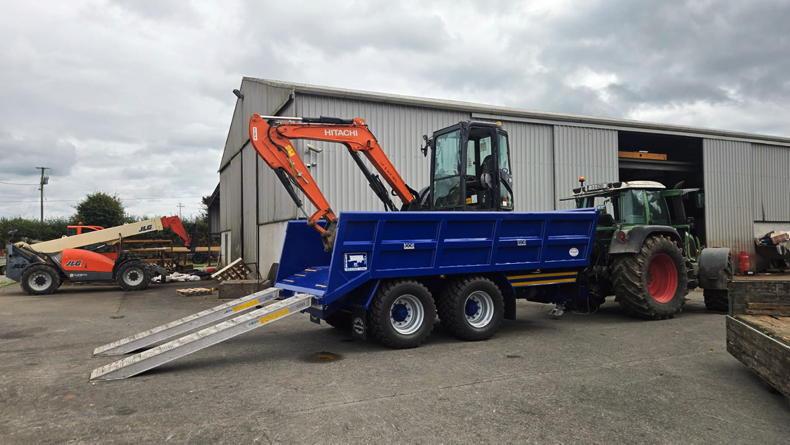
“We built our first multipurpose trailer in 2010/11, and soon realised there was a large opening there for this type of product. Machinery is a big cost on farms, so building one trailer that could do three or four jobs made it an appealing investment.
“Our business today is 95% focused on building trailers, with the other 5% being work for semi-state companies.
“We are currently building a steady 35 trailers annually, and we are on track to build 40 units this year. We have a small team of four staff, and – considering all manufacturing takes place in-house with the exception of some laser cutting – we get through a lot of work. Lead times vary depending on the time of year and the product, but it’s usually around eight weeks.”
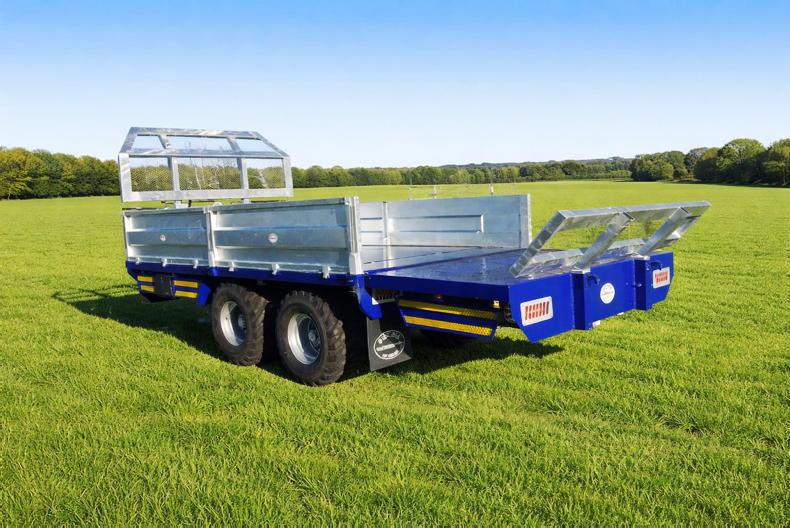
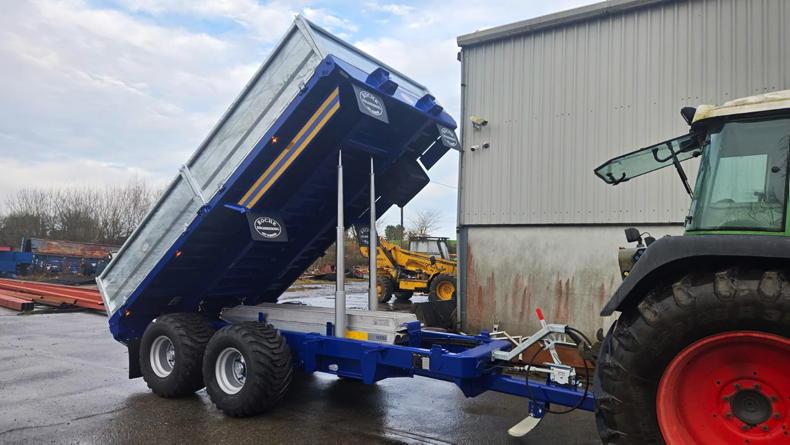
Brian offers four multipurpose trailer models, from 14ft to 20ft, with bale extensions. The firm builds bale trailers, low loaders, dump trailers and has very recently begun building livestock trailers, solely based on customer demand. Brian’s newest product is a beaver-tail dump trailer, which he first showcased at the Tullamore Show in August.
When asked about further new product development, he explained that he is currently building a beaver-tail type livestock trailer. The 20ft x 8ft tandem-axle trailer works off a hydraulic-sprung drawbar, which lifts the front of the trailer and drops the rear of the trailer.
Brian says it is being built for a farmer who is involved in selling in-calf heifers, and that loading on this type of trailer will be less stressful for the cattle. Opting to fit 445-45-R22.5 wheels, over the likes of a lower R17.5- or R19.5-profile wheels Brian notes that the trailer still has a rear loading height of 34in to the hinges on the rear door. He notes that this higher-profile wheel makes the trailer easier to pull both in the field and on the road.
Components
“The big focus for us is quality, rather than price. We do a lot of research into components, and we use what’s best for the customer, rather than the cheapest. We source all components from reputable sources, such as axles, suspensions, braking kits and lights from Distag QCS in Tullow and Granning Axles & Suspensions in Naas.
“Hydraulic cylinders come from Kramp, and wheels come from Agrigear and Kevin Burke Tyres. We look after blasting and painting in-house, with all trailers being treated to two coats of 2K primer and either two or three coats of two-pack paint, depending on the particular colour and the product.
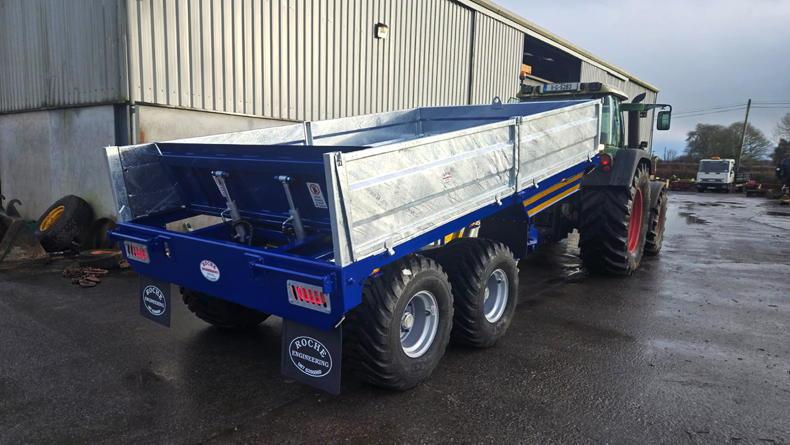
“We use quite a bit of Hardox steel in our trailers, especially on floors and carts. We like to galvanise components that are above the floor and will be in contact with materials, such as racks, posts and side carts. Approximately 35% of components in every multipurpose trailer we build are galvanised. We used to fully galvanise trailers, but it’s not cost-effective anymore,” explained Brian.
Opportunities/threats
“We have built up a very steady and repeatable customer base over the years, and the next phase of our business is expansion. With this, we will be looking at taking on some dealers and maybe even tapping into the export market. We have typically sold the majority of trailers direct, but we do some dealer sales and are looking to grow this. Likewise, we have had some strong enquiries from the UK, and one New Zealand-based importer has recently come to Ireland to meet us,” said Brian.
“The cost of production is every manufacturer’s biggest challenge. Electricity costs have trebled, galvanising costs have trebled, and steel has more than doubled in recent years. We tend to use higher grades of steel in our manufacturing, and these feature a higher carbon content, which draws a higher tax, making them even more expensive. The surge in input costs has eroded our margins. It’s grand saying ‘pass on the price’, but the reality is that the products we build have a price point, and we need to remain competitive. It’s a challenging environment at the minute, and as a manufacturer selling a product, you need to keep a close eye on costings,” he added.
The future
“The business is in a good place right now. We are very happy that after many years and a lot of time and effort, we have pretty much perfected our current offering. The next step for us is to expand production while continuing to be as efficient as possible. My father Bertie and I are milking 100 cows, and have just installed two milking robots, which has made our farm more efficient and helped to free up time on the farming front, which will be put into the business. In recent years we have steadily grown our market share. We have started taking trade stands at various shows and events, and our name is becoming better known. The business is focused on building trailers, and I expect it to stay that way, but in the nature of this business, diversification is ‘never say never’,” said Brian.
Company profile


SHARING OPTIONS