



IAM Agricultural Machinery is set to put on an impressive display both within the live demonstration area and on its stand in the trade village at Grass 2026.
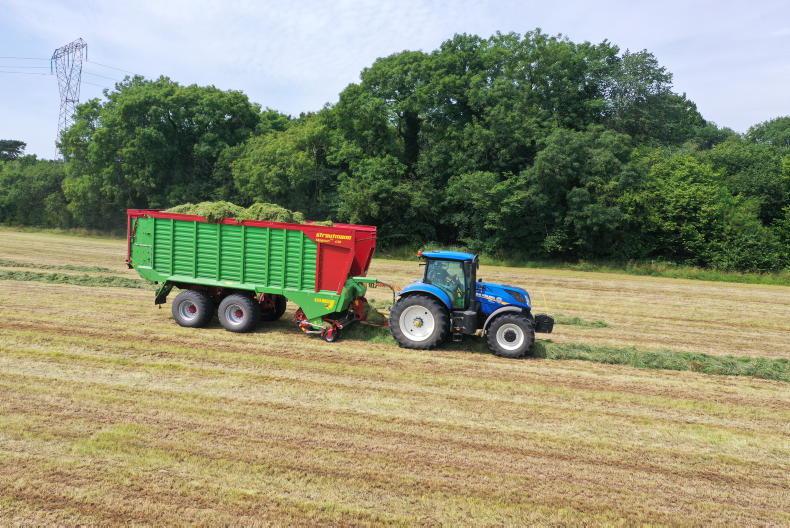
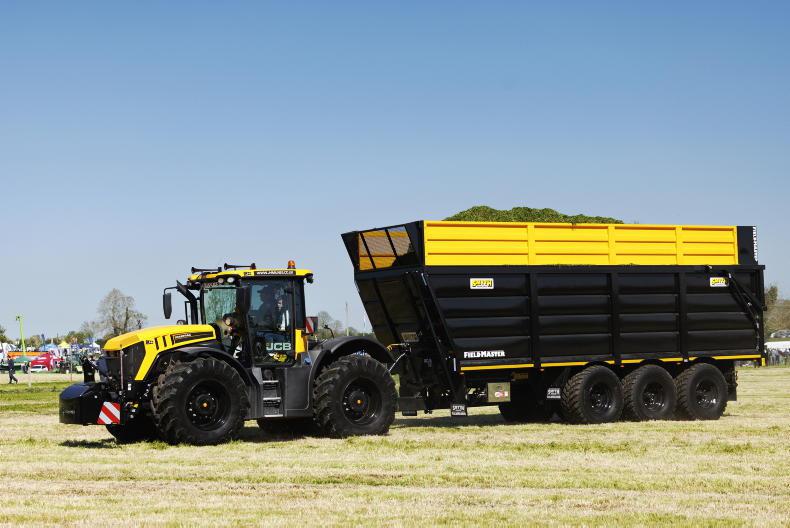
Taking part in the forage wagon demonstration will be two Strautmann machines, the Zelon 290 model and the flagship Magnon 11 forage wagon.
Starting with the Zelon 290, it sits as the middle model within the series, which comprises 24m3 (Zelon 250), 28m3 (Zelon 290) and 35m3 (Zelon 360) load capacities. Features of the machine include a 1.8m-wide camless pickup reel and a 37-knife exact-cut chopping unit, capable of achieving a theoretical chop length of 39mm. Optionally available is the plastic-tined Flex-Load pickup. No different to the larger series, the Zelon uses Strautmann’s Continuous Flow System (CFS), which incorporates a flow roller to help the crop transition from the pickup to the rotor.
The rotor itself measures 1,500mm wide and has a diameter of 725mm. The knife bank features double-sided knives as standard and an automatic blade reset function in the event that a foreign object attempts to pass through.
Other features include a powder-coated steel floor and a suspended 13t bogie tandem-axle chassis, with the option of fitting a 16t chassis. Passive steering is also optional, along with tyre sizes up to 710/40 R22.5. In terms of control, Strautmann offers its E-Control terminal and the option of Isobus control.
Moving on to the Magnon 11, it offers three models with capacities of 42m3 (Magnon 11-430), 46m3 (Magnon 11-470) and 52m3 (Magnon 11-520). Aimed at large-scale operators seeking chop lengths to match those of a forage harvester, the Magnon 11 comes equipped with the Exact-Cut knife bank, with 84 double-sided knives, capable of chopping to 22mm.
The Magnon series is fitted with the successful pivoting headboard and the proven Flex-Load 2.25m wide pickup. The pickup is hydraulically powered, offering the capabilities of being able to adjust pickup speed according to the tractor’s forward speed.
An oil-bath gearbox with an integrated planetary set powers the rotor. The crop is directed back towards the rotor via 105mm-wide internal augers, where it then meets the 2.1m-wide rotor. Each of the rotor tines is equipped with a 10mm-wide Hardox plate. The driveline has been designed to handle up to 3,000Nm of force, meaning even the largest of tractors can be used to power the Magnon 11. That said, a minimum of 250hp is recommended.
Elsewhere, on IAM’s static stand within the trade village, the importer will display a Hardi Master 1,200l sprayer alongside a range of Sky Agriculture products, as well as Topcon Systems GPS guidance solutions.
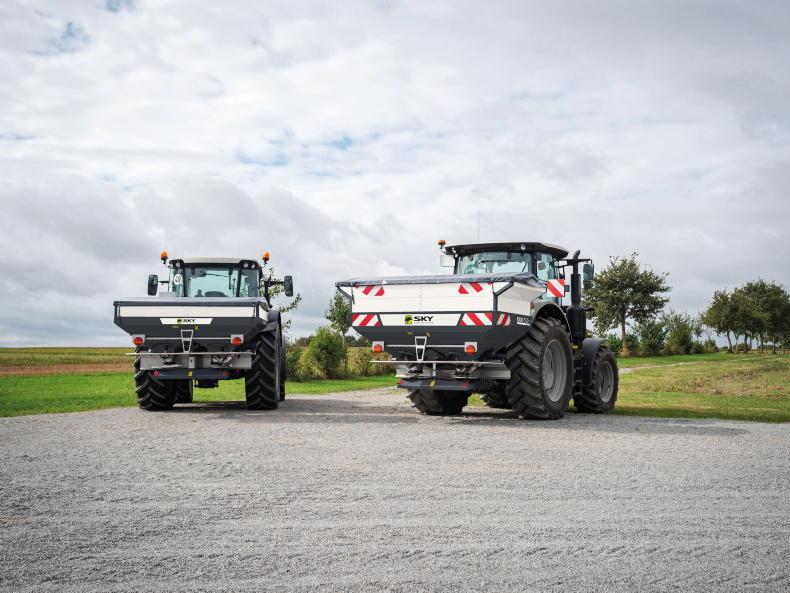
In terms of Sky Agriculture equipment, there will be a number of fertiliser spreader models on display from its range of mounted machines, namely the DX30+ /X40+ /X50+ models.
Sky offers three ranges of fertiliser spreaders – the entry-level mounted DX range, the high-end mounted X+ range and the XT trailed range. This corresponds to 18 different models, with the mounted ranging from 900l up to 4,200l, and working widths from 12m to 50m.
The entry level DX20/20+ offers working widths from 9mm to 24m and capacities from 900 to 2,100 litres. Meanwhile, DX30+ spreaders are capable of working widths between 12m and 36m and capacities from 1,500 to 3,000 litres.
The X40+ Econov is part of the manufacturer’s flagship mounted spreader line. It’s the second-largest model in the mounted spreader range, with a maximum carrying capacity of 3,200l. This is 1,000l behind the wider-chassis X50 spreader, although the business end of both is the exact same. The narrow chassis of the X40+ sits within the width of the tractor, which will be a big benefit for many.
All Sky spreaders achieve section control by keeping the speed of the outwards turning discs constant at 540rpm. Instead of altering disc speed, the fertiliser’s drop point and shutter position are continuously altered. The section control is achieved by continuously moving the drop point as you enter into a point or previously spread part of the field.



SHARING OPTIONS