Manitou quickly established itself as a household name in construction and agricultural sectors having built its first four-wheel drive telehandler in 1981 and later launching its agricultural range in 1989.
However, the firm was arguably not quite as strong for articulated telescopic wheeled loaders on the Irish market given the strong opposition up through the years from brands such as JCB, John Deere, Terex (formally Matbro) and Redrock. Although the market has since seen the demise of some of these brands, there has been a large number of newcomers in more recent years in one form or another.
In 2018, Manitou launched its latest MLA-T articulated telescopic wheeled loader range to strengthen its position on the market.
The range consists of eight models from 24hp to 143hp with lift capacities ranging from 875kg to 4,978kg.
We caught up with father and son duo Paul and Gareth Duffy, who took delivery of a full spec MLA-T 533-145+ Elite in January 2020.
Why Manitou?
Based near the village of Doohamlet, Co Monaghan, the Duffys milk 100 cows alongside a beef and duck farming enterprise. Having always liked the pivot steer concept, in 2019 it was decided that the farm’s 2006 John Deere 3800 loader would be upgraded.
“We always kept John Deere tractors and so bought the John Deere 3800 pivot steer in 2008 as a two-year-old machine to replace a Matbro Telegram at the time. Over its 12 years on the farm, the John Deere 3800 never missed a beat, it was just at an age where we wanted to upgrade it to a fresher machine,” Gareth said.

The design and layout of the engine bay leaves service and maintenance checks very easy.
“Only that John Deere stopped manufacturing pivot steer loaders we would have stuck with them but we wanted to buy new. We demoed a Kramer KL60.8 from Meath Farm Machinery, our John Deere dealer.
“It was a very well built machine and performed well. However, it was too big for what we required and the next model down was too small. The rigid chassis was very stable but we always liked the pivot steer concept.
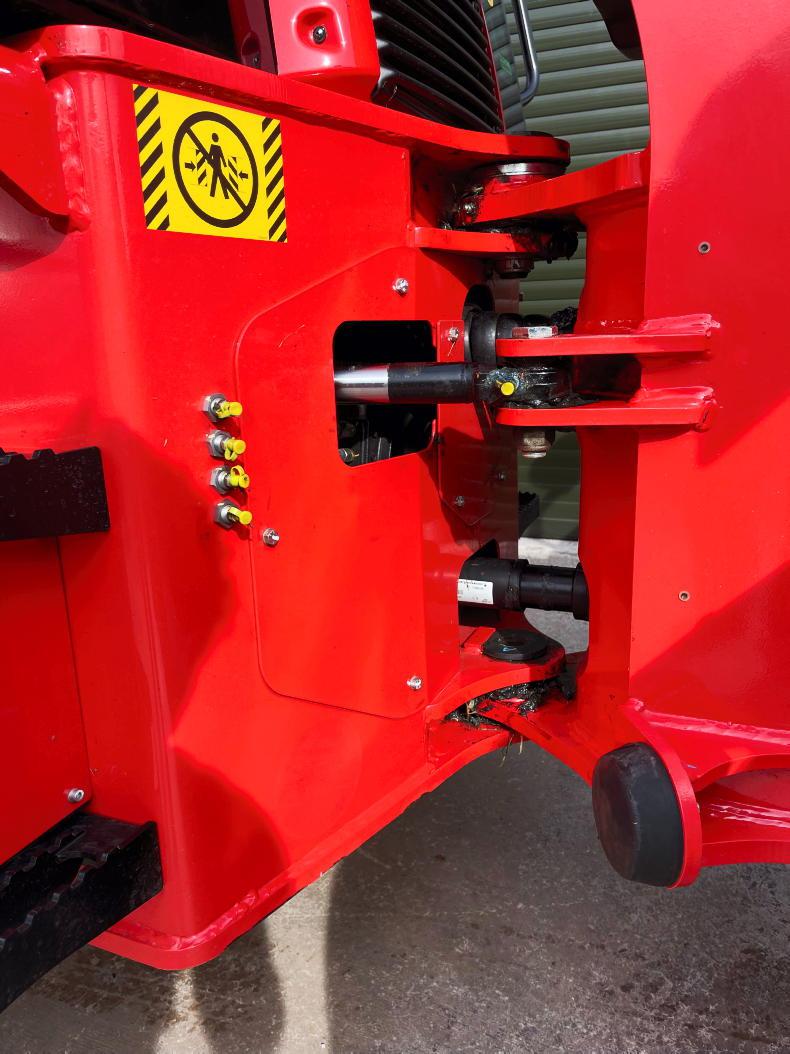
The Duffys like the strong articulation point of the MLA and the fact grease points are all centrally located.
“In 2018, we were at the Ploughing and happened to stumble across the new Manitou MLA-T. We were impressed with the build and design of the 533-145+ model as well as its size. Leaving the Ploughing, it was between the MLA-T 533-145+ and the JCB TM320S. With plenty of experience using a JCB TM320S pushing up grass for a local contractor, I knew it was a good machine but not perfect – I wanted to try the MLA-T. In the runup to the 2019 silage season we were down in Ardee at Mid-Louth Garage getting a few bits for the mower. We got a closer look at an MLA-T 533-145+. We cut our own silage and so saw about a demo for first cut, which we got. In fairness, the loader was left with us for two weeks so we got a great feel for it. When it came to financials there wasn’t much between it and a new TM320S. We were getting a good trade on our loader, so struck a deal and placed an order for the Elite model which came with a 360° LED light package, climate control, boom suspension and intelligent hydraulic functions. Aside from that we specified it with the wider 500/70 R24 tyres and an extra hydraulic service on the front,” the lads explained.
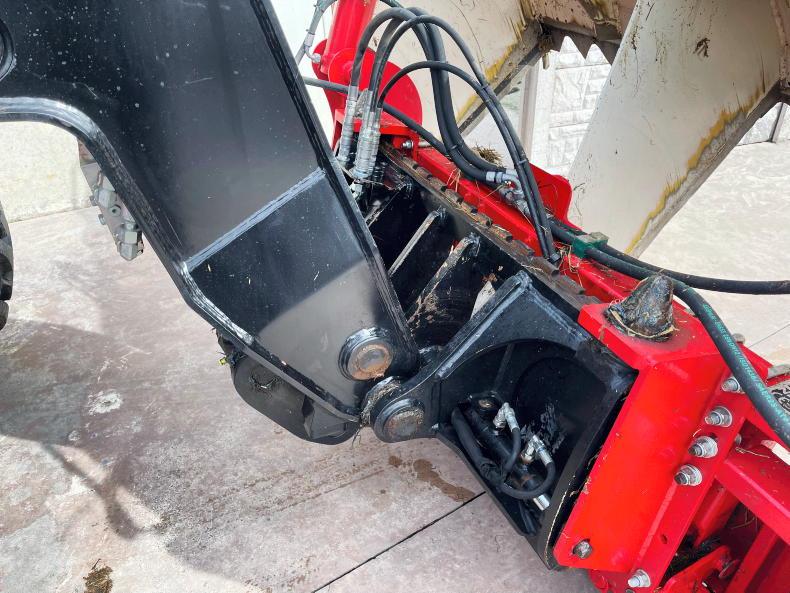
The MLA-T is fitted with a pin and cone type headstock.
Engine and transmission
Powering the loader is a 4.1 litre four-cylinder Deutz TCD engine churning out 143hp and torque figure of 550Nm at 1,600rpm. A particular like of the Duffys was the MLA-T’s engine bay layout. “Everything from the positioning of the engine oil dipstick to the hydraulic oil level gauge and oil filters are all really well thought through for servicing. We like that the diesel and AdBlue fill points are together and located under the bonnet, instead of being scattered out around the machine like on some brands.”

The Duffys pointed out their like for the strength in the loader’s boom and the large hydraulic rams used.
Unlike the JCB TM320S and more so their previous John Deere 3800 which featured a powershift gearbox, the MLA-T is fitted with an M-Varioshift CVT. This twin motor 40km/h unit is built by Rexroth Dana. Although a two-motor setup, it permanently relies on one motor with the second only engaging when required.
Gareth noted that once used to the CVT, he was impressed with its performance, especially on the silage pit where he originally felt that the powershfit might just have the edge.

Control layout is simple and of good quality. The CVT has a speed regulator which can be altered via the dial on the left.
One thing he did note was the addition of a high and low range similar to that found on other brands or a high and low preset would be welcome for applications where both high and low speeds are required. Instead, the transmission speed is altered using the in-cab dial. This speed regulator works independent of engine rpm, thus allowing low speeds and fast hydraulics. There is also a hand throttle for setting a constant engine rpm if required.
The loader is seated on Spicer axles which feature limited slip differentials and multiple disc oil bath brakes.
Build and hydraulics
The Duffys outlined a number of reasons why they liked the build of the MLA-T. “The construction of the boom and headstock and the size of the hydraulic rams really impressed us. The absence of the ram on top of the boom and the lower overall pivot height greatly improves visibility of the headstock and implement,” Gareth said. The central pivot is pinned and bushed top and bottom which the lads feel is a strong design and, although it doesn’t oscillate a JCB TM, the rear axle does instead. All pivot related grease points are brought back to one block, making the job much easier.

The lads agreed that the digital dash display could be much larger.
The MLA-T 533-145+ Elite features a flow rate of 158l/min. The flow rate being another one of the major selling points of the machine which Gareth instantly noted while having had the loader on demo using the 12ft silage fork.

The 150l diesel and 10l AdBlue tanks are positioned beside each other and under the loader’s bonnet.
As previously noted, the lads opted for an additional front service which they need for their push off 7ft sheargrab. Third-service hydraulic flow can be quickly altered via an in-cab dial. While on the topic of third services, there is a pressure relief button both inside and outside the cab to allow for the easy attachment of hydraulic implements.
Cab
The Duffys feel the cab is a nice environment with great visibility to all sides including the lower half of the right-hand door. Gareth said: “The TM320S we looked at hadn’t a full-length right hand glass door, the door was shorter as the cab filter was below it and so slightly restricted visibility to the right-hand side. Control layout is good and the mouse type joystick is nice in hand.”

Gareth and Paul Duffy, Doohamlet, Co Monaghan.
Instead of a traditional joystick Manitou use its JSM (Joystick Switch and Move) mouse-like joystick which features forward, neutral, reverse, third service control as well as the usual boom movements.

Cab visibility couldn't be faulted.
The duo praised the LED light package noting that it was well worth the money but also pointed out that the dash display could easily be twice the size as it is quite small and not so easily visible on the move.
Engine: 4.1L four cylinder Deutz TCD engine.
Horsepower: 143hp.
Transmission: M-Varioshift transmission from Rexroth Dana.
Max speed: 40km/h.
Hydraulics: Rexroth, 158l/min flowrate.
Max lift height: 5.2m.
Max lift capacity: 3,300kg
Fuel tank capacity:150l (AdBlue 10l).
Unladen weight: 8,430kg.
List price: €135,000 plus VAT.
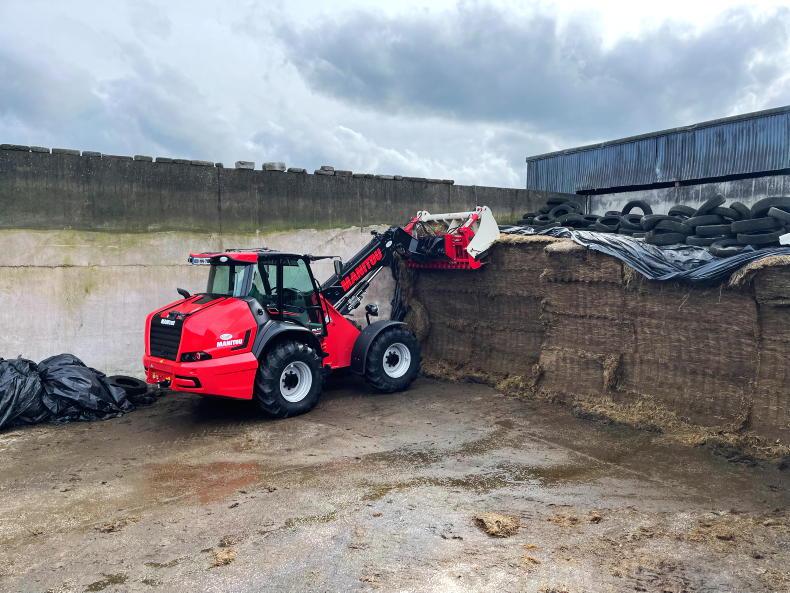
“With just shy of 700 hours clocked up, we are happy with its performance. Aside from pushing up 200 acres of silage each year its main duties are in the yard foddering and cleaning out sheds. Handling the wagon silage is where it was really tested, with its hydraulics really impressing us. Even at low speeds and low engine revs it had great torque and flicking ability. We’d typically climb the pit at 6km/h which it manages no problem. The only two things we’d maybe like to see done differently are a larger dash display and possibly a low and high preset on the transmission positioned on the joystick to save reaching for the dial. Aside from that it’s a well-engineered loader from front to back. Having driven other loaders over the years, it’s definitely up there with the top in terms of performance, comfort and visibility. We would buy one again,” said father and son firmly.
Manitou quickly established itself as a household name in construction and agricultural sectors having built its first four-wheel drive telehandler in 1981 and later launching its agricultural range in 1989.
However, the firm was arguably not quite as strong for articulated telescopic wheeled loaders on the Irish market given the strong opposition up through the years from brands such as JCB, John Deere, Terex (formally Matbro) and Redrock. Although the market has since seen the demise of some of these brands, there has been a large number of newcomers in more recent years in one form or another.
In 2018, Manitou launched its latest MLA-T articulated telescopic wheeled loader range to strengthen its position on the market.
The range consists of eight models from 24hp to 143hp with lift capacities ranging from 875kg to 4,978kg.
We caught up with father and son duo Paul and Gareth Duffy, who took delivery of a full spec MLA-T 533-145+ Elite in January 2020.
Why Manitou?
Based near the village of Doohamlet, Co Monaghan, the Duffys milk 100 cows alongside a beef and duck farming enterprise. Having always liked the pivot steer concept, in 2019 it was decided that the farm’s 2006 John Deere 3800 loader would be upgraded.
“We always kept John Deere tractors and so bought the John Deere 3800 pivot steer in 2008 as a two-year-old machine to replace a Matbro Telegram at the time. Over its 12 years on the farm, the John Deere 3800 never missed a beat, it was just at an age where we wanted to upgrade it to a fresher machine,” Gareth said.
The design and layout of the engine bay leaves service and maintenance checks very easy.
“Only that John Deere stopped manufacturing pivot steer loaders we would have stuck with them but we wanted to buy new. We demoed a Kramer KL60.8 from Meath Farm Machinery, our John Deere dealer.
“It was a very well built machine and performed well. However, it was too big for what we required and the next model down was too small. The rigid chassis was very stable but we always liked the pivot steer concept.
The Duffys like the strong articulation point of the MLA and the fact grease points are all centrally located.
“In 2018, we were at the Ploughing and happened to stumble across the new Manitou MLA-T. We were impressed with the build and design of the 533-145+ model as well as its size. Leaving the Ploughing, it was between the MLA-T 533-145+ and the JCB TM320S. With plenty of experience using a JCB TM320S pushing up grass for a local contractor, I knew it was a good machine but not perfect – I wanted to try the MLA-T. In the runup to the 2019 silage season we were down in Ardee at Mid-Louth Garage getting a few bits for the mower. We got a closer look at an MLA-T 533-145+. We cut our own silage and so saw about a demo for first cut, which we got. In fairness, the loader was left with us for two weeks so we got a great feel for it. When it came to financials there wasn’t much between it and a new TM320S. We were getting a good trade on our loader, so struck a deal and placed an order for the Elite model which came with a 360° LED light package, climate control, boom suspension and intelligent hydraulic functions. Aside from that we specified it with the wider 500/70 R24 tyres and an extra hydraulic service on the front,” the lads explained.
The MLA-T is fitted with a pin and cone type headstock.
Engine and transmission
Powering the loader is a 4.1 litre four-cylinder Deutz TCD engine churning out 143hp and torque figure of 550Nm at 1,600rpm. A particular like of the Duffys was the MLA-T’s engine bay layout. “Everything from the positioning of the engine oil dipstick to the hydraulic oil level gauge and oil filters are all really well thought through for servicing. We like that the diesel and AdBlue fill points are together and located under the bonnet, instead of being scattered out around the machine like on some brands.”
The Duffys pointed out their like for the strength in the loader’s boom and the large hydraulic rams used.
Unlike the JCB TM320S and more so their previous John Deere 3800 which featured a powershift gearbox, the MLA-T is fitted with an M-Varioshift CVT. This twin motor 40km/h unit is built by Rexroth Dana. Although a two-motor setup, it permanently relies on one motor with the second only engaging when required.
Gareth noted that once used to the CVT, he was impressed with its performance, especially on the silage pit where he originally felt that the powershfit might just have the edge.
Control layout is simple and of good quality. The CVT has a speed regulator which can be altered via the dial on the left.
One thing he did note was the addition of a high and low range similar to that found on other brands or a high and low preset would be welcome for applications where both high and low speeds are required. Instead, the transmission speed is altered using the in-cab dial. This speed regulator works independent of engine rpm, thus allowing low speeds and fast hydraulics. There is also a hand throttle for setting a constant engine rpm if required.
The loader is seated on Spicer axles which feature limited slip differentials and multiple disc oil bath brakes.
Build and hydraulics
The Duffys outlined a number of reasons why they liked the build of the MLA-T. “The construction of the boom and headstock and the size of the hydraulic rams really impressed us. The absence of the ram on top of the boom and the lower overall pivot height greatly improves visibility of the headstock and implement,” Gareth said. The central pivot is pinned and bushed top and bottom which the lads feel is a strong design and, although it doesn’t oscillate a JCB TM, the rear axle does instead. All pivot related grease points are brought back to one block, making the job much easier.
The lads agreed that the digital dash display could be much larger.
The MLA-T 533-145+ Elite features a flow rate of 158l/min. The flow rate being another one of the major selling points of the machine which Gareth instantly noted while having had the loader on demo using the 12ft silage fork.
The 150l diesel and 10l AdBlue tanks are positioned beside each other and under the loader’s bonnet.
As previously noted, the lads opted for an additional front service which they need for their push off 7ft sheargrab. Third-service hydraulic flow can be quickly altered via an in-cab dial. While on the topic of third services, there is a pressure relief button both inside and outside the cab to allow for the easy attachment of hydraulic implements.
Cab
The Duffys feel the cab is a nice environment with great visibility to all sides including the lower half of the right-hand door. Gareth said: “The TM320S we looked at hadn’t a full-length right hand glass door, the door was shorter as the cab filter was below it and so slightly restricted visibility to the right-hand side. Control layout is good and the mouse type joystick is nice in hand.”
Gareth and Paul Duffy, Doohamlet, Co Monaghan.
Instead of a traditional joystick Manitou use its JSM (Joystick Switch and Move) mouse-like joystick which features forward, neutral, reverse, third service control as well as the usual boom movements.
Cab visibility couldn't be faulted.
The duo praised the LED light package noting that it was well worth the money but also pointed out that the dash display could easily be twice the size as it is quite small and not so easily visible on the move.
Engine: 4.1L four cylinder Deutz TCD engine.
Horsepower: 143hp.
Transmission: M-Varioshift transmission from Rexroth Dana.
Max speed: 40km/h.
Hydraulics: Rexroth, 158l/min flowrate.
Max lift height: 5.2m.
Max lift capacity: 3,300kg
Fuel tank capacity:150l (AdBlue 10l).
Unladen weight: 8,430kg.
List price: €135,000 plus VAT.
“With just shy of 700 hours clocked up, we are happy with its performance. Aside from pushing up 200 acres of silage each year its main duties are in the yard foddering and cleaning out sheds. Handling the wagon silage is where it was really tested, with its hydraulics really impressing us. Even at low speeds and low engine revs it had great torque and flicking ability. We’d typically climb the pit at 6km/h which it manages no problem. The only two things we’d maybe like to see done differently are a larger dash display and possibly a low and high preset on the transmission positioned on the joystick to save reaching for the dial. Aside from that it’s a well-engineered loader from front to back. Having driven other loaders over the years, it’s definitely up there with the top in terms of performance, comfort and visibility. We would buy one again,” said father and son firmly.








SHARING OPTIONS