


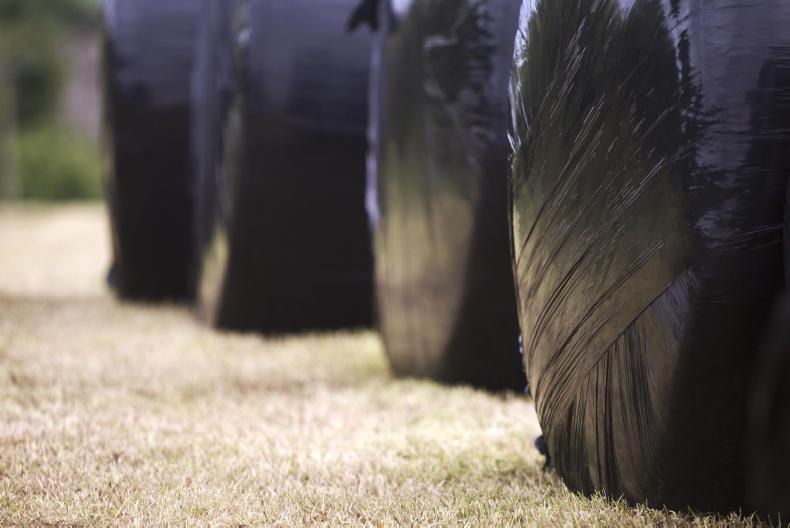
To most farmers, silage plastic, silage wrap or film as it is known is just one small part associated with making baled silage. It’s probably the most important part of the entire process as it protects next winter’s feed supply from the elements. Most of us take it for granted that once it is applied, the bales are stacked and not seen again until the cattle are housed and need feeding.
How it’s made
The manufacturing process operates 24/7 in Gorey. The plant runs almost all year round apart from planned maintenance in August every year ,and extreme events such a Storm Ophelia bring the five production lines to a stop.
The plant starts by mixing plastic prills, C8 resin, UV light inhibitor, glue and colour into a mixing plant. These are then heated to 240°C and extruded to produce the multi-layered film.
This film then travels upwards in a cylindrical pint shape to be cooled with jets of chilled air to 70°C in the first five seconds after extrusion. The film cools to ambient temperature as it travels to the top of the 30m tower. The speed at which the film is extruded, or in layman’s terms “pulled out”, determines the thickness of the film, which is a consistent 25 microns thick.
The addition of glue is what ensures the film sticks when being applied to a bale. The colour is down to customer preference, with black still being most popular.
The plant produces 30 to 40 pallets of film per day with each having 40 rolls. Each of the five production lines can produce up to 480 rolls in 24 hours. Stockpiling starts from September onwards with dispatch dependent on grass growth across Ireland and Europe.
Area sales manager north Maurice Keady said this year was “particularly late on account of the bad weather”.
Watching the shiny black column of film travelling upwards and then coming back down to be cut into rolls was a marvel. From each full width sheet of film, three strips are cut out to make up individual rolls.
A small narrow strip from each side of these is also trimmed off for quality purposes, a bit like trimming the edge of an apple-tart before it goes in the oven. Once this has been done, the film is rolled onto cardboard cores and a plastic bag is added to protect it from the weather. The final step is adding a batch number for traceability.
NRF
Accrording to Pat O’ Brien, area sales manager south, NRF or net replacement film is getting more popular for many reasons. NRF is used in place of net underneath the bale-wrap and is applied in the same fashion as net would be on a normal baler. Silawrap are selling more of it as contractors and customers are asking for it.
“The benefits include only one product to recycle so no need to separate the film from the net any more, better-quality silage, reduced bale mould, and better-shaped bales. We expect to sell in excess of 500t this year even though we have only been manufacturing it for three years. We have seen more machinery companies offering this technology as an option on their balers such as McHale and Krone. Silawrap also manufactures NRF for use on balers involved in baling sugar beet pulp, maize and waste recycling.
Maize plastic
The company’s X-tend maize plastic is both photo and oxo-degradable, meaning it eventually degrades upon exposure to both light and air. “Most maize is now grown under plastic as farmers cannot afford to harvest a poor crop – especially in a year like we are having where every tonne of fodder harvested will be vital and sowing date is expected to be delayed. The main benefit is the plastic helps the crop get off to a better start versus being planted in the open,” according to Maurice.
Quality control
The company has a number of factories across Europe that use the same quality control and tests on their products. The most interesting of the testing machines is a weatherometer.
This imitates a year’s worth of weather by artificially replicating various environments across the world. Palm-sized plastic samples are placed into the chamber where both moisture and UV light are used to test plastic strength.
In the lab, quality control expert Colm Southern takes me through some of the tests he conducts.
The plastic is tested for puncture strength by dropping a known weight from a height and recording the amount of weight taken to puncture it. The Elmendorf test measures tear resistance and the cling test measures the resistance required to separate two layers of film.
Samples are taken four times per 24-hour period, with a negligible failure rate, according to Colm. He explained that all plastic is manufactured to a specific specification which is set by their headquarters in Luxembourg and also by what is required by Irish standards, the toughest in the world.
They also use a round bale wrapper with artificial bale to visually inspect the film as it is being applied.
Both Pat and Colm said it’s all well and good their plastic conforming to a standard but unless the end user is willing to care for his bales it’s all in vain. He gave us a couple of tips for farmers when it comes to wrapping, handling and storing bales (see box above right).
1) Adjust the film dispenser height so the film is applied to the centre of the bale. If it is not applied centrally, more film will be required to wrap the bale properly.
2) Make sure there is no tack (glue), dirt or old film on the rollers dispensing the roll of film. Clean with white spirits or paint thinners every 500 bales.
3) Applying the correct number of film layers. Maurice said: “Most Irish farmers apply four layers but should probably be applying six, especially in high-DM crops that can puncture film more easily and are harder to preserve.”
4) A 50% overlap of film should be used on bales, ie each layer of film being applied should cover half the previous layer applied.
The bale handler and trailer
1) Clean any surface rust off the bale handler. Rust will pull and tear any plastic no matter how strong it is or how well it is applied.
2) Make sure there are no sharp points or pieces of metal that can damage or tear a wrapped bale. This applies to both the trailer and bale handler.
Bale storage
1) If storing bales near a ditch, keep them away from sharp stones, briars and low-hanging branches. Take care when placing bales on concrete as it acts like sandpaper and can cause damage.
2) If storing bales one bale high, stack them like barrels as this part of the bale has the most film on it. If storing 2 or 3 high place bales on the round. Leave a small space 1 cm or half an inch between the bales to let rain water drain away.
3) Nets and other methods of scaring crows should be used.
4) Bales should be fenced away from livestock.



SHARING OPTIONS