


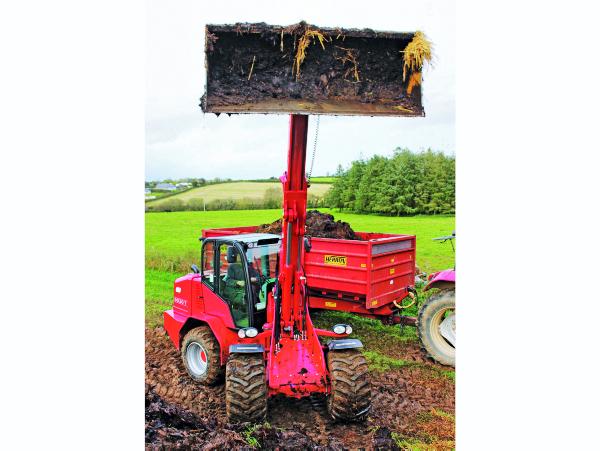
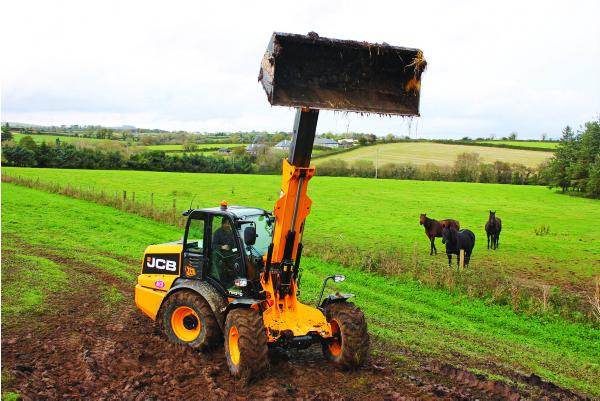
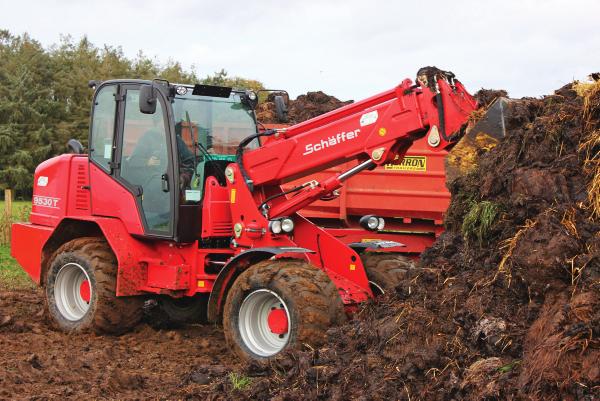
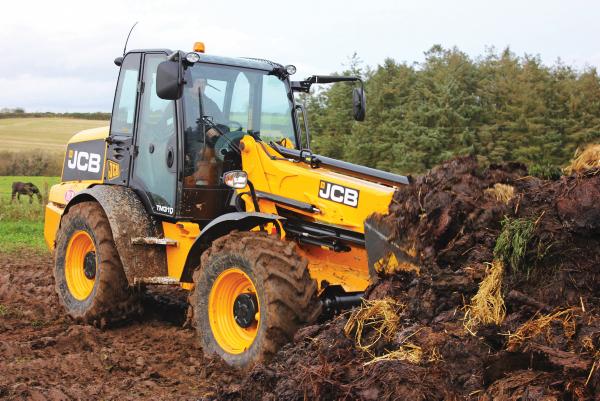
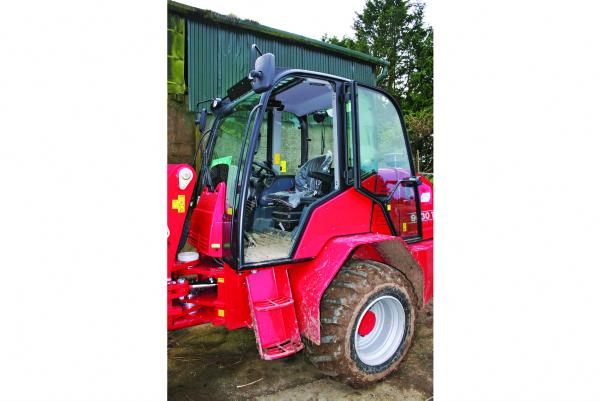
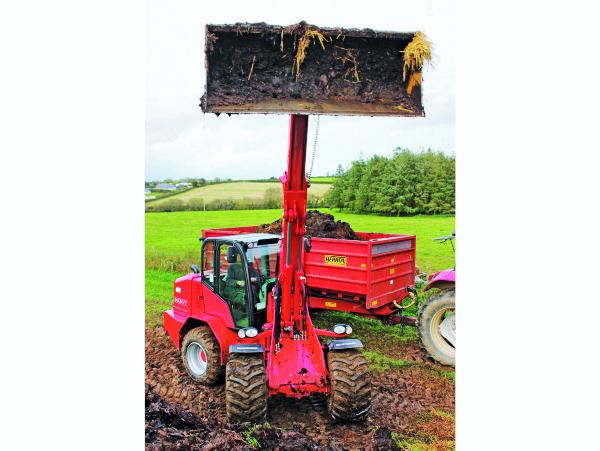
Both machines were tested in farm conditions over a number of duties, mainly manure loading and handling.
There is a slow but steady trickle of farmers moving away from tractors with front-end loaders to dedicated machines such as industrial loaders or telehandlers for their farm handling needs.
Depending on the spending budget, some will buy second-hand machines. There is now an increasing number of these being offered in Ireland after the boom in sales in 2007 when over 950 new machines were sold.
In the past, many used machines have come from Britain where farms tend to be bigger and there is a healthy supply of second-hand units.
Brands and types vary from rigid chassis machines with side booms, to artic steer shovels and artic steer telescopic handlers.
The artic-steer machines seem to be more popular on farms in Ireland and Britain. They have excellent manoeuvrability, better all-round visibility and pretty decent reach with a front mounted telescopic boom.
Historically, Matbro, Sanderson, Redrock, Manitou and JCB all offered versions suitable for agricultural use. JCB is the only manufacturer within this group to survive unscathed while, in more recent times, Manitou ceased producing their own machine and bought the rights to the Redrock machine when Redrock went into liquidation.
The Irish Farmers Journal decided to see what the latest generation of agri-spec articulated telehandlers had to offer by inviting JCB, Manitou and Schäffer to an agricultural ‘Dungfest’.
The JCB would be, perhaps, the most popular within the group, but we were interested to see what Manitou, with its re-designed Redrock, would bring to the table plus the German made Schäffer.
Though initially looking very promising, unfortunately Manitou couldn’t come to the party due to lack of machine availability.
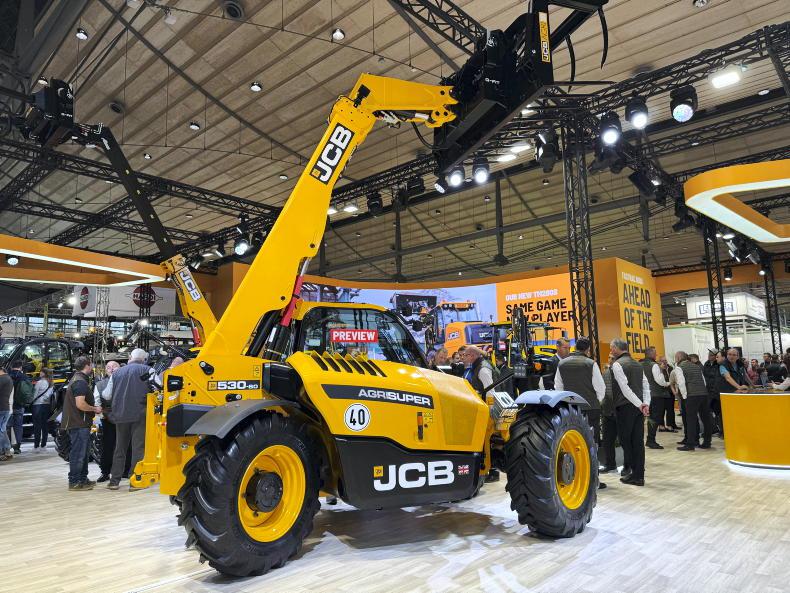
ECI JCB in Dublin delivered a brand new JCB TM310 to us while TFM delivered their demonstrator Schäffer 9530T.
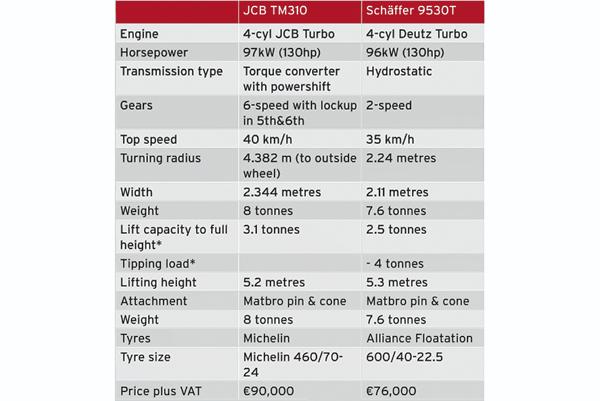
On paper these two are of a similar horsepower and weight with similar lifting capacities and reach.
But that’s where the similarities end; see the specifications listed in Table 1 as quoted by both manufacturers.
Appearance and function
With both the JCB TM310 and Schäffer 9530T parked side by side, there really didn’t look like there was much in it size-wise.
As we mentioned earlier, on paper as well they are similar in terms of engine power, lifting capacity and reach.
The biggest difference between the machines, though, is their transmissions and, aside from the price, this is likely to be the major factor when choosing a machine.
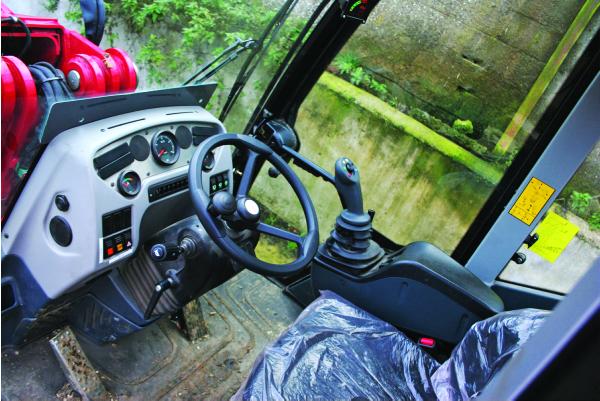
First, though, a little about the operating environment on both. The feel inside the cab of the Schäffer is most definitely understated.
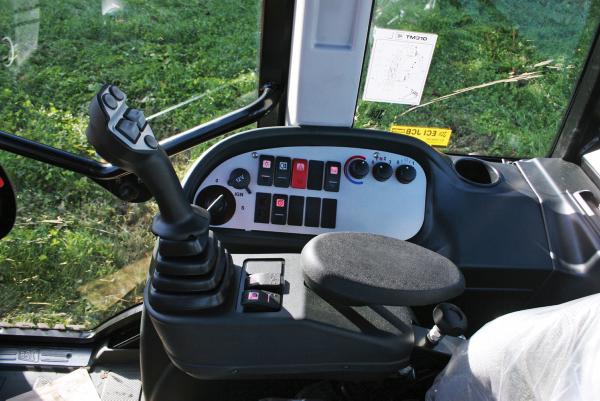
It is very well finished and has a very conservative German feel to it, while the JCB has gone to the other end of the spectrum with lots of chrome and matt silver finishing touches inside the cab, plus blue digital display on the dash.
Both manufacturers integrate a certain amount of transmission control into their joysticks.
The JCB unit is a servo type joystick with a low pressure oil circuit operating the boom raise/lower and bucket tilt/crowd features.
Switches operate the remaining functions for boom in/out and third service, while there is one on the front of the joystick for operating the forward/reverse shuttle.
The JCB is also equipped with a conventionally mounted shuttle lever under the left hand side of the steering. Either can be used but the other has to be in the neutral position for the one being operated to function.
Powershift gear selection is also done by twisting a collar on the shuttle lever. While there are six speeds in total only first, second, third and automatic can be selected.
In automatic, there are three selectable modes suitable for work and road.
The Schäffer’s electronic proportional joystick is quite ‘funky’ both in looks and use. All boom functions and transmission functions are controlled by it.
It has an almost clock-like appearance with colourful buttons placed around the exterior to operate third service and other extra hydraulic services.
In the centre, there is a round rocker switch which controls the direction of the machine and there is no left hand shuttle.
A rocker switch at the front of the unit selects the 9530T’s two transmission speeds.
To boom out or in, the operator twists the joystick left or right, which is also very unusual.
Both machines look well and appear equally well engineered.
JCB’s racy feel is mirrored in its external styling as well. Telescopic mirrors and an internal mirror provide excellent visibility rearwards. Its front light units mounted over the front wheel fenders look vulnerable though, as do the electrical plugs into them.
The Schäffer wasn’t so well equipped with neither telescopic mirrors nor an internal mirror, but its front light units looked better placed and less susceptible to damage.
In the cab, the load monitor is very bright at night, almost to the point of being dangerous when driving on the road. Perhaps there is a way of dimming the unit’s LEDs but we could not find it and could not reposition it either.
Productivity
In terms of productivity, the two machines are separated largely by their transmissions. The Schäffer 9530Twith its hydrostatic transmission is nice and smooth, very controllable and is a bit armchair-like in its productivity.
By nature, hydrostatic transmissions are not very aggressive. But that often leaves them lacking in the productivity department compared with torque converter transmissions hooked to a powerful motor. Driving on the road, the Schäffer could smell a hill and steep hills really dragged.
By comparison, the JCB TM310 is raw power, super productive and requires a bit more ‘driving’. With torque converter lock-up in fifth and sixth gear, combined with a very responsive JCB engine, road work should be no problem at speed where terrain permits. Six speeds, three selectable and three auto-modes, offer more than enough options for all uses.
In the hydraulics department, both operated boom functions at speeds you would expect. Using the same bucket, the JCB performed better when tearing material out of the pile. The Schäffer’s sluggish steering in tough conditions got to be a bit annoying, though.
Both telehandlers featured hydraulic quick attach. We felt Schaffer’s was a bit safer as the Q/A function was isolated by a separate switch, whereas you had to get off the JCB and physically turn a tap to isolate its quick attach.
Who’s the winner? The competition was far closer than we expected. The JCB TM310 is a hard horse to better, a real thoroughbred workhorse. Still, we had a peculiar auld liking for the Schäffer 9530T.
OPERATION
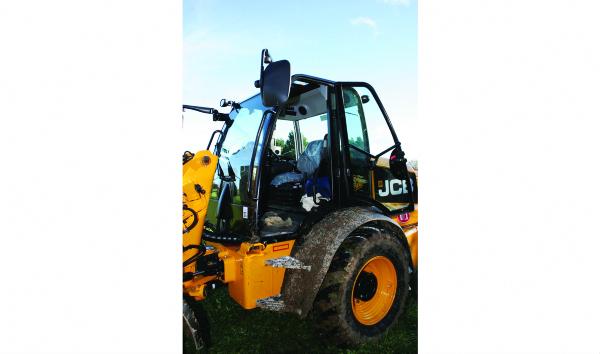
Working conditions were typical of our winter weather and so were ideal for testing all aspects of the loaders, particularly the cab. When it wasn’t cold and raining it was possible to operate both machines with doors pinned back, which makes getting in and out that bit easier.
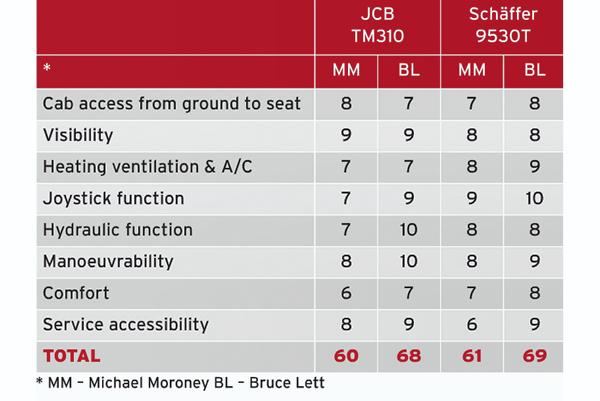
We have conducted a simple little mini-survey which focuses largely on the cab area. There are eight features which we both marked out of 10. The results surprised us.
Let me explain my results – Bruce Lett
Cab access - Well, I’m tall so generally I have to twist and contort quite a bit to get to the seat if something is awkward. For me, the Schäffer was that bit better.
Visibility - The Schäffer has a very low seating position which hindered visibility compared with the JCB which was excellent. I found side and rear visibility better with the Schäffer.
Heating, ventilation and air conditioning – Both machines were equipped with both. On the damp, wet days, the JCB struggled compared with the Schäffer to clear the windscreen and keep it clear.
Joystick function – One word, ‘funky’ (and yes, functional as well).
Hydraulic function – The JCB was excellent in all areas, boom and steering, regardless of engine rpm. The Schäffer’s steering lacked oil supply at times by comparison and you felt you were fighting with the wheel to turn it fast enough on rapid manoeuvres.
Comfort – This relates to road use. For me, the Schäffer won this one. Both machines had boom suspension but the JCB was far more capable of maintaining a high forward speed. On a rough road, and unfortunately we have plenty of them, this led to the driver being well rattled (but getting there quicker).
Service accessibility – Access to grease nipples, daily check, radiators and service items was excellent all round. Where possible, Schäffer banked grease nipples together which gave them the edge in my score.
Michael Moroney results explained
Cab access – While the JCB cab was a little higher off the ground, the cab access was good for me. The cab is uncluttered and I found access easier than with the Schäffer so that’s why it gets a marginally higher score.
Visibility – I liked the higher seating position of the JCB; there was good visibility around the yard and on the road. The low seating position of the Schäffer hindered front visibility which was very good in the JCB. The rear visibility from the Schäffer was probably better and both would benefit from a reversing camera.
Heating ventilation and air conditioning – While both machines have heating and air con systems, I found that the Schäffer quickly cleared the windscreen. There seemed to be more power to the fan and it kept clear during the working and road cycles. I found that the JCB was slower to clear a windscreen fog.
Joystick function – Once I got used to the Schäffer joystick, I began to like it more than the JCB; it was not too difficult to get used to, while the JCB joystick felt flimsy while it was effective.
Hydraulic function – I found that the Schäffer system seemed to have power for big loads but there was an issue with a lack of steering oil supply at times. The JCB was lively in all functions, the boom and the steering, but I felt that the Schäffer had more tear-out power by comparison.
Comfort – For road work, I was more comfortable with the Schäffer, less bounce and I felt more in control. The JCB powershift system was faster on the road and with that came more bounce, even if both machines had boom suspension. The test road was a typical secondary road with its now customary potholes so we were well tested and the slower speed and tyres on the Schäffer provided more comfort and machine control.
Service accessibility – Both machines were designed for good service access with easily raised engine bonnet sections for access to grease nipples, radiators and service items. Daily checks should be easy on both machines with more space around the JCB engine, which is why I give it a higher score. The fact that the Schäffer had banked grease nipples together gave it the edge in my score.





SHARING OPTIONS