Heffernan Tyres is a well-regarded, third-generation family-owned business, with over 70 years’ experience in the tyre industry. The Kildare-based company has developed strong partnerships with independent tyre dealers throughout Ireland and continues to strengthen those relationships even further by expanding its product range for road fleets, quarries, farms and agricultural contractors.
Andrew Robinson says the company is planning and positioning itself to meet the changing demands of the agricultural tyre industry as the EU targets net zero GHG emissions by 2050.
The company has done so by taking on the distribution of the Global Rubber Industries (GRI) tyre brand, which offers ranges manufactured with 87.3% and 93.5% sustainable materials.
“We are distributors in Ireland for GRI’s Green XLR Earth and the Ultimate Green XT tyre range, Pirelli, Aeolus and Float Control, the Dutch-built central tyre inflation system known as CTIS,” Andrew outlined.
Global Rubber Industries
Global Rubber Industries (GRI) is a speciality tyre manufacturer founded in 2002 and focused on the agricultural, material handling and construction sectors. Headquartered in Sri Lanka, the company supplies tyres to markets worldwide and has become recognised for its focus on sustainability, fuel efficiency and environmentally responsible tyre technology, Andrew believes.
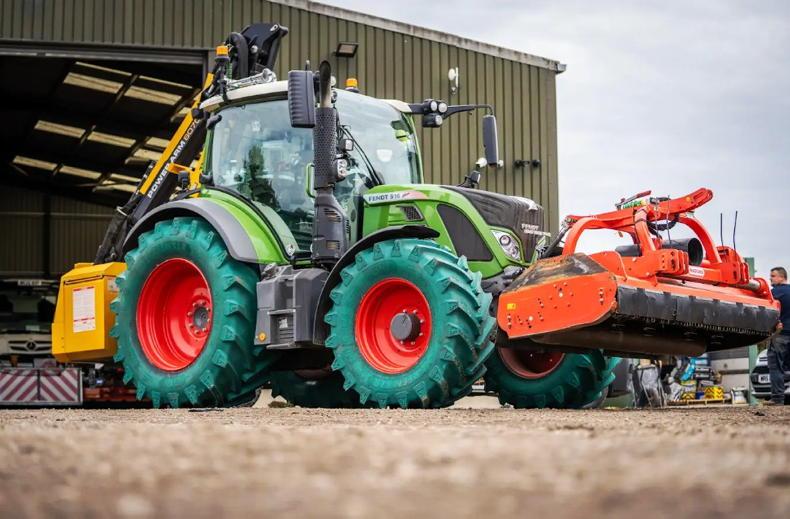
GRI has recently gained attention for developing high-performance “green” tyres using large percentages of sustainable and bio-based materials, including its Green XLR Earth agricultural tyre range. With the intention of standing out, Andrew says the company developed the tyre with a green pigment to draw people’s attention, considering everyone is used to seeing traditional black tyres.
The signature green colour on GRI tyres is the result of using natural eco-friendly pigments during the rubber mixing phase, rather than painting or dyeing the surface.
“Once you catch someone’s attention with this green tyre then the conversation starts about sustainability and EU targets, etc, but at the end of the day, if you’re a farmer or contractor, you want to know about price, tyre range, performance, etc, so it must tick all these boxes too and it does,” Andrew says.
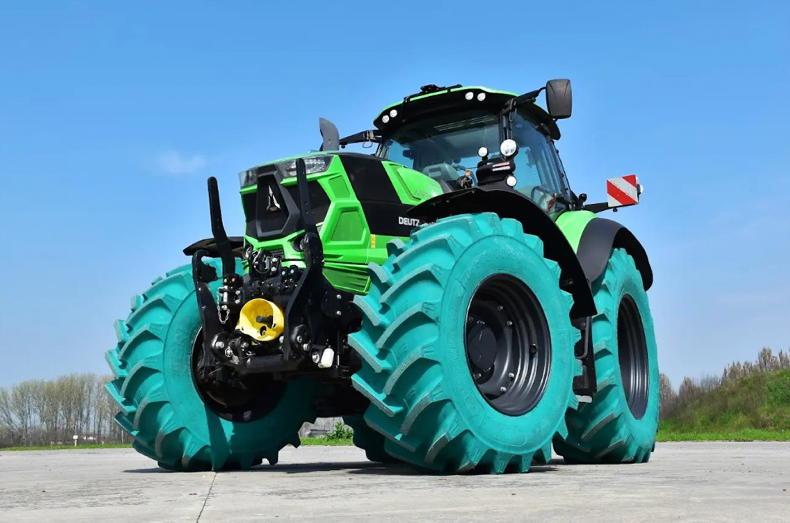
Heffernan Tyres are Irish distributors for GRI’s Green XLR Earth and the Ultimate Green XT tyre range.
Ten-year warranty
GRI is reinforcing its confidence in the durability and performance of its agricultural tyre range by offering a 10-year warranty on its Radial Agriculture tyres and an eight-year warranty on Bias tyres.
The warranties remain valid until tread depth falls below 10% of the original tread depth. At the centre of the company’s sustainability push are two flagship products: the Green XLR Earth and the Ultimate Green XT.
To differentiate between the two, the Green XLR Earth contains a claimed 87.3% sustainable and bio-sourced materials, while the Ultimate Green XT is manufactured using 93.5% sustainable materials.
These include natural rubber, recycled carbon black, reclaimed rubber and soybean oil.
According to GRI, the resulting carbon footprint reductions have been independently verified by Bureau Veritas on a comprehensive sustainability assessment using Life Cycle Assessment (LCA) methodology aligned with ISO 14040/44 and ISO 14067 standards. It confirms a 44.8% reduction in emissions, which is equivalent to 242.3kg CO2eq for the Green XLR Earth compared with standard industry equivalents.

Float Control is a Dutch manufacturer of Central Tyre Inflation Systems.
Real world field tests
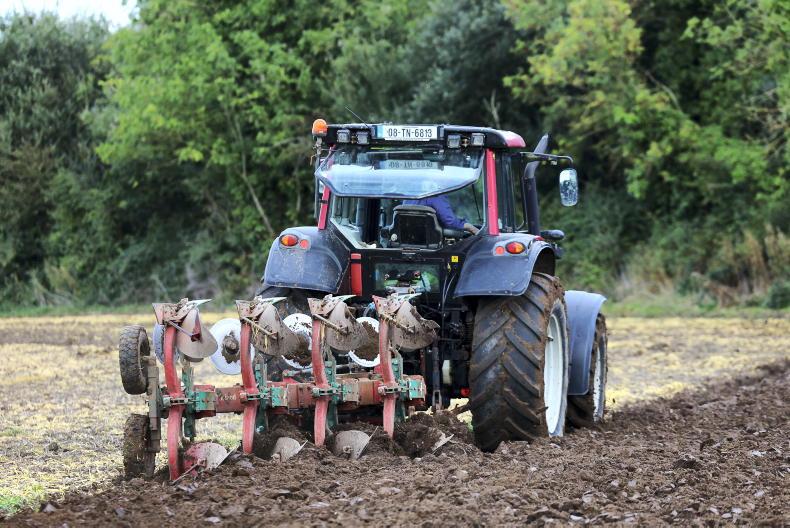
Andrew points out that independent field testing was also carried out by the Provana Group in Italy, who evaluated the Green XLR Earth during ploughing operations, recording an average fuel consumption of 25.6 litres per hour.
The results showed fuel efficiency matching, and in some cases exceeding, premium competitor benchmarks. Further field testing focused on the 600/70 R30 and 710/70 R42 tyre sizes, carrying maximum rear axle loads of up to 12,160kg under demanding agricultural conditions.
Questions around the durability of bio-based materials in harsh farming conditions remain central to farmers’ adoption. To address this, GRI conducted extensive field trials in Italy between May and November 2024. Under the Project Tecnoagricola programme, the Green XLR Earth was tested in temperatures ranging from -25°C in spring to peaks of 35°C during July and August. According to the findings, the tyres maintained stable fuel efficiency while delivering effective self-cleaning performance, with tread lugs actively clearing soil and preventing buildup.
On asphalt surfaces, the Green XLR Earth exceeded the Standard Mileage Index and performed close to premium competitor averages. In field conditions, he says, the tyre reportedly delivered 15% higher travelling distance than competing premium brands, while maintaining consistent and even wear patterns throughout testing. According to Andrew, the tyre contributes to lowering a farm’s carbon footprint in two key ways: firstly, through a 44.8% lower manufacturing carbon footprint, and secondly, through reduced rolling resistance, helping machinery consume less fuel and energy during daily operations.
Andrew acknowledges that a major consideration for farmers and contractors is the real-world lifespan of a relatively unknown brand compared with established premium manufacturers such as Michelin, Trelleborg, BKT and Alliance.
“The 10-year warranty, along with independent in-field testing, reflects the confidence GRI has in its products,” he says.
Andrew also notes that the company already offers a wide range of tyre sizes suitable for most modern tractors, with the range continuing to expand.
“We still don’t know exactly what will drive sales in the long term,” he says. “However, if the EU decides within the next year or two that standard tyres fall into this Carbon Border Adjustment Mechanism (CBAM) category, which is a type of tax on carbon intensive goods entering the EU, we hope our product would qualify for exemption.”
He also believes the shift may come from a top-down approach within the agricultural supply chain rather than solely from farmers themselves.
Large corporations, agri-food processors, and retailers are increasingly recognising that farmers cannot continue absorbing rising costs while margins remain under pressure. As a result, they may need to introduce initiatives that help farmers reduce their carbon footprint.
“There are many discussions taking place, but what we do know is that the EU has committed to net-zero targets, and this type of tyre technology is a step in the right direction.”

The retrofit-able solutions are controlled via the machines Isobus display.
Central Tyre Inflation Systems
Heffernan Tyres is now agent for the Float Control system which can be retrofitted to large tractors and heavy trailers/tankers. Float Control is a Dutch manufacturer and supplier of Central Tyre Inflation Systems (CTIS) designed to automatically inflate/deflate tyres from the tractor cab in order to achieve optimum pressures for field work or road work for better wear and stability.
“It has become increasingly popular across Europe among farmers and contractors looking to reduce ground compaction, lower diesel consumption, and maximise tyre lifespan while not harming soil structure and reducing crop yields.”
One often overlooked advantage of the Float Control system, Andrew believes, is its ability to continuously regulate tyre pressure.
“As tyres heat up during operation, the air pressure inside naturally increases. The Float Control system automatically compensates for this throughout operations,” he says. The Float Control system can be fitted to tractors, trailers, harvesters, combines, and self-propelled sprayers.
The system can be operated through the machine’s Isobus display, allowing operators to adjust tyre pressures easily from the cab.
Pricing varies depending on the machine specification but typically ranges between €10,000 and €15,000.

Heffernan Tyres has reintroduced the Pirelli agriculture tyre brand to Ireland.
The return of the Pirelli agri tyre brand
Heffernan Tyres has also reintroduced the Pirelli agriculture tyre brand to Ireland. In the late 1990s, Pirelli Agri exited the agricultural tyre market following its acquisition by Trelleborg, with the products subsequently absorbed into the Trelleborg range.
Fast forward to 2017, and as Andrew explains, the Pirelli tractor tyre began reappearing on the market through its parent company, the Prometeon Tyre Group. With more than 8,000 employees and manufacturing facilities in Italy, Turkey, Egypt, and Brazil, Prometeon is a company of considerable scale.
The tyres initially returned under the Pirelli brand, leveraging the strength and recognition of the Pirelli name while some tyre products re-established themselves in the market under Prometeon branding.
This strategy was introduced in three stages: firstly, tyres branded solely as Pirelli; secondly, Pirelli tyres engineered by Prometeon; and finally, products sold exclusively under the Prometeon name. The company is currently in the second phase, with tyres displaying the Pirelli name on one sidewall and “Engineered by Prometeon” on the opposite side.
Prometeon agricultural tyres currently hold around 60% of the South American market, where some of the tyres are manufactured. As part of its ongoing development, the company continues to expand its multi-brand and multi-product strategy, according to Andrew.
Aeolus: a budget-friendly offering
Another string to Heffernan’s bow is the Aeolus tyre brand. Aeolus is an off-the-road (OTR) tyre manufacturer, with more than 60 years of experience in the industry and two production facilities based in China. The company specialises in designing and manufacturing tyres tailored to specific customer applications, including some of the largest tyres in the world.
The brand focuses on engineering solutions for demanding sectors, particularly agriculture, construction, and heavy transport. According to Andrew, for the agricultural sector specifically, Aeolus develops its trailer and flotation tyres under a dedicated heavy-duty range designed specifically for towed equipment. The Aeolus AE77 is one of the more popular models offered. “It is designed for heavy-duty applications such as silage trailers, slurry tankers, fertiliser spreaders, and dump trailers.”
The tyre features a reinforced casing to improve durability and re-treadability, while its flotation design helps protect soil structure by distributing weight more evenly in field conditions. Aeolus is associated with Pirelli and Prometeon, and also has an involvement in the management structure of the Prometeon Tyre Group.
From a market perspective, Aeolus products are increasingly positioned as a cost-effective alternative in the agricultural sector. Andrew explains “We needed a good quality budget tyre, and this range offers excellent value. Farmers are seeing strong performance, particularly on trailers and tankers, and the brand is growing rapidly.”
Heffernan Tyres is a well-regarded, third-generation family-owned business, with over 70 years’ experience in the tyre industry. The Kildare-based company has developed strong partnerships with independent tyre dealers throughout Ireland and continues to strengthen those relationships even further by expanding its product range for road fleets, quarries, farms and agricultural contractors.
Andrew Robinson says the company is planning and positioning itself to meet the changing demands of the agricultural tyre industry as the EU targets net zero GHG emissions by 2050.
The company has done so by taking on the distribution of the Global Rubber Industries (GRI) tyre brand, which offers ranges manufactured with 87.3% and 93.5% sustainable materials.
“We are distributors in Ireland for GRI’s Green XLR Earth and the Ultimate Green XT tyre range, Pirelli, Aeolus and Float Control, the Dutch-built central tyre inflation system known as CTIS,” Andrew outlined.
Global Rubber Industries
Global Rubber Industries (GRI) is a speciality tyre manufacturer founded in 2002 and focused on the agricultural, material handling and construction sectors. Headquartered in Sri Lanka, the company supplies tyres to markets worldwide and has become recognised for its focus on sustainability, fuel efficiency and environmentally responsible tyre technology, Andrew believes.
GRI has recently gained attention for developing high-performance “green” tyres using large percentages of sustainable and bio-based materials, including its Green XLR Earth agricultural tyre range. With the intention of standing out, Andrew says the company developed the tyre with a green pigment to draw people’s attention, considering everyone is used to seeing traditional black tyres.
The signature green colour on GRI tyres is the result of using natural eco-friendly pigments during the rubber mixing phase, rather than painting or dyeing the surface.
“Once you catch someone’s attention with this green tyre then the conversation starts about sustainability and EU targets, etc, but at the end of the day, if you’re a farmer or contractor, you want to know about price, tyre range, performance, etc, so it must tick all these boxes too and it does,” Andrew says.

Heffernan Tyres are Irish distributors for GRI’s Green XLR Earth and the Ultimate Green XT tyre range.
Ten-year warranty
GRI is reinforcing its confidence in the durability and performance of its agricultural tyre range by offering a 10-year warranty on its Radial Agriculture tyres and an eight-year warranty on Bias tyres.
The warranties remain valid until tread depth falls below 10% of the original tread depth. At the centre of the company’s sustainability push are two flagship products: the Green XLR Earth and the Ultimate Green XT.
To differentiate between the two, the Green XLR Earth contains a claimed 87.3% sustainable and bio-sourced materials, while the Ultimate Green XT is manufactured using 93.5% sustainable materials.
These include natural rubber, recycled carbon black, reclaimed rubber and soybean oil.
According to GRI, the resulting carbon footprint reductions have been independently verified by Bureau Veritas on a comprehensive sustainability assessment using Life Cycle Assessment (LCA) methodology aligned with ISO 14040/44 and ISO 14067 standards. It confirms a 44.8% reduction in emissions, which is equivalent to 242.3kg CO2eq for the Green XLR Earth compared with standard industry equivalents.

Float Control is a Dutch manufacturer of Central Tyre Inflation Systems.
Real world field tests
Andrew points out that independent field testing was also carried out by the Provana Group in Italy, who evaluated the Green XLR Earth during ploughing operations, recording an average fuel consumption of 25.6 litres per hour.
The results showed fuel efficiency matching, and in some cases exceeding, premium competitor benchmarks. Further field testing focused on the 600/70 R30 and 710/70 R42 tyre sizes, carrying maximum rear axle loads of up to 12,160kg under demanding agricultural conditions.
Questions around the durability of bio-based materials in harsh farming conditions remain central to farmers’ adoption. To address this, GRI conducted extensive field trials in Italy between May and November 2024. Under the Project Tecnoagricola programme, the Green XLR Earth was tested in temperatures ranging from -25°C in spring to peaks of 35°C during July and August. According to the findings, the tyres maintained stable fuel efficiency while delivering effective self-cleaning performance, with tread lugs actively clearing soil and preventing buildup.
On asphalt surfaces, the Green XLR Earth exceeded the Standard Mileage Index and performed close to premium competitor averages. In field conditions, he says, the tyre reportedly delivered 15% higher travelling distance than competing premium brands, while maintaining consistent and even wear patterns throughout testing. According to Andrew, the tyre contributes to lowering a farm’s carbon footprint in two key ways: firstly, through a 44.8% lower manufacturing carbon footprint, and secondly, through reduced rolling resistance, helping machinery consume less fuel and energy during daily operations.
Andrew acknowledges that a major consideration for farmers and contractors is the real-world lifespan of a relatively unknown brand compared with established premium manufacturers such as Michelin, Trelleborg, BKT and Alliance.
“The 10-year warranty, along with independent in-field testing, reflects the confidence GRI has in its products,” he says.
Andrew also notes that the company already offers a wide range of tyre sizes suitable for most modern tractors, with the range continuing to expand.
“We still don’t know exactly what will drive sales in the long term,” he says. “However, if the EU decides within the next year or two that standard tyres fall into this Carbon Border Adjustment Mechanism (CBAM) category, which is a type of tax on carbon intensive goods entering the EU, we hope our product would qualify for exemption.”
He also believes the shift may come from a top-down approach within the agricultural supply chain rather than solely from farmers themselves.
Large corporations, agri-food processors, and retailers are increasingly recognising that farmers cannot continue absorbing rising costs while margins remain under pressure. As a result, they may need to introduce initiatives that help farmers reduce their carbon footprint.
“There are many discussions taking place, but what we do know is that the EU has committed to net-zero targets, and this type of tyre technology is a step in the right direction.”

The retrofit-able solutions are controlled via the machines Isobus display.
Central Tyre Inflation Systems
Heffernan Tyres is now agent for the Float Control system which can be retrofitted to large tractors and heavy trailers/tankers. Float Control is a Dutch manufacturer and supplier of Central Tyre Inflation Systems (CTIS) designed to automatically inflate/deflate tyres from the tractor cab in order to achieve optimum pressures for field work or road work for better wear and stability.
“It has become increasingly popular across Europe among farmers and contractors looking to reduce ground compaction, lower diesel consumption, and maximise tyre lifespan while not harming soil structure and reducing crop yields.”
One often overlooked advantage of the Float Control system, Andrew believes, is its ability to continuously regulate tyre pressure.
“As tyres heat up during operation, the air pressure inside naturally increases. The Float Control system automatically compensates for this throughout operations,” he says. The Float Control system can be fitted to tractors, trailers, harvesters, combines, and self-propelled sprayers.
The system can be operated through the machine’s Isobus display, allowing operators to adjust tyre pressures easily from the cab.
Pricing varies depending on the machine specification but typically ranges between €10,000 and €15,000.

Heffernan Tyres has reintroduced the Pirelli agriculture tyre brand to Ireland.
The return of the Pirelli agri tyre brand
Heffernan Tyres has also reintroduced the Pirelli agriculture tyre brand to Ireland. In the late 1990s, Pirelli Agri exited the agricultural tyre market following its acquisition by Trelleborg, with the products subsequently absorbed into the Trelleborg range.
Fast forward to 2017, and as Andrew explains, the Pirelli tractor tyre began reappearing on the market through its parent company, the Prometeon Tyre Group. With more than 8,000 employees and manufacturing facilities in Italy, Turkey, Egypt, and Brazil, Prometeon is a company of considerable scale.
The tyres initially returned under the Pirelli brand, leveraging the strength and recognition of the Pirelli name while some tyre products re-established themselves in the market under Prometeon branding.
This strategy was introduced in three stages: firstly, tyres branded solely as Pirelli; secondly, Pirelli tyres engineered by Prometeon; and finally, products sold exclusively under the Prometeon name. The company is currently in the second phase, with tyres displaying the Pirelli name on one sidewall and “Engineered by Prometeon” on the opposite side.
Prometeon agricultural tyres currently hold around 60% of the South American market, where some of the tyres are manufactured. As part of its ongoing development, the company continues to expand its multi-brand and multi-product strategy, according to Andrew.
Aeolus: a budget-friendly offering
Another string to Heffernan’s bow is the Aeolus tyre brand. Aeolus is an off-the-road (OTR) tyre manufacturer, with more than 60 years of experience in the industry and two production facilities based in China. The company specialises in designing and manufacturing tyres tailored to specific customer applications, including some of the largest tyres in the world.
The brand focuses on engineering solutions for demanding sectors, particularly agriculture, construction, and heavy transport. According to Andrew, for the agricultural sector specifically, Aeolus develops its trailer and flotation tyres under a dedicated heavy-duty range designed specifically for towed equipment. The Aeolus AE77 is one of the more popular models offered. “It is designed for heavy-duty applications such as silage trailers, slurry tankers, fertiliser spreaders, and dump trailers.”
The tyre features a reinforced casing to improve durability and re-treadability, while its flotation design helps protect soil structure by distributing weight more evenly in field conditions. Aeolus is associated with Pirelli and Prometeon, and also has an involvement in the management structure of the Prometeon Tyre Group.
From a market perspective, Aeolus products are increasingly positioned as a cost-effective alternative in the agricultural sector. Andrew explains “We needed a good quality budget tyre, and this range offers excellent value. Farmers are seeing strong performance, particularly on trailers and tankers, and the brand is growing rapidly.”
SHARING OPTIONS