


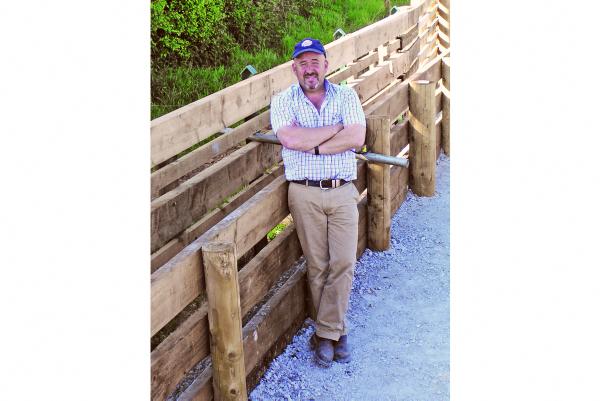
His name is probably most widely known because of his fencing company, Mulligan Fencing, which carries out fencing projects on motorways and other civil projects around Ireland and Britain.
However, as is so with rural-based business people, there’s a strong farming link too.
Alan also runs a suckler operation, calving down about 150 cows per each spring on the farm at Dunderry, helped by his parents Finian and Mabel.
Alan rang to put forward the case for a timber handling unit, not surprising given that he handles big volumes of it. But what’s more, he told me that he had just built a unit for himself and he invited me to go to see it. The block of land is just a short drive from the yard — a mile — but that’s a long way to walk cattle on the public road for routine handling jobs.
On the phone, Alan emphasised that a timber unit could be well priced, strong, quick to put up and as large or small, simple or elaborate as wanted. And, not surprisingly, given the large number of suckler cows he handles, he was also keen to discuss the best design for a unit — he has put in a circular forcing pen and multiple drafting pens.
When starting farming, Alan did work experience in New Zealand at contract milking and shearing. ‘‘They have loads of forestry and every farm there had timber handling units.’’
Size and layout
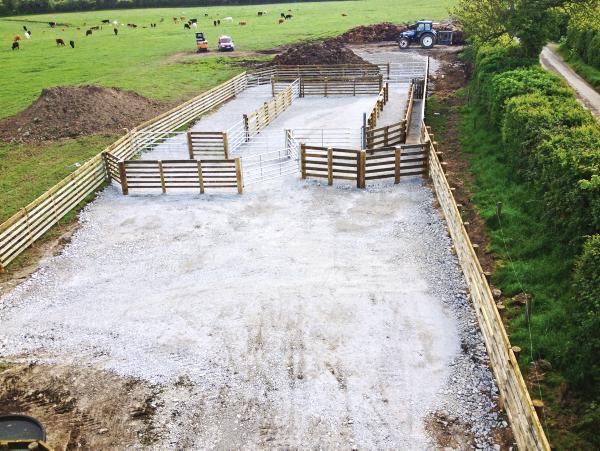
The unit is large, measuring 14.5m (47 feet) long and 35m (115 feet) wide, rectangle-shaped. This makes it large enough to comfortably hold 80 cows with their calves. It is sited near a road gate, at a corner where two fields meet. There is a gate between the two fields so the unit serves both.
Altogether, this unit has six pens and 11 gates. A smaller handling unit for a smaller block of land with grazing for fewer cattle would require fewer pens. Alan grazes up to 80 cows with calves in these fields.
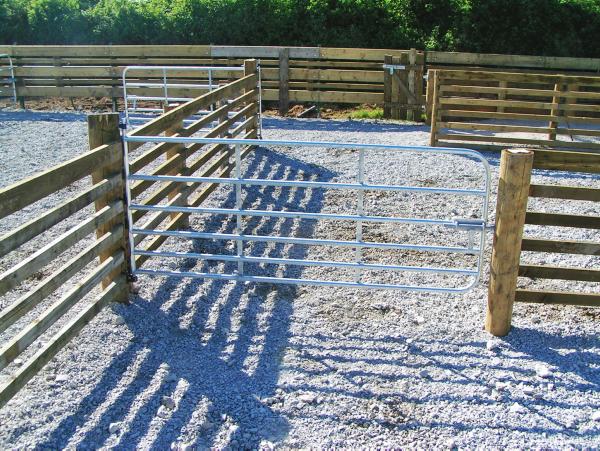
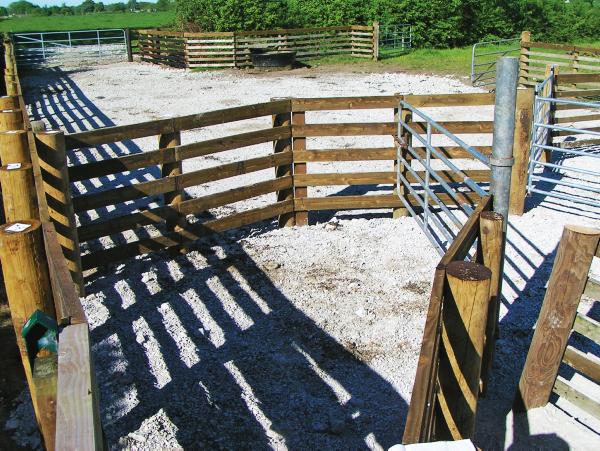
Near to the road, there is a loading/unloading gate. It is 3m (10 feet) wide, so as to fit snugly to a lorry or cattle trailer. After unloading, cattle enter a series of approach pens which lead them towards the circular forcing pen. Three different pens feed into the forcing pen via gates, allowing sorting. The forcing pen leads to the chute with cattle exiting at the headgate back where they started, at the loading pen.
Hardcore floor
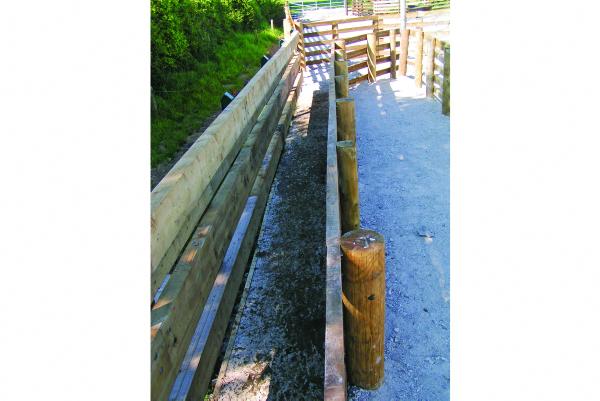
The floor of this unit is 804 hardcore. Interestingly, this includes the raised catwalk, which runs beside the chute. As can be seen in the main picture, the catwalk is a generous five feet wide — there is no risk of stepping over an edge and falling.
‘‘A concrete slab is required for a unit in a yard that will be in more regular use over the year,’’ says Alan. ‘‘But a hardcore floor is fine for a unit on an outfarm.’’
Eight inches of top soil was lifted, posts driven and then the hardcore spread on top.
Construction
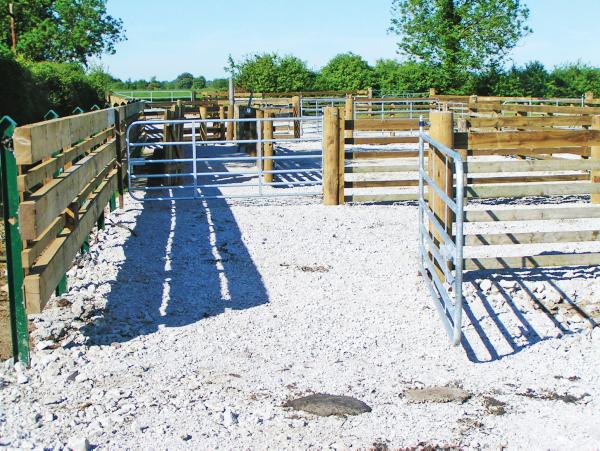
Most of this handling unit is made of post and rail timber. The only metal is gates and one centre post holding the rotating gate in the circular forcing pen. All posts are direct driven into the soil. This is lower cost than boring holes and packing with hardcore, etc. Enough post is buried in the ground for strength.
Two post sizes are used and both are driven 1m into the ground. ‘‘They won’t move,’’ Alan says. The posts at corners and ends are 200mm to 250mm (eight to 10 inches), 2.5m (eight feet) long posts. Intermediate posts are 125mm to 175mm (five to seven inches), 2.5m (eight feet) long. Posts are driven at 2.1m centres to suit rails which are 4.2m long.
The quality of posts is obviously important. Alan uses kiln dried Larch posts, all treated to IS436.
‘‘Kiln dried means the moisture content is brought down to 25%. At that, the timber accepts the preservative treatment better. It more than doubles the cost but they have a working life of over 20 years when directly driven into soil.’’
The unit sides, inside and out, have six rails.
This way, the gap between rails is not big enough for an animal to put its head through.
The lower five rails are 100mm x 44mm. The top rail is a stronger 150mm x 50mm.
‘‘The rails are dried and treated to motorway standard.’’
Nails
Rails are fitted to posts with 100mm (four-inch) galvanised nails of 4.5mm gauge, two at each end and two in the middle.
Nail holes are drilled at the ends to prevent cracking. ‘‘These nails have heavy galvanising of 300g per square metre. That’s because good timber will outlast rusty nails.’’
Strong chute
Heavier 200mm x 60mm rails are used in the chute. Likewise, the posts are closer together at 1.5m centres and they alternate between heavy and intermediates.
Cost
Alan Mulligan said that he will supply and erect timber and gates for a unit the same size as his own for €12,500, plus VAT. ‘‘That includes stripping the topsoil and placing the stone — but supply of stone would be by the customer. This way, I can quote the price to a farmer without seeing the site conditions — even if the site is low and needs more stone, my price stays the same.
‘‘A smaller unit to hold half this amount of stock would cost €8,000, plus VAT. It would have the same size crush, holding seven cows, the same circular forcing pen and a semi automatic headgate.’’
Ecocem cement in bags
Ecocem Ireland has introduced a 25kg bag version of its eco-friendly general purpose cement. The product is a GGBS (Ground Granulated Blastfurnace Slag) cement. Until now, it has mainly been supplied in bulk to the concrete manufacturing sector. Now it goes on sale in local agri stores and builders’ merchants in bagged form.
This is the first cement of its kind available here in a 25kg bag, Ecocem says.
Its benefits include increased strength and durability, a superior finish which is brighter and whiter in colour, and it is eco-friendly, with up to a 50% reduction on CO2 emissions, the company claims.
‘‘Ecocem cement has already proved itself in large-scale construction projects around Ireland, including the Aviva Stadium, the Waterford Cable Stayed Bridge, the Giant’s Causeway Interpretative Centre and the NUI Galway,’’ Conor O’Riain, head of New Markets and Products at Ecocem Materials said.
Recently, the company announced plans to create 25 direct jobs and 36 indirect jobs in a three-year, €19m investment in a new bagging plant at Dublin Port.
Ecocem Materials Limited isan Irish company was set up in 2000 to undertake industrial developments in Europe in the production and use of GGBS.




SHARING OPTIONS