


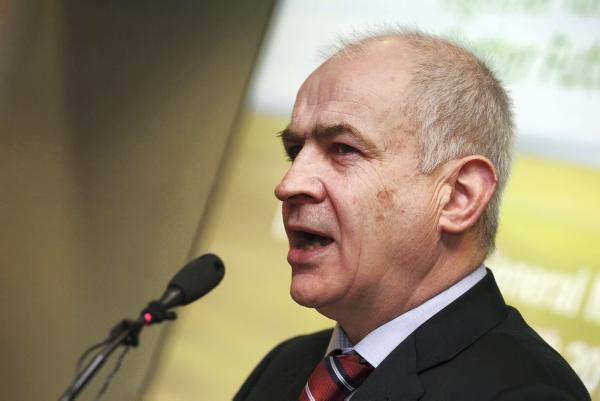
IFA president Eddie Downey recently held a meeting with the Ulster Farmers Union president in Dublin on the cattle price situation across the country. The IFA president is also meeting major retail buyers in London as part of IFA’s campaign to secure higher prices for winter finishers and more workable specifications.
Downey said that cattle prices remain difficult and are at unacceptably low levels for winter finishers. He said there are some indications of an improvement in the market situation, with prices in Britain and across Europe showing some positive movements. In addition, some retailers are offering promotions, which is moving beef in stock and demand is expected to pick up strongly for Easter. “The pick-up in the weather and grass growth should also boost the cattle trade and improve confidence at farm level.”
Downey said the latest report from EBLEX (organisation for the English beef and sheep industry) indicates that the trade is more buoyant. EBLEX points out that price increases were evident across some categories, with both heifers and young bulls on the rise. In addition, the R4 steer price is reported at £3.73/kg, which is equivalent to €4.70/kg, including VAT. EBLEX reports that British cow prices continue to increase with O4 prices reported at £2.40/kg, which is equivalent to €3.03/kg.
The IFA Livestock Committee chairman Henry Burns said that, across Europe, prices remain stable to slightly stronger, with Bord Bia reporting increases in Spain and Italy for bulls. He said R3 bulls in Italy are making the equivalent of €4.34/kg, including VAT. In France, young bulls are at €4.11/kg and €4/kg in Germany. Burns said that male cattle are making over €4/kg in key European markets.
He said that based on current market returns, where prices are strong in our main market in Britain and prices are stable or improving across Europe, factories should be able to restore cattle prices to viable levels.
The IFA Livestock Committee leader again called on Minister Coveney to take immediate action on cattle prices and specification with the factories, to move on live exports, particularly to Northern Ireland and Britain, to increase competition and restore confidence in the trade, to address the labelling issues, to restore and protect the confidentially of the AIMS system and to protect the beef sector in the EU trade talks with the US and Brazil.
Designated areas
IFA president Eddie Downey has called on the Minister for Arts, Heritage and the Gaeltacht Jimmy Deenihan to allow farmers who have suffered damage to their land, as a result of the recent floods, to carry out remedial works.
Roscommon meeting
IFA general secretary Pat Smith attended the Roscommon IFA county executive as guest speaker. He said: “Compared with this time last year, steer and heifers are down €70 to €80 per head. Bull beef and cow prices are down €180 to €200/head. If prices are not restored, losses to the beef sector will reach €175m per year.’’
Cork Central IFA county executive
IFA Animal Health Committee executive Tomas Bourke attended the Cork Central IFA county executive as the guest speaker. He gave a report on all animal health issues such as TB, BVD and Johne’s disease.
Stocking levels
At a meeting with the Department of Agriculture, IFA Hill Committee chairman Pat Dunne said the 80% stocking criteria is not acceptable and he called for the stocking levels to be determined by the farmer and his planner. He pointed out that hill farmers need a good environmental management scheme.
North Tipperary IFA county executive
IFA director of livestock Kevin Kinsella attended the north Tipperary county executive as guest speaker. He said Minister Coveney must address the implications associated with his proposals to transfer entitlements to protect the SFP under the new CAP arrangements.
IFA environment meeting
Speaking after a meeting with Minister Hogan, IFA president Eddie Downey said: “Farmers in Ireland have a proven and undisputed record of producing some of the most emission efficient food in the world. This is a key strength which has the ability to drive future demand for our produce in international markets.’’



SHARING OPTIONS