Meeting forestry stakeholders at the Ploughing is a good way to gauge the mood of the sector, especially this year as the long awaited Forestry Programme (2023-2027) was officially announced the previous week.
The number of forestry exhibitors was down on previous years. “No reflection on the Ploughing but there was too much uncertainty surrounding the programme during the year so we didn’t book a stand,” said a spokesperson for one of the absent forestry companies.
The companies that did turn up expressed a variety of opinions on the programme, ranging from positive about the increased supports and variety of schemes to negative about the complexity of the new scheme especially in relation to environmental requirements and land availability.
“The incentives should attract farmers in particular to plant, but whether they will actually plant is a different argument as a lot of marginal agricultural land that would have been suitable for forestry is now excluded,” said Conor Daly, managing director of The Forestry Company.

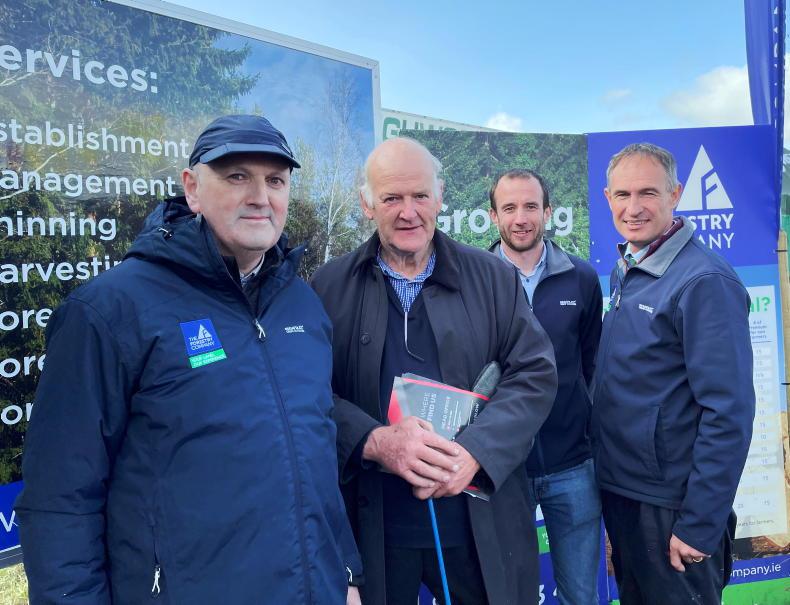
Pat Ryan, Emerald Forestry Consultants (EFC) discussed forestry matters with Ned Hogan, a visitor to the EFC stand. \ Donal Magner
“That said, this is a great opportunity for farmers to get involved in forestry as the premiums are very good both for commercial forestry and native woodlands,” he added.
“There is no doubt the programme is geared up for native forest establishment. We deal with farmers first but also non-farmer investors and currently we are discussing projects with some private investors who are opting for native woodlands as biodiversity environment projects.”
He said the biggest immediate challenge is getting approvals for existing licence holders who are now being reassessed under the revised environmental requirements.
“The new programme is very welcome but there is an awful lot of legwork to do even for projects already approved,” said Michael Connelly, SWS Forestry.
He said existing hard won licences under the previous scheme were now subject to reappraisal.
“Everything has to go back out for approval, so we are at the testing stage. There are significantly more layers now as the reduced land that was previously accepted is coming under more environmental scrutiny.”
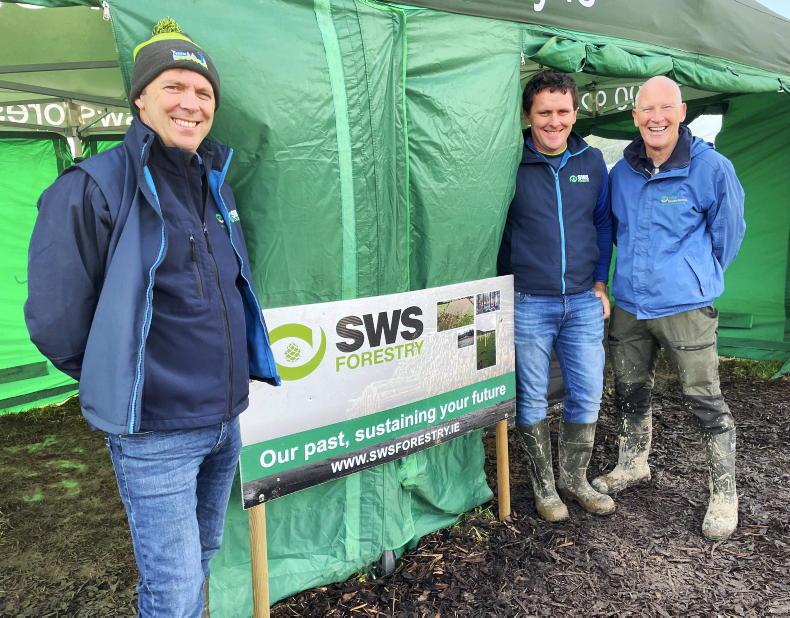
The SWS Forestry team: Declan Lawless Kevin Kelly and Michael Connelly. \ Donal Magner
He said every site will need some kind of environmental report . “The amount of work to get an afforestation project over the line is phenomenal and at the end of a time consuming process, there is the real risk that it fails.”
There was unanimous agreement among those interviewed that time delays are a major difficulty in getting licences.
Patrick Ryan, Emerald Forestry Consultants said there hasn’t been sufficient debate on the benefits of commercial forestry and carbon sequestration in the forest and the role of timber in decarbonising the economy.
“We will face a serious shortage of timber in the future if we continue to fall well short of commercial afforestation targets,” he said. “We will end up importing what we need.” which was a view shared by John Ryan, forestry manager of the Murray Timber Group.
All hands on deck
Meanwhile at the Department of Agriculture stand, all hands were on deck
promoting the new programme and Ireland’s Forestry Strategy 2023-2027. Visitors to the stand, including Olive Leavy, secretary of the Irish Forest Owners; Jason Fleming, chair of the IFA forestry group, and Pat Leavy, forest owner and farmer, were discussing the programme with Barry Delaney, director of forestry at the Department.
“The outcome of the findings of the ash dieback review group will have a major impact on the future of the programme,” said Jason Fleming. He has repeatedly said that without a positive result, the IFA would not back the programme.
Otherwise he supports the various schemes, but has misgivings about aspects of it. The new programme had shifted from commercial forestry to native woodland and biodiversity, he maintained. “This means that Payment for Ecosystem Services (PES) now need to reflect this change,” he said. “The new programme has to reflect the income foregone from timber production and payment for ecological services must be extended beyond the proposed seven years.”
Regarding restrictions on suitable land, Barry Delaney said that both the Department and foresters could speed up the licensing process by working together. “Every single application will have a habitats map and that will help [the Department] to go through these much faster,” he said. “As a result we can turn around applications much quicker.”
Ecosystem services
Like timber production, ecosystem services are now part of multipurpose forestry maintained Olive Leavy, but she echoed the need for a much faster licence approval system. “There is an onus on the Department to make sure that licence applications and approvals are handled as efficiently and quickly as possible,” she said.
During a wide ranging discussion between all four, Fleming said the ash dieback should serve as a lesson to the
Department and forest owners that forest protection is vital.
“I believe timber imports should cease or logs should be debarked at source to prevent the introduction of the bark beetle,” he said.
Delaney outlined the comprehensive checks carried out on all log imports. He said “up to 9m m3 of timber in Ireland has been licensed and is available,” which should be sufficient to satisfy demand from Irish timber processors.
Meeting forestry stakeholders at the Ploughing is a good way to gauge the mood of the sector, especially this year as the long awaited Forestry Programme (2023-2027) was officially announced the previous week.
The number of forestry exhibitors was down on previous years. “No reflection on the Ploughing but there was too much uncertainty surrounding the programme during the year so we didn’t book a stand,” said a spokesperson for one of the absent forestry companies.
The companies that did turn up expressed a variety of opinions on the programme, ranging from positive about the increased supports and variety of schemes to negative about the complexity of the new scheme especially in relation to environmental requirements and land availability.
“The incentives should attract farmers in particular to plant, but whether they will actually plant is a different argument as a lot of marginal agricultural land that would have been suitable for forestry is now excluded,” said Conor Daly, managing director of The Forestry Company.
Pat Ryan, Emerald Forestry Consultants (EFC) discussed forestry matters with Ned Hogan, a visitor to the EFC stand. \ Donal Magner
“That said, this is a great opportunity for farmers to get involved in forestry as the premiums are very good both for commercial forestry and native woodlands,” he added.
“There is no doubt the programme is geared up for native forest establishment. We deal with farmers first but also non-farmer investors and currently we are discussing projects with some private investors who are opting for native woodlands as biodiversity environment projects.”
He said the biggest immediate challenge is getting approvals for existing licence holders who are now being reassessed under the revised environmental requirements.
“The new programme is very welcome but there is an awful lot of legwork to do even for projects already approved,” said Michael Connelly, SWS Forestry.
He said existing hard won licences under the previous scheme were now subject to reappraisal.
“Everything has to go back out for approval, so we are at the testing stage. There are significantly more layers now as the reduced land that was previously accepted is coming under more environmental scrutiny.”
The SWS Forestry team: Declan Lawless Kevin Kelly and Michael Connelly. \ Donal Magner
He said every site will need some kind of environmental report . “The amount of work to get an afforestation project over the line is phenomenal and at the end of a time consuming process, there is the real risk that it fails.”
There was unanimous agreement among those interviewed that time delays are a major difficulty in getting licences.
Patrick Ryan, Emerald Forestry Consultants said there hasn’t been sufficient debate on the benefits of commercial forestry and carbon sequestration in the forest and the role of timber in decarbonising the economy.
“We will face a serious shortage of timber in the future if we continue to fall well short of commercial afforestation targets,” he said. “We will end up importing what we need.” which was a view shared by John Ryan, forestry manager of the Murray Timber Group.
All hands on deck
Meanwhile at the Department of Agriculture stand, all hands were on deck
promoting the new programme and Ireland’s Forestry Strategy 2023-2027. Visitors to the stand, including Olive Leavy, secretary of the Irish Forest Owners; Jason Fleming, chair of the IFA forestry group, and Pat Leavy, forest owner and farmer, were discussing the programme with Barry Delaney, director of forestry at the Department.
“The outcome of the findings of the ash dieback review group will have a major impact on the future of the programme,” said Jason Fleming. He has repeatedly said that without a positive result, the IFA would not back the programme.
Otherwise he supports the various schemes, but has misgivings about aspects of it. The new programme had shifted from commercial forestry to native woodland and biodiversity, he maintained. “This means that Payment for Ecosystem Services (PES) now need to reflect this change,” he said. “The new programme has to reflect the income foregone from timber production and payment for ecological services must be extended beyond the proposed seven years.”
Regarding restrictions on suitable land, Barry Delaney said that both the Department and foresters could speed up the licensing process by working together. “Every single application will have a habitats map and that will help [the Department] to go through these much faster,” he said. “As a result we can turn around applications much quicker.”
Ecosystem services
Like timber production, ecosystem services are now part of multipurpose forestry maintained Olive Leavy, but she echoed the need for a much faster licence approval system. “There is an onus on the Department to make sure that licence applications and approvals are handled as efficiently and quickly as possible,” she said.
During a wide ranging discussion between all four, Fleming said the ash dieback should serve as a lesson to the
Department and forest owners that forest protection is vital.
“I believe timber imports should cease or logs should be debarked at source to prevent the introduction of the bark beetle,” he said.
Delaney outlined the comprehensive checks carried out on all log imports. He said “up to 9m m3 of timber in Ireland has been licensed and is available,” which should be sufficient to satisfy demand from Irish timber processors.





SHARING OPTIONS