



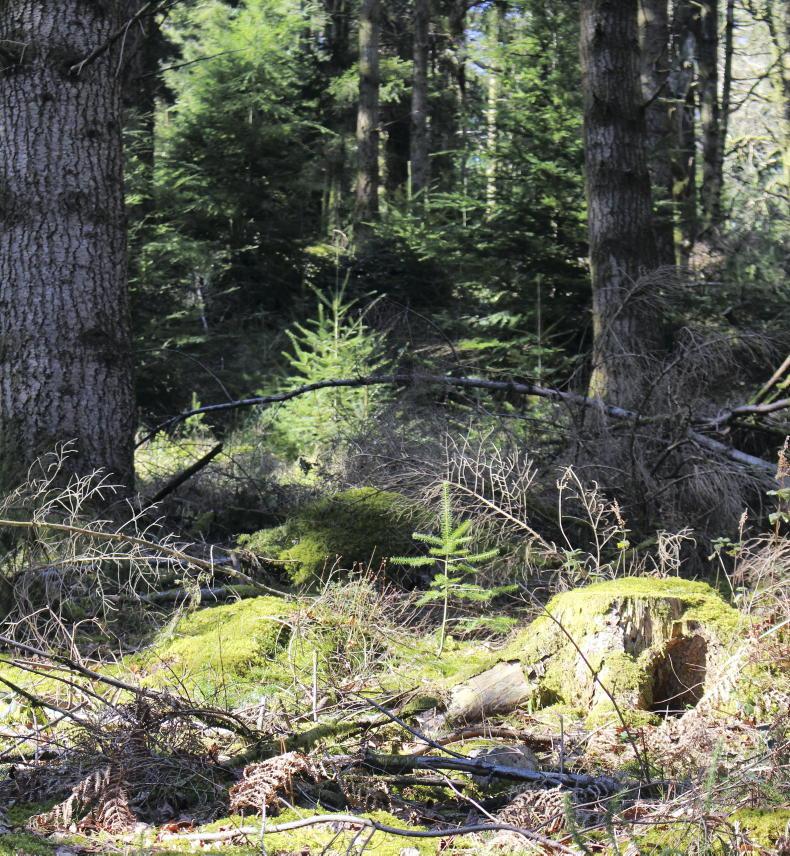
As the mid-term review of the current forestry programme is underway, it is an opportune time to look at how forestry is featured in Food Vision 2030, issued earlier this year. Farmers need to be placed “at the centre of a new and improved afforestation scheme” is one of the more positive statements in the report. “Adding forestry to the farming mix can also be achieved on many extensive farms without necessarily impacting on the drystock enterprise,” the report claims.
It calls for “greater flexibility in how trees are planted on farms in order to provide farmers with more options that complement their existing farming model”. It acknowledges that “harmonisation and coherence with other agriculture support measures is also needed”.
However, there is little in Food Vision 2030 to address the poor performance of forestry over the past decade especially in afforestation. Under Action 3 it aims to “increase afforestation from existing levels to at least 8,000 ha per year” presumably by 2030. How this will be achieved against an annual average planting programme of little more than 2,000ha in recent years is ignored.
The absence of realistic goals for forestry has been a feature of Food Vision reports over the years. In 2017 when afforestation was 5,636ha, it aimed to increase “annual afforestation level to 15,000 ha from 2021”. The report, then known as FoodWise 2025, outlined the benefits of forestry as a land use option for farmers but failed to address what was the declining afforestation programme. By 2021, instead of fulfilling a 15,000ha planting programme, afforestation had fallen to an all-time low of 2,016ha.
It might be argued that forestry shouldn’t even feature in a report which is primarily about mainstream agriculture, in particular food and drink production. But successive climate action reports have outlined the need for a viable afforestation programme to complement agriculture. In the foreword to the report, Tom Arnold, chair of 2030 Agri-Food Strategy Stakeholder Committee mentions the role forestry can play in achieving climate neutrality objectives through carbon sequestration.
However, if the current low afforestation programmes continue, forestry is in danger of becoming a net-carbon emitter rather than a carbon sink. In relation to developing a woodland carbon code, which has been in existence in the UK for 13 years, Food Vision 2030, limply states: “There is also scope to consider the role of forests and voluntary carbon markets.”
A realistic afforestation programme would be better and more honest than blithely introducing “actions” which are little more than pious aspirations. This year we are likely to increase afforestation to approximately 2,500ha with Minister Healy-Rae committing to a 3,000ha target next year. A year-on-year 20% increase such as this would achieve a 5,000ha afforestation programme by 2030. This is far short of the required programme but in the absence of initiatives such as a woodland carbon code, it would at least represent a target for the sector.
The report states that the “development of a new forestry strategy will be critical if the sector is to maximise its potential contribution to the economy and to rural communities”. This is a welcome recommendation, especially as the Food Vision 2030 authors maintain that the strategy will be “in line with the recommendation of the Mackinnon Report”, which offered so much hope to the sector when it was completed by Jim Mackinnon in November 2019.
The successful reintroduction of Mackinnon would undo some of the damage caused by the current strategy.
In brief
Food Vision 2030 aims:
The area planted up until the end of September reached 2,209ha, well up on last year, but is likely to fall short of the hoped for 3,000ha by year end. Based on projected figures for October, November and December, afforestation should be approximately 2,500ha. Although disappointing after a good start, it will be the highest afforestation programme since 2020.
An area of concern is the low number of afforestation and felling licences issued so far this year. Afforestation for the first nine months at 2,620ha is way below last year’s delivery of 3,689ha.
Felling licences were issued for 13,637ha, equating to 4,093m3. Again, this is down on last year’s performance at this stage which reached 17,698ha and way below the 2023 nine-month area of 27,031ha.
Forest road licences reached 177km which again was well down on last year’s performance of 258km. However, roads actually constructed reached 59km, up on 53km for last year and 49ha in 2023.
These are the main finding in the Department of Agriculture, Food and the Marine dashboard nine-monthly report.
Dashboard reports provide a weekly breakdown of planting, felling and roading licences issued by area and number as well as data on native tree area and forest reconstitution and improvement schemes.
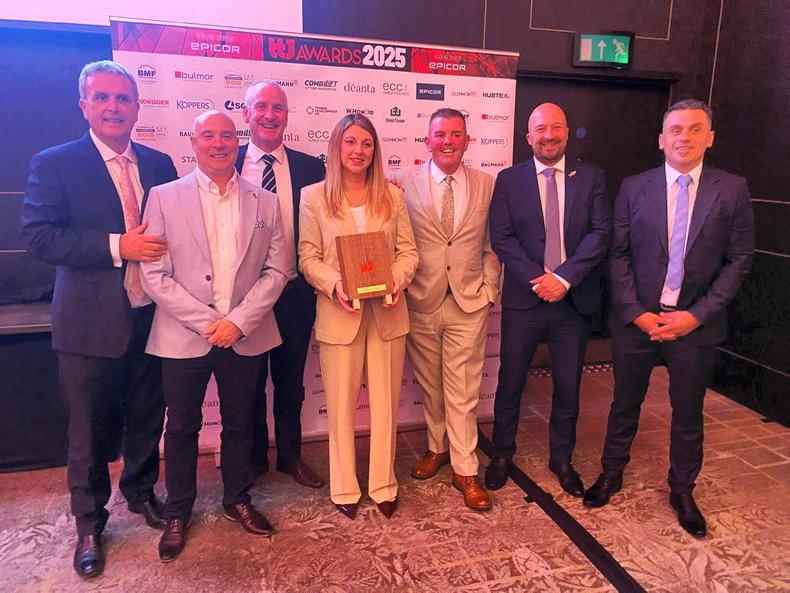
Mike and Pat Glennon, joint managing directors of Glennon Brothers Limited praised the company’s staff in Ireland and Scotland for the role they have played in winning the Timber Trades Journal (TTJ) award for best timber supplier in the UK. “We are delighted to win the prestigious TTJ award for Timber Trader Sawmiller of the Year 2025, for the sixth time, despite once again being up against an exceptionally strong list of fellow nominees,” said Mike Glennon said at the ceremony, hosted by the TTJ at Hilton Bankside Hotel, London.
“Over 930 families in the UK and Ireland, depend on Glennon Brothers, for their livelihood and on their behalf, I would like to say a sincere thank you and our customers for your support,” he said.
The Longford-based company has sawmills and timber frame outlets in Fermoy, and Enniskillen in Ireland as well as Troon, Windymains, Irvine and Invergordon in Scotland. The awards are presented by the TTJ, which is a major global timber trade publication since it was established 152 years ago.


SHARING OPTIONS