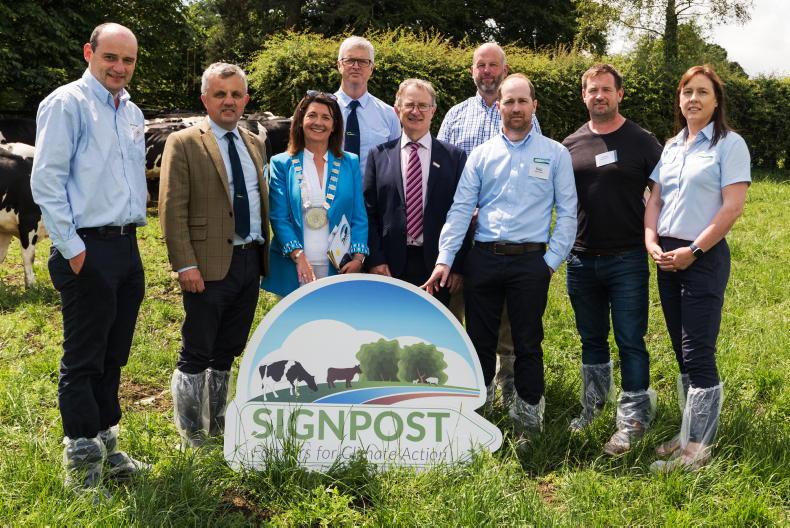
Irish tillage farmers are more likely to be rewarded for the low-carbon nature of their business when the AgNav tool developed by Teagasc has verified the data, Eoin Woulfe of Teagasc told a recent Irish Grain Growers Group meeting in Enniscorthy.
Woulfe had given a comprehensive presentation on AgNav and its potential to help grain farmers better understand the economic and environmental impact of the actions they are taking on their farms.
He showed how tillage farms generally have low emission profiles, but how increased organic fertiliser usage, improved soil fertility, cover crops and straw chopping can improve their carbon footprint.
During the question and answer session that followed, farmers wanted to know when they would properly be paid for low-carbon grain and for carbon sequestration.
Woulfe highlighted the importance of verification, and urged all tillage farmers to avail of AgNav, which is free to use.
Evidence
“If, instead of having 30 or 40 farmers, we had the information of 500 or 600 farmers, then the science and the evidence can’t be denied. People can’t say that’s because you did that up in Oak Park,” he said.
“If we can get this done for 500 or 600 farms all across the country, all different soil types, different weather patterns, different abilities to grow grain, it can have a significant impact.”
Maurice Kelly, CEO of Kelly’s of Borris and president of the FTMTA, spoke of the co-dependence between machinery dealers and tillage farmers and contractors.
“We need to have a good understanding of the demand for equipment, because the lead-in times for ordering are significant,” he said.
“So we have to understand the plans farmers have, there’s no use in us looking for machines the day a farmer comes in looking to purchase, it has to be in the yard, and would need to have been ordered six to eight months earlier.”
He spoke of the cost of carrying parts for a wide range of tractors, combines and machinery.
Despite being in the heart of an area where a lot of dairying and drystock farming occurs, as well as being a tillage heartland, Kelly reckoned that roughly two-thirds of their business is with the tillage sector.
Simple OSR business in Wexford
“It’s not very complicated business,” said Tom Finlay of Biogreen Energy Products. Based in Adamstown in Wexford, and owned by Golden Vale Marts, Biogreen Energy processes oilseed rape.
“We buy about 6,000t of seed, we crush it into oil and rapecake. The oil primarily goes into pig feed and the cake goes back primarily into ruminant feed. It’s an alternative to soy oil, which is important, and it’s a better product, with a better feed conversion on pig farms. It’s native, and it’s local, and it has a lower carbon footprint.”
Finlay revealed that Biogreen has purchased Tirlán’s rape-crushing plant, which will double its processing capacity when installed on its premises.
It means it is in the market for OSR, and would be interested if growers were willing to store crop on-farm.
“We’d be happy to pay storage on a fixed rate per month over the winter months,” he said.