



Forestry is a major renewable energy source in Europe, especially in Scandinavia. Countries such as Sweden and Finland use wood, first as a major construction and design material, and secondly as a key medium in converting low-value logs and timber residue (wood chips, sawdust, offcuts) to renewable energy.
In Sweden, almost 50% of the energy programme is now from renewables, compared with 14% in Ireland. Bioenergy – mainly wood – accounts for 60% of Sweden’s renewable energy programme, with the remainder generated from hydropower (27%) and wind (13%).
While the Scandinavians have high productive forest area to achieve climate change targets with wood, other European countries are also in a position to maximise their wood energy component, as forest cover in the EU is approximately 39% of the land area.
Forestry is an existing and accepted renewable energy source in most countries in addition to hydropower, in countries fortunate to have this resource available. Wind and solar are becoming major energy generators throughout Europe, but all countries are discovering that there are negative landscape, environment and land use impacts regardless of energy source. But unlike Ireland, forestry, or forest biomass, remains the tried-and-trusted renewable heat and electricity generator for most European countries.
Most of these countries have well-developed wood cultures, mainly because of their high forest cover. Like Ireland, Denmark is one of the few countries that has opportunities to increase forest cover significantly and has plans to do this within the next 20 years (see panel).
Because of our low forest cover, comparisons between European and Irish forestry have limited merit from a landscape perspective. The landforms of an Irish, largely deforested, landscape are different from other European countries, where forest, woodland and scrubland are major landscape features.
As a result, they have few opportunities to expand their forest estate, while Ireland has a identified a 60% increase in forest cover as a strategic Government objective. The biggest challenge facing Irish foresters in landscape planning is how to integrate “new forests” with the natural and cultural landscape.
How existing and new forests merge into this landscape remains a major challenge facing foresters and landowners, especially farmers, assuming they will carry out most of Ireland’s afforestation programme. This not only applies to forestry, but other renewable energy sources, in particular wind and solar, because regardless of the energy source, they all impact on the landscape and land use.
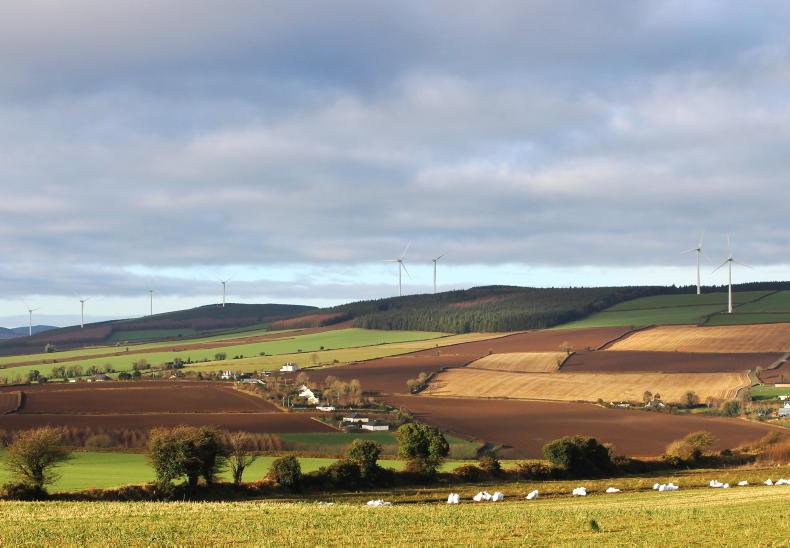
The most visually intrusive are onshore windfarms, but their location on poorer-quality, exposed land makes sense at least from a land use perspective as well as their effectiveness in creating a renewable electricity source. However, the large-scale conversion of agricultural land to solar farms is questionable from a land use and landscape planning perspective.
Applications in 2024 to convert 5,700ha of good agricultural land to solar farms makes little sense compared with the actuality of a 1,573ha afforestation programme on unproductive agricultural land.
Forestry is seen as a key land use in developing renewable energy in Europe. While its contribution to renewable energy is acknowledged, its main benefit is in decarbonising construction, the world’s greatest emitter of greenhouse gas.
A sustainable homegrown renewable energy and construction programme will require at least 17% forest cover by mid-century. This is close to the forest cover climate targets identified by the Scots and the Danes.
A programme of this magnitude will also require a balanced afforestation programme that’s compatible with landscape values and sustainable productive agriculture. This will require establishing forests in the right locations, including a return to some upland unenclosed land, as well as other land currently precluded from the afforestation programme for a variety of reasons. It will also require a realistic scientific appraisal of species diversity rather than a mandatory 50:50 ratio of native to introduced species.
Comparisons between Denmark’s and Ireland’s afforestation programme are relevant mainly because both countries have low forest cover compared with the EU average. Denmark’s Nature Agency says there are “officially 608,078ha of forests in Denmark corresponding to 14.1% of the land area”.
Last November, Denmark’s three-party government announced plans to increase forest cover by 390,00ha to 23.5% of the land area within 20 years, comprising 250,000ha of new forests and 140,000ha by converting “low-lying farmland into natural areas”. For a country which has a land area about half the size of the island of Ireland, this programme has major implications for land use in Denmark especially agriculture.
“With this agreement, we are now allocating €5.76bn to carry out a significant transformation of Denmark’s land use,” said Jeppe Bruus, Denmark’s Minister for Green Transition. “Denmark will become the first country in the world to introduce a CO2e tax on agriculture,” he added. “And with the new agreement, we are launching an ambitious nitrogen reduction effort to ensure the return of fish to our coasts and fjords.” When I met with Danish stakeholders recently, at a meeting hosted by the Irish Timber Growers Association (ITGA), it was clear from discussions that the Danes are serious about achieving 23.5% forest cover.
In Denmark, wood biomass is a greater energy source than wind and solar combined. However, Denmark is not a truly sustainable wood energy provider, as it relies on imports for half of its wood pellets and wood chips mainly from Baltic countries. The increased afforestation programme will eventually displace much of these imports.
Teagasc is holding a series of 14 forestry clinics in August and September to provide advice to farmers whose forests have been damaged by storms Darwin and Éowyn.
“At each clinic, forest owners can avail of a free, private and personalised one-to-one consultation with an experienced Teagasc forestry adviser,” said Tom Houlihan, acting head of the Teagasc Forestry Development Department. “These clinics will continue Teagasc’s comprehensive support for forest owners who are currently navigating post-storm timber harvesting and marketing processes and planning for a new generation of trees,” he said.
Clinics are free of charge but prior booking of a consultation is essential, while participants should bring maps and other relevant information. Full details of all clinics are available on the Teagasc website (Google Teagasc forestry clinics).
Correction
In my article on species diversity (16 August), I inadvertently wrote that birch had 55% of the annual afforestation programme in 2024. The sentence should have read: “Broadleaves – mainly native – account for 872ha or 55% of the 2024 annual afforestation programme, while birch annual planting was 215.3ha or 14% of the annual planting programme.”


SHARING OPTIONS