


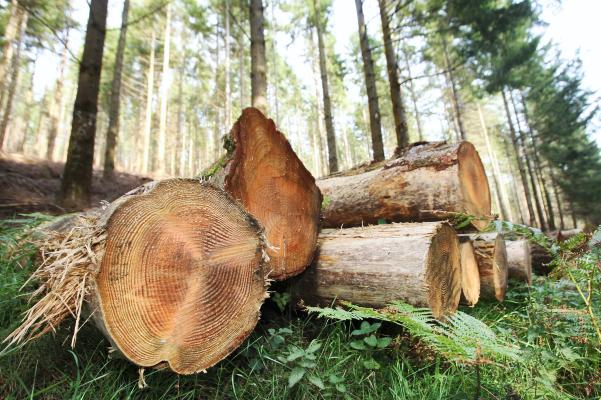
A buyer for an Irish sawmill paid €74 per cubic metre (m3) for a standing sale of Sitka spruce sawlog aged 30 years in Co Wicklow recently.
This may not be the highest price paid for sawlog in Ireland this year, but based on the age of the crop, size and quality of timber, it is likely to far exceed prices paid for softwoods in northern Europe.
This is equivalent to €86/ m3 at roadside when felling and extraction costs are factored in.
When I asked two Swedish foresters what price they received for 75-year-old conifer sawlog last May, the estimate was between €58 and €60/m3 at roadside.
It should be remembered that the Swedes sell their timber measured underbark unlike in Ireland where bark is included in the measurement.
This means that the Irish sawmills are paying close to 40% more than their Swedish counterparts and, considering the age difference of the species, this is a remarkable price differentiation.
The average prices achieved during the third quarter this year for Coillte sales (Table 1) don’t quite match the Wicklow sale but the anecdotal evidence suggests that prices have increased since September.
The excellent prices achieved for conifers are mainly due to a shortage of timber. Too many mills are chasing too few logs and, as a result, it’s a seller’s market.
To dampen prices and reduce dependency on Irish supply, sawmills continue to import up to 250,000m3 annually.
Analysis
Prices supplied in Table 1 are from Coillte for their own sales while private prices are provided by University College Dublin (UCD) in association with the Irish Timber Growers Association (ITGA).
It is important to acknowledge that prices are averages and based on sales nationwide. There is significant variation from forest to forest depending on timber quality, distance from mills, access and species.
It should also be noted that private sale prices are based on a small number of sales and may not always be a true reflection of actual prices. However, the private prices are regarded as good indicators of price trends.
Private prices are less than those achieved by Coillte mainly because Coillte sales are generally larger in terms of area harvested so felling and extraction costs are much more competitive.
Coillte prices for medium to large category size logs are likely to be a more accurate reflection of true prices than private sale data as the company has a larger number of sales with a wide geographical spread.
But Coillte either don’t sell small timber or else retain it for the company’s own board mills so few if any prices are available from the company for small log size categories. As a result, plantation owners depend on private sales data for small log prices.
Most plantation owners who planted during the period 1988 to 2000 will be interested in log prices in the 0.074m3 to 0.274m3 category as they will either have logs at the thinning stage or preparing their forests for first thinning.
Revenue for the smallest log size (0.074m3) was only €5.87/m3 for the third quarter but this may be misleading as prices paid for this category for the first six months this year averaged €10.70/ m3. Farmers with good quality first thinnings within reasonable distance of a board mill, stake plant, sawmill or wood energy outlet should expect €8 to €10/m3 or €500/ha.
Plantation owners with third and fourth thinning can expect €35 to €50/m3 or up to €2,000/ha depending on quality, stocking and distance from sawmills in this instance as the percentage of sawlog material increases and pulpwood decreases.
The big pay day is at clearfell where plantation owners with 300 to 400m3/ha receiving over €20,000/ha.
Future prices
Good prices are likely to continue for small logs as panel board processors and wood energy make demands on a scarce resource.
The prospects are also good for sawlog as the fiercely competitive sawmills maintain export market share. They require more homegrown timber.
Applications for felling licences and road construction grants continue to increase, both good indicators of forest owners’ intentions to thin so more timber will reach the market but not in sufficient volumes to depress prices.






SHARING OPTIONS