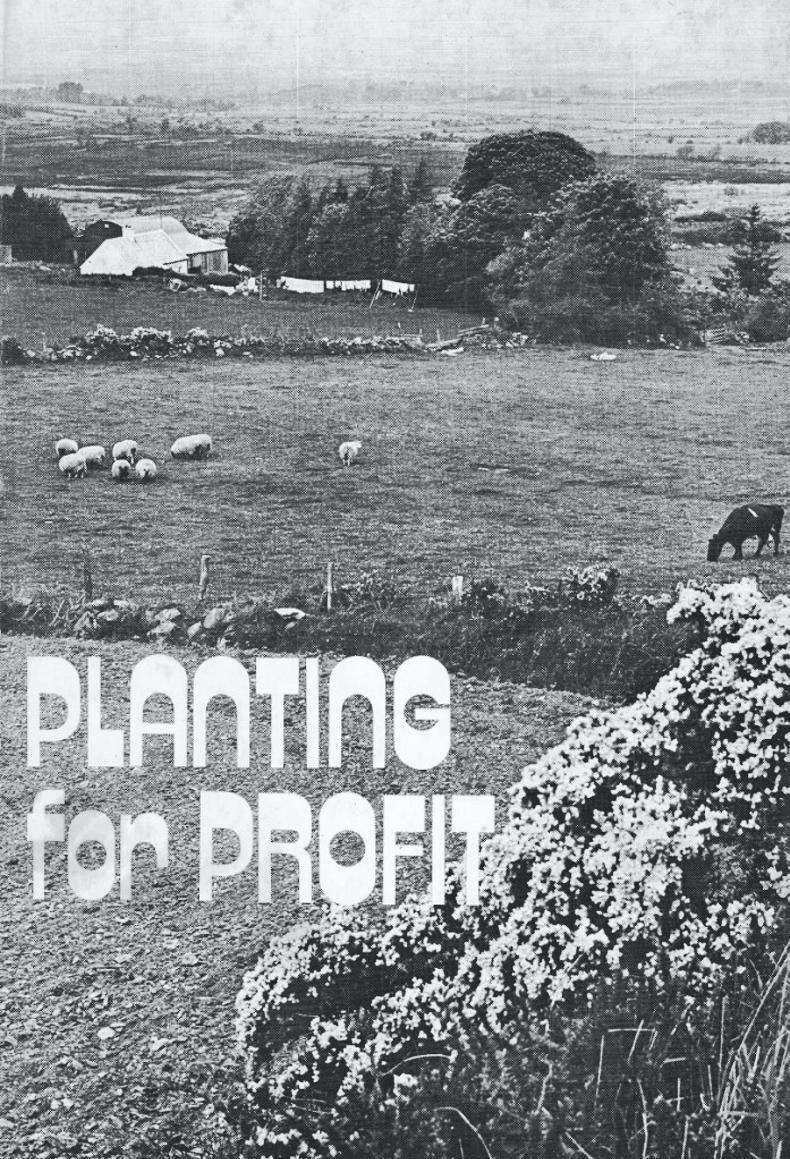
I came across the booklet Planting for Profit recently, which encouraged farmers to plant portions of their land during the 1960s and 1970s. Multi-purpose forestry objectives such as flora and fauna management, biodiversity and landscape enhancement were rarely mentioned back then. Benefits of forests in water quality improvement and flooding control, although acknowledged in Europe at the time, had still to register in Ireland, while the debate on the role of forests in climate change mitigation is only a recent phenomenon.
The advice to foresters in Planting for Profit can’t be faulted for its directness: “Your success as a forester will be measured by your financial returns and if you don’t make money your rating will be low.” The objective of the booklet was to demonstrate to farmers that forestry could be profitable.
Now, as the planting season draws to a close, farmers thinking about planting in the autumn will begin to weigh up the options of planting some of their farms. An RDS survey carried out a few years ago showed the profit motive isn’t the only one when landowners decide to plant.
However, it is likely that farmers who opt for forestry will expect a better return than the previous land use and the foresters who advise them will be judged by the standards set by the author of Planting for Profit, H M Fitzpatrick.
Return on investment
There are more factors involved when making an investment in forestry today compared with the 1960s and 1970s, but making a return on investment from the crop is still likely to be the main objective.
Farmers’ investment in land and time is matched for the first 15 years by the State through the provision of grants and premia. After that, forest owners are on their own as they are legally obliged to replant after the forest is clearfelled.
In well-managed commercial conifer forests, rates of return of between 4% and 7% are achievable, according to the Society of Irish Foresters. These rates of return are for predominantly Sitka spruce and Norway spruce crops. Forest owners who plant broadleaves can expect a major reduction in the rate of returns because of limited markets, longer rotations and more intensive management.
Forest owners who opt for forestry as a commercial land use will argue that as this is a permanent land use, it is vital that they have the option of planting the species that provide the best financial return. In Ireland, the species that provide acceptable returns are Sitka spruce and Norway spruce. Sawmills and panel board mills that now export over 70% of their product will argue these species are essential to ensure a viable timber processing sector in Ireland.
Coillte, the Irish Forestry Unit Trust (IForUT) and the Northern Ireland Forest Service regard Sitka spruce as the mainstay of their forestry programmes. For example, the Coillte Premium Partners (CPP) scheme only accepts Sitka spruce forests with a minimum yield class (YC) of 20 (m3/ha/annum), although high-yielding Norway spruce is also likely to be considered. However, broadleaves and diverse conifers are excluded from the scheme. The State’s policy in relation to broadleaves for the 2014-2020 programme is “to provide at least 30% of the national area afforested with broadleaved species”. Add in minor conifer diversity and Areas of Biodiversity Enhancement (ABE) and the commercial forest afforestation programme could be reduced to 50% of total planting. Setting the annual afforestation target at 30% broadleaves presents a challenge to growers. Few forest owners believe that profitable forests can be achieved with a 30% broadleaf species mix.
So is the State right to aim for this species mix? It would argue that this is not an unreasonable request as it provides generous afforestation grants and premium payments along with funding for forest road construction and a favourable tax regime.
For much of the last century, when the State planted over 95% of the forests, broadleaf planting rarely exceeded 5%. At the turn of this century broadleaf planting reached an average of 20%, which was the target set by the 1996 strategic plan for forestry, Growing for the Future. Over the past 10-year period, broadleaf planting has averaged 31% (see Table 1).
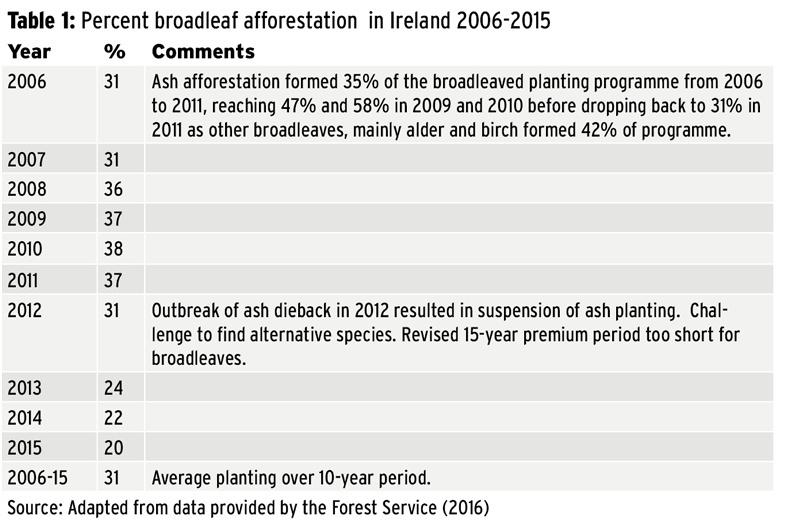
Broadleaved planting has fallen to 20% in recent years for a number of reasons. Ash planting has ceased due to infection by the fungal pathogen Hymenoscyphus fraxineus.
Ash was planted widely up to 2011 and foresters have been unsuccessful in finding a broadleaf replacement for ash which not only has a ready market (hurley ash, firewood and furniture) but has a relatively short rotation, unlike oak and beech. Instead, forest owners are choosing fast-growing conifers as first thinning revenue is achieved soon after year 15 when premium payments run out while final harvest revenue is likely at year 30 compared with 80-100-year rotations for oak, beech and sycamore.
Foresters, landowners and the processing sector believe that achieving an optimum species balance – between conifers and broadleaves, native and introduced – is important in order to attain a viable afforestation programme. A number of realistic steps need to be taken to resolve this to everyone’s satisfaction including:
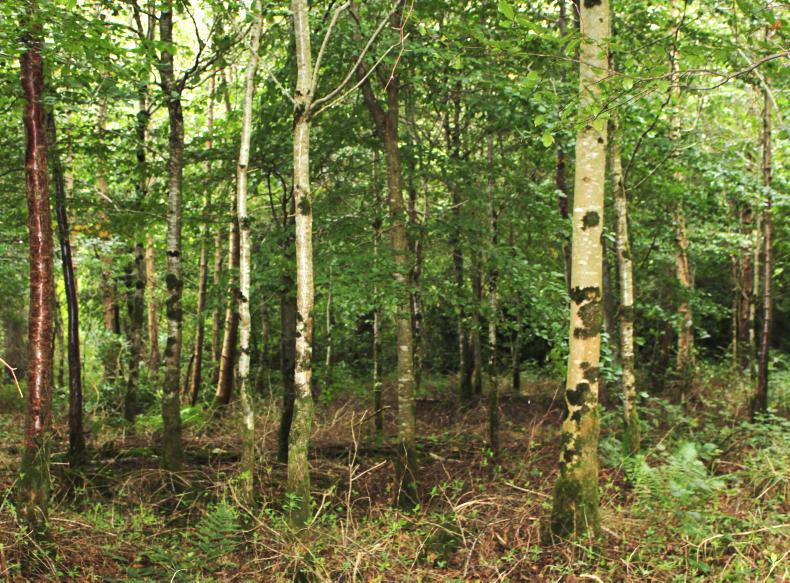
Review the 30% target which was set without full consultation with the relevant stakeholders.Provide a rationale for a realistic species mix based on land availability.Increase the premium period for broadleaves – 15 years is regarded as too short for a crop that takes 100 years to reach maturity. Instead of having a broadleaf-conifer divide, aim for a biodiverse species mix to include the native Scots pine. Last year during a field day in Lough Bawn Woodland in Co Monaghan visitors admired the mature and semi-mature broadleaved woodland managed by Jack Tenison. He accepted the plaudits but posed the question: who pays the forest owner while managing a broadleaf forest that is unlikely to provide a reasonable income stream during the owner’s lifetime or possibly the lifetime of his or her successor? Multipurpose forestry is a fine objective, but foresters and forest owners are still judged by their ability to make a living out of their forests.
I came across the booklet Planting for Profit recently, which encouraged farmers to plant portions of their land during the 1960s and 1970s. Multi-purpose forestry objectives such as flora and fauna management, biodiversity and landscape enhancement were rarely mentioned back then. Benefits of forests in water quality improvement and flooding control, although acknowledged in Europe at the time, had still to register in Ireland, while the debate on the role of forests in climate change mitigation is only a recent phenomenon.
The advice to foresters in Planting for Profit can’t be faulted for its directness: “Your success as a forester will be measured by your financial returns and if you don’t make money your rating will be low.” The objective of the booklet was to demonstrate to farmers that forestry could be profitable.
Now, as the planting season draws to a close, farmers thinking about planting in the autumn will begin to weigh up the options of planting some of their farms. An RDS survey carried out a few years ago showed the profit motive isn’t the only one when landowners decide to plant.
However, it is likely that farmers who opt for forestry will expect a better return than the previous land use and the foresters who advise them will be judged by the standards set by the author of Planting for Profit, H M Fitzpatrick.
Return on investment
There are more factors involved when making an investment in forestry today compared with the 1960s and 1970s, but making a return on investment from the crop is still likely to be the main objective.
Farmers’ investment in land and time is matched for the first 15 years by the State through the provision of grants and premia. After that, forest owners are on their own as they are legally obliged to replant after the forest is clearfelled.
In well-managed commercial conifer forests, rates of return of between 4% and 7% are achievable, according to the Society of Irish Foresters. These rates of return are for predominantly Sitka spruce and Norway spruce crops. Forest owners who plant broadleaves can expect a major reduction in the rate of returns because of limited markets, longer rotations and more intensive management.
Forest owners who opt for forestry as a commercial land use will argue that as this is a permanent land use, it is vital that they have the option of planting the species that provide the best financial return. In Ireland, the species that provide acceptable returns are Sitka spruce and Norway spruce. Sawmills and panel board mills that now export over 70% of their product will argue these species are essential to ensure a viable timber processing sector in Ireland.
Coillte, the Irish Forestry Unit Trust (IForUT) and the Northern Ireland Forest Service regard Sitka spruce as the mainstay of their forestry programmes. For example, the Coillte Premium Partners (CPP) scheme only accepts Sitka spruce forests with a minimum yield class (YC) of 20 (m3/ha/annum), although high-yielding Norway spruce is also likely to be considered. However, broadleaves and diverse conifers are excluded from the scheme. The State’s policy in relation to broadleaves for the 2014-2020 programme is “to provide at least 30% of the national area afforested with broadleaved species”. Add in minor conifer diversity and Areas of Biodiversity Enhancement (ABE) and the commercial forest afforestation programme could be reduced to 50% of total planting. Setting the annual afforestation target at 30% broadleaves presents a challenge to growers. Few forest owners believe that profitable forests can be achieved with a 30% broadleaf species mix.
So is the State right to aim for this species mix? It would argue that this is not an unreasonable request as it provides generous afforestation grants and premium payments along with funding for forest road construction and a favourable tax regime.
For much of the last century, when the State planted over 95% of the forests, broadleaf planting rarely exceeded 5%. At the turn of this century broadleaf planting reached an average of 20%, which was the target set by the 1996 strategic plan for forestry, Growing for the Future. Over the past 10-year period, broadleaf planting has averaged 31% (see Table 1).
Broadleaved planting has fallen to 20% in recent years for a number of reasons. Ash planting has ceased due to infection by the fungal pathogen Hymenoscyphus fraxineus.
Ash was planted widely up to 2011 and foresters have been unsuccessful in finding a broadleaf replacement for ash which not only has a ready market (hurley ash, firewood and furniture) but has a relatively short rotation, unlike oak and beech. Instead, forest owners are choosing fast-growing conifers as first thinning revenue is achieved soon after year 15 when premium payments run out while final harvest revenue is likely at year 30 compared with 80-100-year rotations for oak, beech and sycamore.
Foresters, landowners and the processing sector believe that achieving an optimum species balance – between conifers and broadleaves, native and introduced – is important in order to attain a viable afforestation programme. A number of realistic steps need to be taken to resolve this to everyone’s satisfaction including:
Review the 30% target which was set without full consultation with the relevant stakeholders.Provide a rationale for a realistic species mix based on land availability.Increase the premium period for broadleaves – 15 years is regarded as too short for a crop that takes 100 years to reach maturity. Instead of having a broadleaf-conifer divide, aim for a biodiverse species mix to include the native Scots pine. Last year during a field day in Lough Bawn Woodland in Co Monaghan visitors admired the mature and semi-mature broadleaved woodland managed by Jack Tenison. He accepted the plaudits but posed the question: who pays the forest owner while managing a broadleaf forest that is unlikely to provide a reasonable income stream during the owner’s lifetime or possibly the lifetime of his or her successor? Multipurpose forestry is a fine objective, but foresters and forest owners are still judged by their ability to make a living out of their forests.







SHARING OPTIONS