



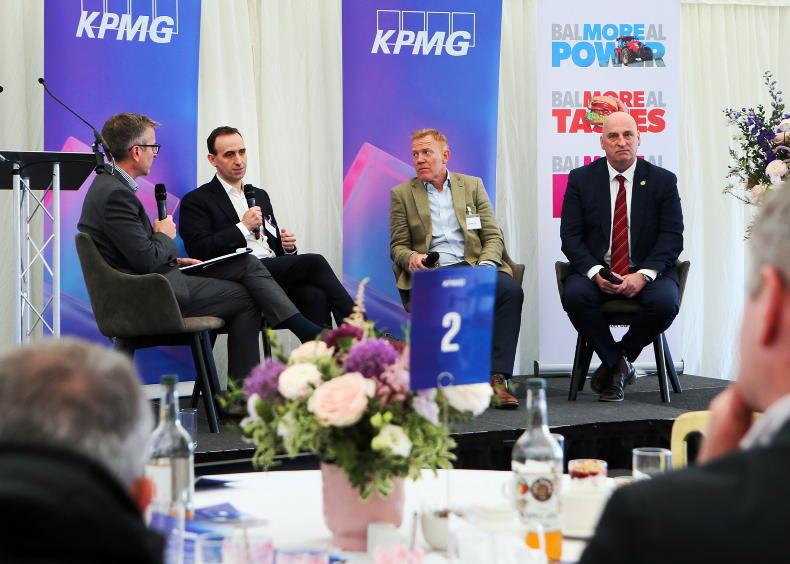
Poor prices and a shift in government policy in England has left many arable growers considering alternative income streams, BBC’s Countryfile presenter, Adam Henson told a KPMG breakfast event at Balmoral Show.
Henson, who is a tenant farmer on a 650ha estate in the Cotswolds, said his main arable enterprise lost money in 2025. In the past, those losses might have been compensated by area-based payments, but with the safety net of the basic payment scheme (BPS) now gone in England, he is reliant on taking part in the Sustainable Farming Incentive (SFI) to supplement his income.
SFI actions on arable land include growing herbal leys and flower-rich grass margins. In total, 20% of the Henson farm is now in environmental schemes and across the Cotswolds he estimates around one third of land is no longer in arable production.
“We have been driven down that route – when it comes to providing food, we are struggling to make money,” he said.
Core income
Rather than arable farming, the core income on the farm now comes from a farm shop and café, as well as a glamping/holiday site. At present, the farm attracts 180,000 to 200,000 visitors per year.
Henson said he was currently assessing all the farm resources, with the potential that more ends up outside of food production.
“We are looking at the straw shed and the grain store and wondering what else could we be doing, for example, a wedding venue or storing vintage cars,” he said.
“Everything we are looking at now is not farming. Our ability to last requires us to make money – we need cash.”
However, despite being an ardent supporter of regenerative farming, improving farm biodiversity etc, he acknowledged that if the economics changed and it was more profitable to produce food, he would still plough up the 20% of land in environmental schemes.
“I would be crying on my pillow, but that is the reality – I have to make money,” he said.
Sustainability down the agenda, but can’t be ignored
Environmental sustainability has moved down the agenda of many companies in the last couple of years, but the issue will come to the fore again and still needs to be addressed, Russell Smyth from KPMG told last Thursday’s event.
He said the key to getting farmers engaged around sustainability is an economic rationale, where efficiency improvements on farms save money and also result in lower emissions.
Smyth also maintained that the wider drive for more renewables to include anaerobic digestion, lacks political momentum on the back of the disastrous Renewable Heat Incentive (RHI) scheme in NI.
Rather than switching to renewables to address climate change, he said the narrative needed to be repositioned and it should be about improving energy security and lowering energy costs.





SHARING OPTIONS